ROCHESTONZelfire.

THREAT HUNTING & CONTAINMENT

ZelKill

Hunt with evidence. Contain with confidence.

ZelKill is an AINA-powered threat hunting platform that unifies logs and events into clear hunts. Correlation, timelines, and MITRE mapping support evidence-driven investigation, guided next steps, and controlled containment.

ZelKill

Threat hunting & containment

ROCHESTON ZELFIRE ECOSYSTEM

BUILT FOR YOUR WORKFLOW

What you can do.

Connected hunts

Bring logs and events together to investigate related activity.

Evidence and timelines

Review correlations and MITRE mappings alongside incident evidence.

Controlled containment

Coordinate response actions with investigation context.

THE COMPLETE PRODUCT GUIDE

Explore ZelKill.

Get to know the capabilities, workflows, and intelligence behind the product.

01

ROCHESTON ZELKILL

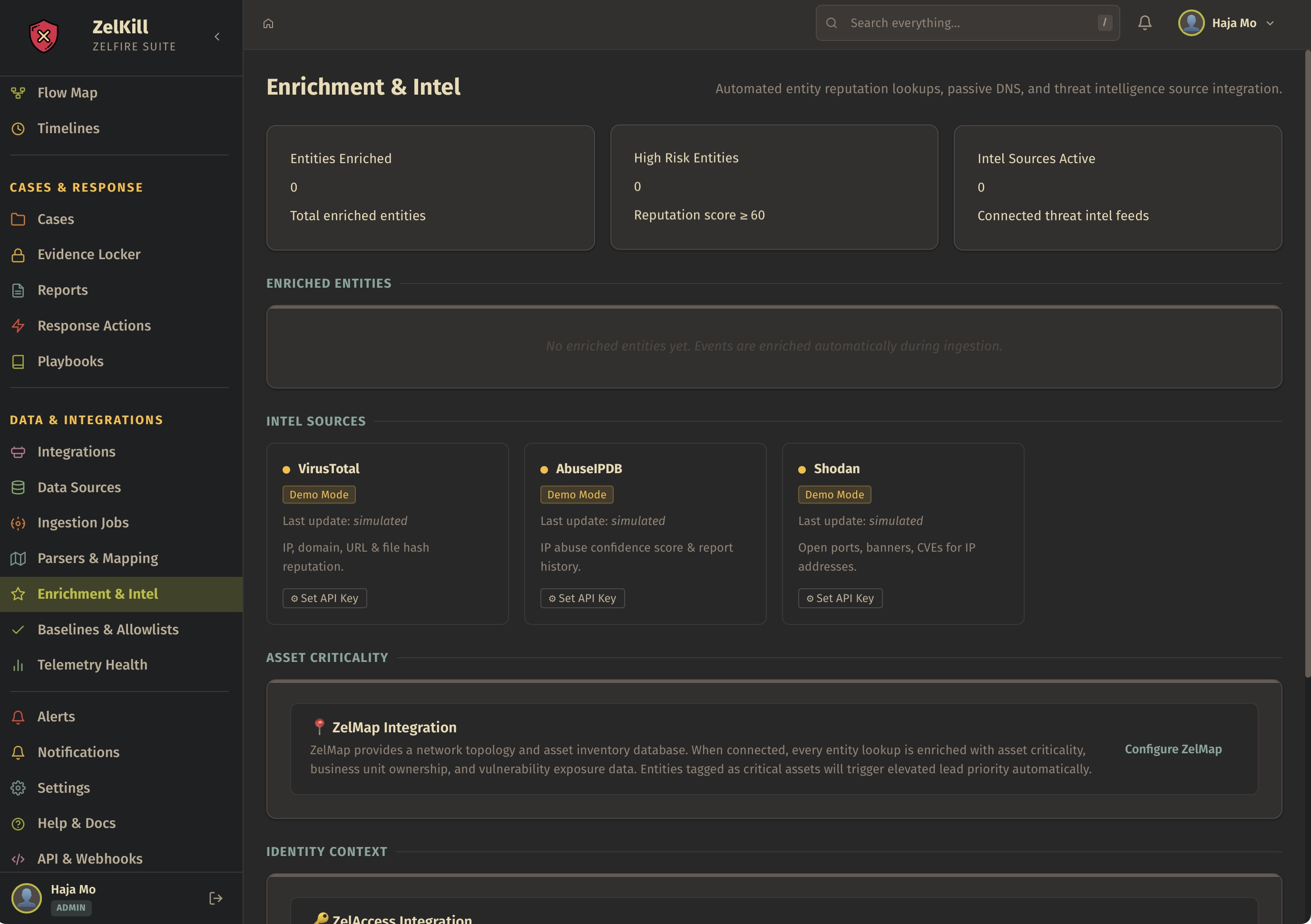
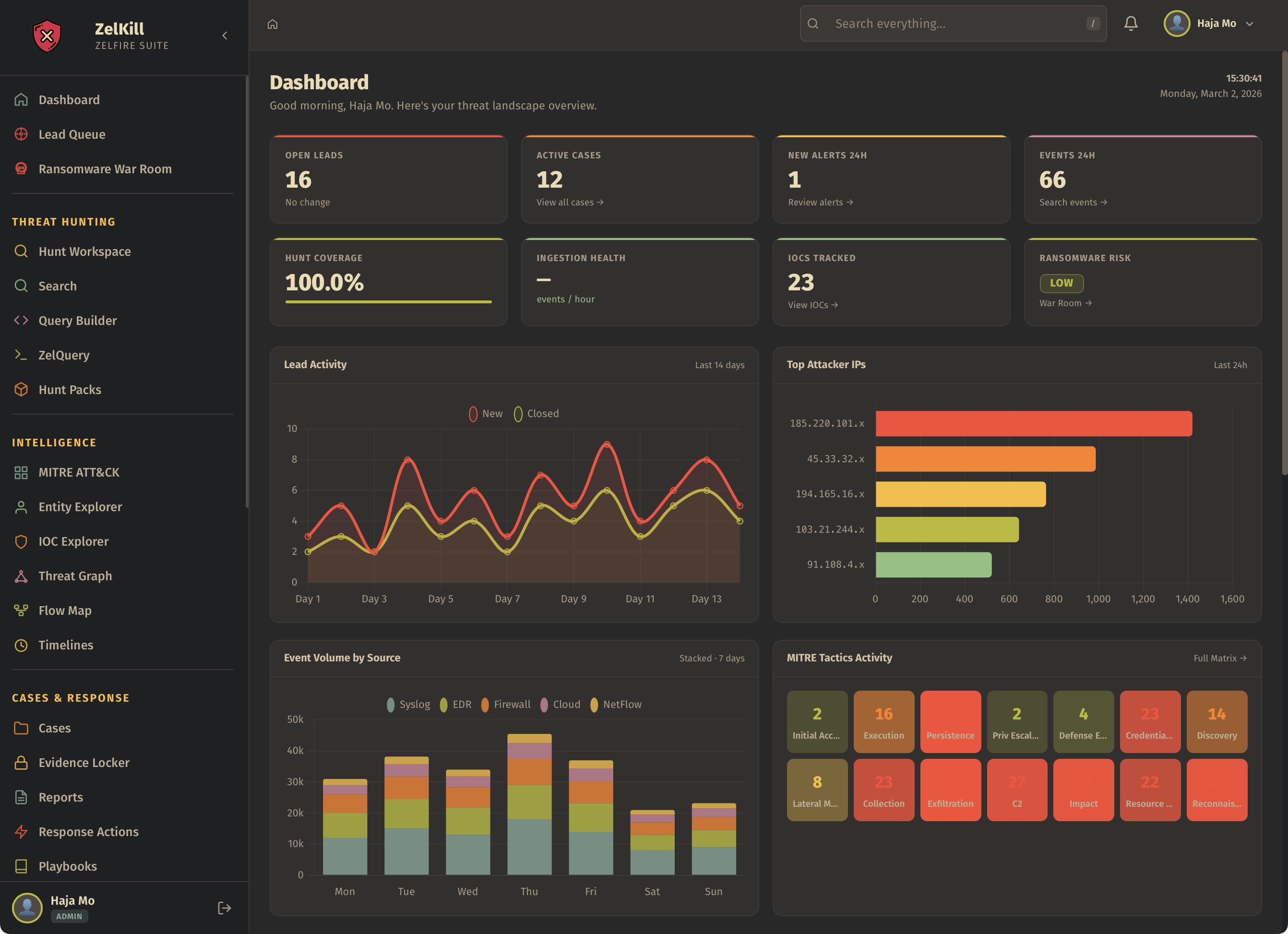
ZelKill is Rocheston’s elite threat hunting platform built to turn messy logs into clear answers. Search, correlate, visualize, and act—fast—without drowning in complex tools.
AI driven modern threat hunting platform

02

Universal Logs, Any Source, Any Environment

Most platforms force you into their ecosystem. ZelKill connects to SIEMs, servers, cloud, identity, firewalls, proxies, DNS, and uploads—so you can hunt across everything you own.

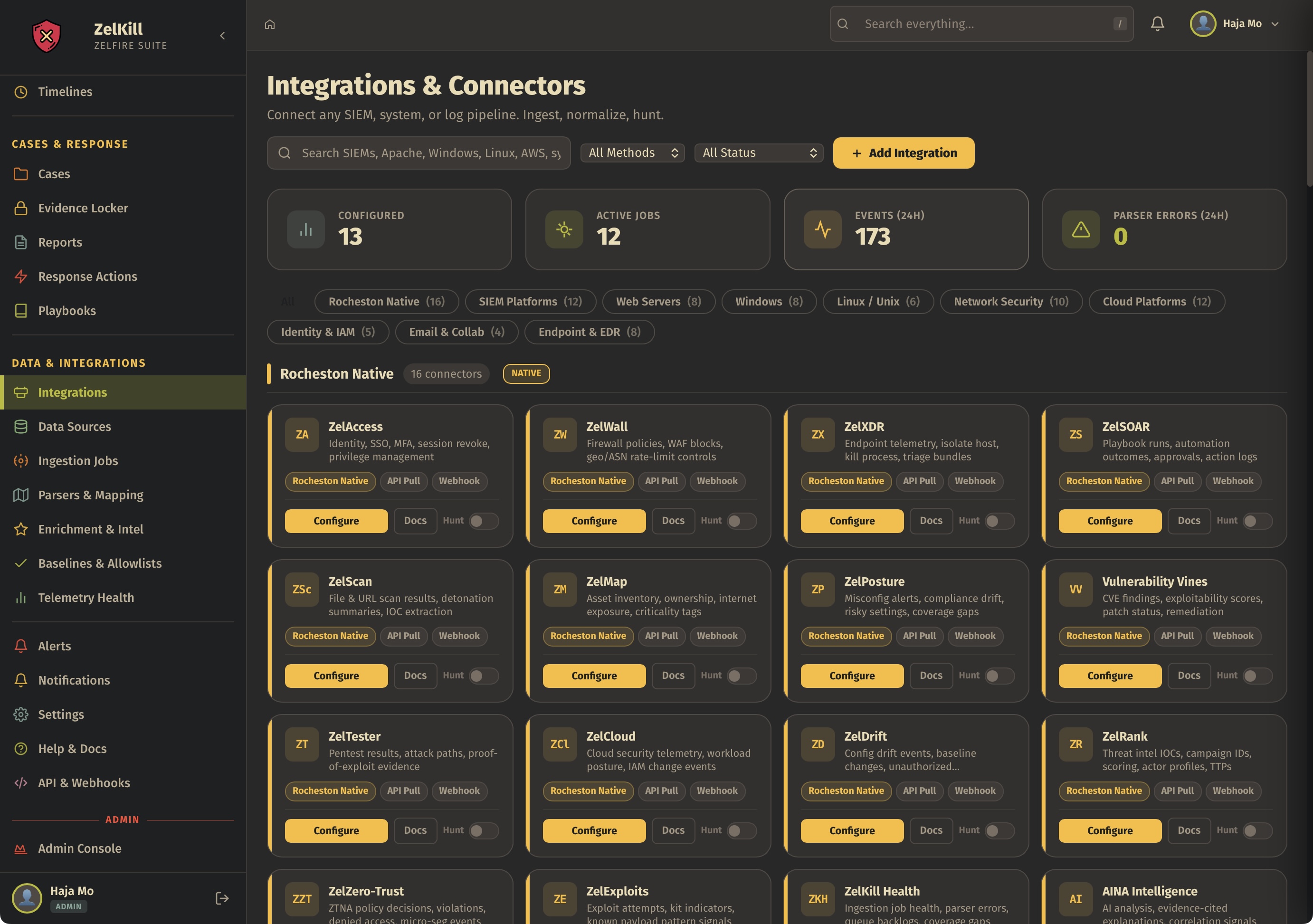
❝ No vendor lock-in. Just pure visibility. ❞

03

One Hunting Schema That Makes Everything Searchable

ZelKill normalizes every log into one unified schema so you can pivot instantly across sources without custom pipelines or glue scripts.

❝ When everything speaks one language, truth shows up faster. ❞

04

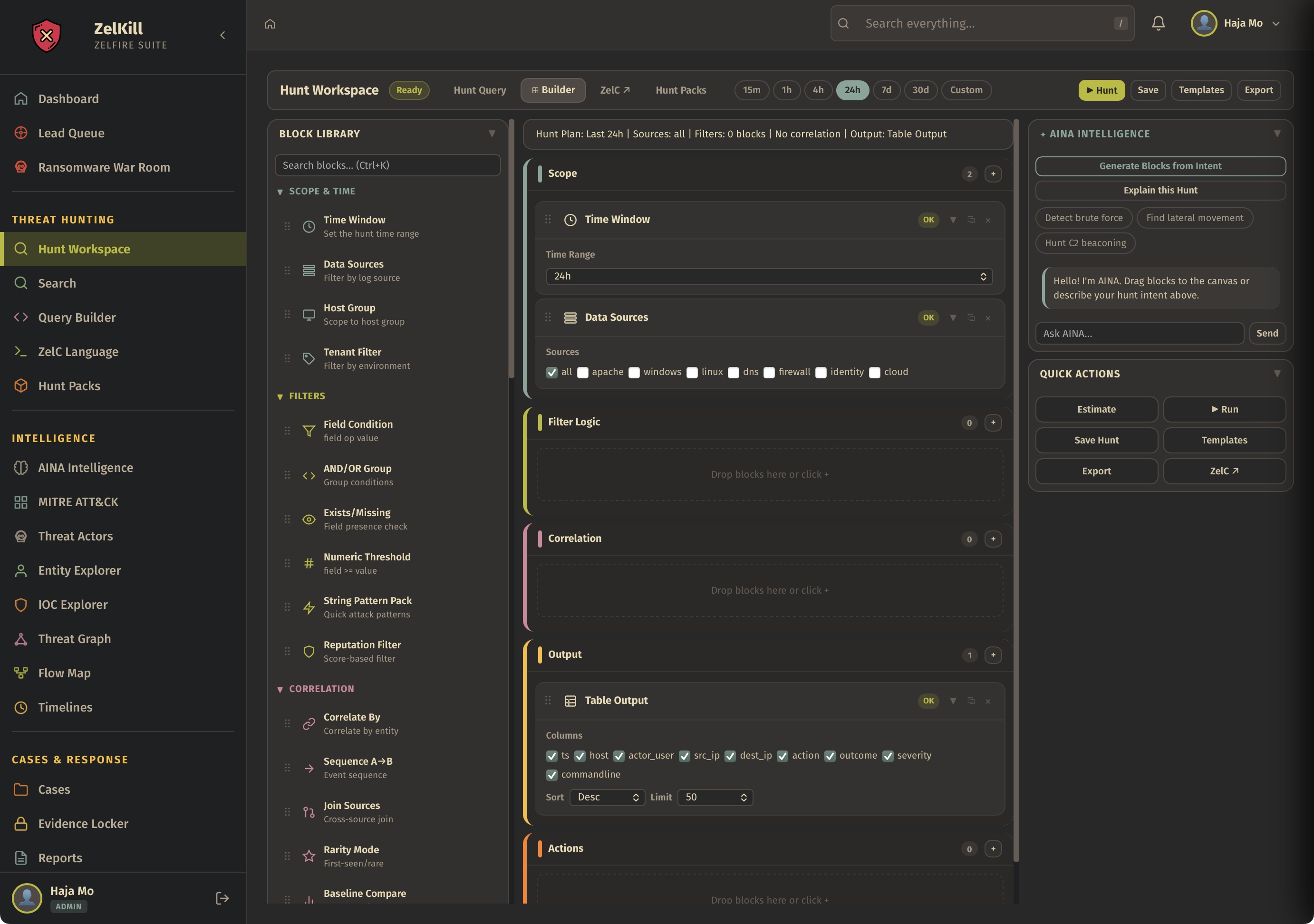
Drag-and-Drop Hunt Builder

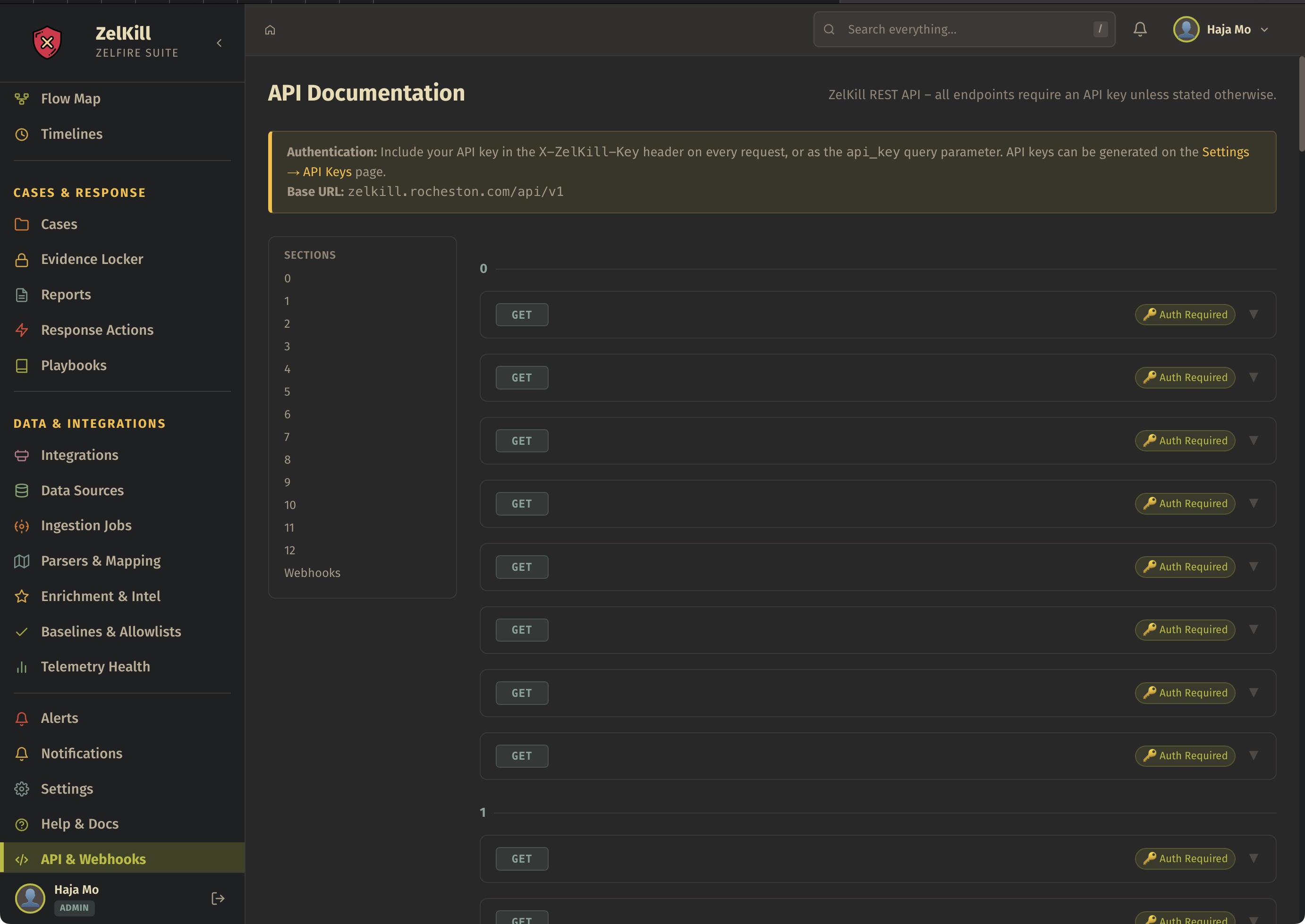
Build powerful hunts visually by dragging blocks into a pipeline: scope, filters, correlation, outputs, actions. No query intimidation. No wasted time.

❝ Hunting should feel like building power—not writing pain. ❞

05

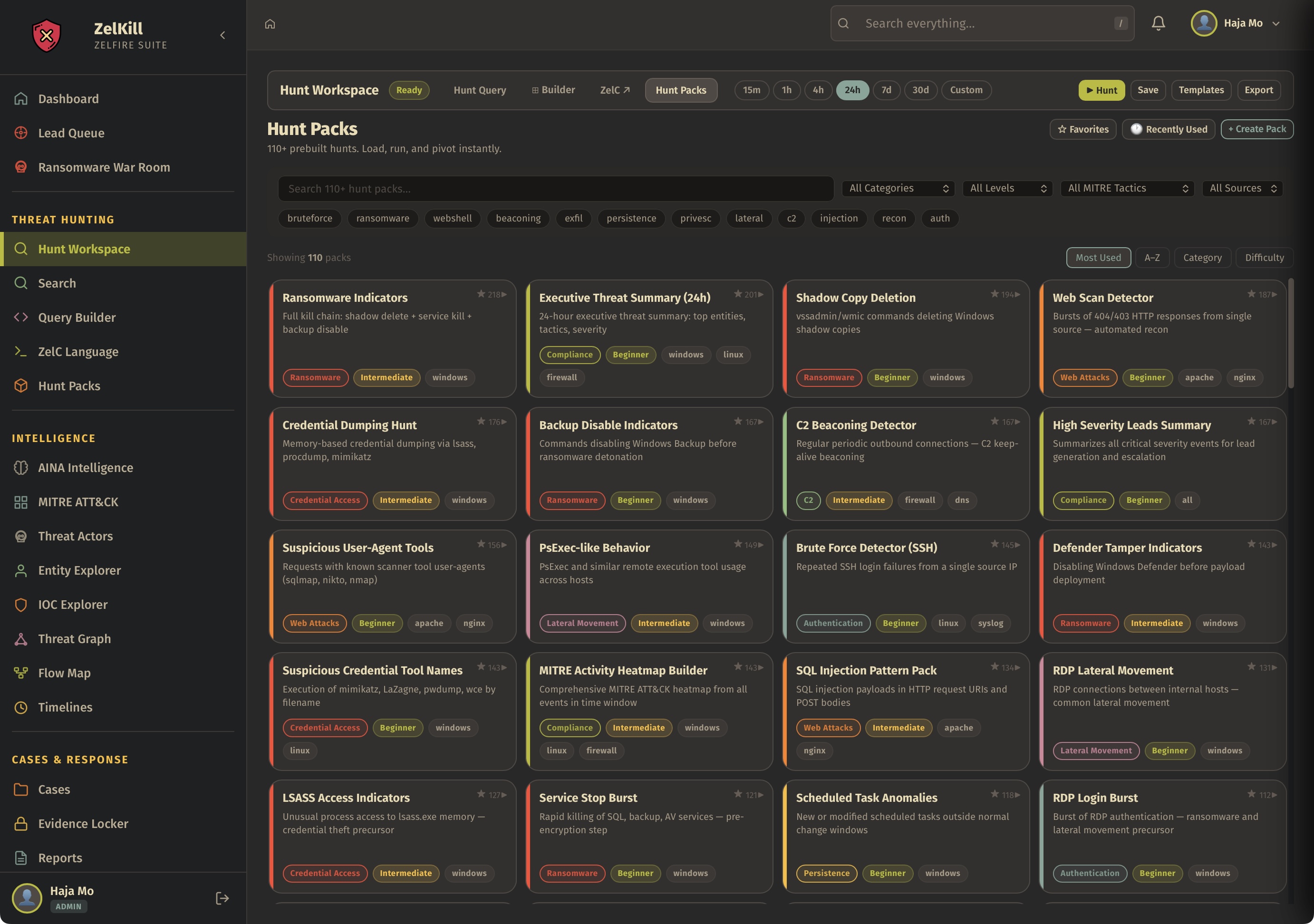
100+ Hunt Packs Ready to Run

ZelKill ships with a massive library of prebuilt hunts covering ransomware, brute force, web attacks, lateral movement, persistence, C2, exfiltration, identity abuse, and cloud threats.

❝ One click turns chaos into a hunt plan. ❞

06

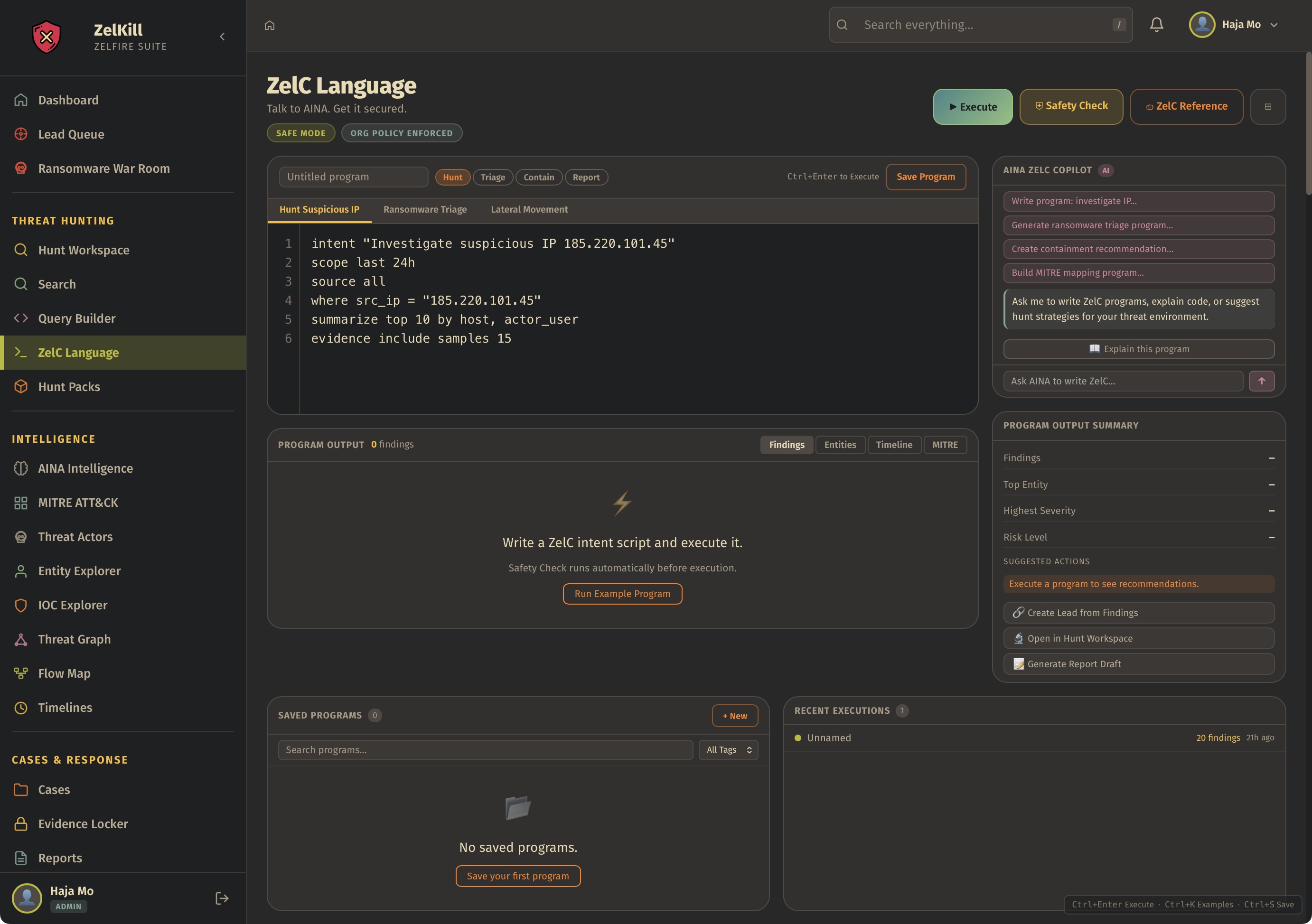
ZelC Language Templates

For advanced hunters, ZelC enables intent-based programs that safety-check before execution, then generate evidence-linked results with professional formatting.

❝ State intent. ZelKill executes safely—with proof. ❞

07

Correlation That Rebuilds Real Kill Chains

ZelKill correlates events by host, user, IP, domain, hash, and time—so you see the chain, not isolated dots.

❝ Incidents don’t happen in one log line. ❞

08

Sequence Hunting (A → B) Built In

Detect real attacker flow with sequence logic: “Event A then Event B within X minutes.” Turn patterns into proof.

❝ Catch the story, not just the symptoms. ❞

09

Rarity Mode That Finds the Needle

Most noise is common activity. ZelKill highlights first-seen and low-prevalence entities so the rare and dangerous rises instantly.

❝ The rarest thing is often the real threat. ❞

10

Baseline Compare for Instant Anomaly Clarity

Compare current behavior against historical baselines to spot meaningful deviations without guessing.

❝ Show me what changed—then show me why. ❞

11

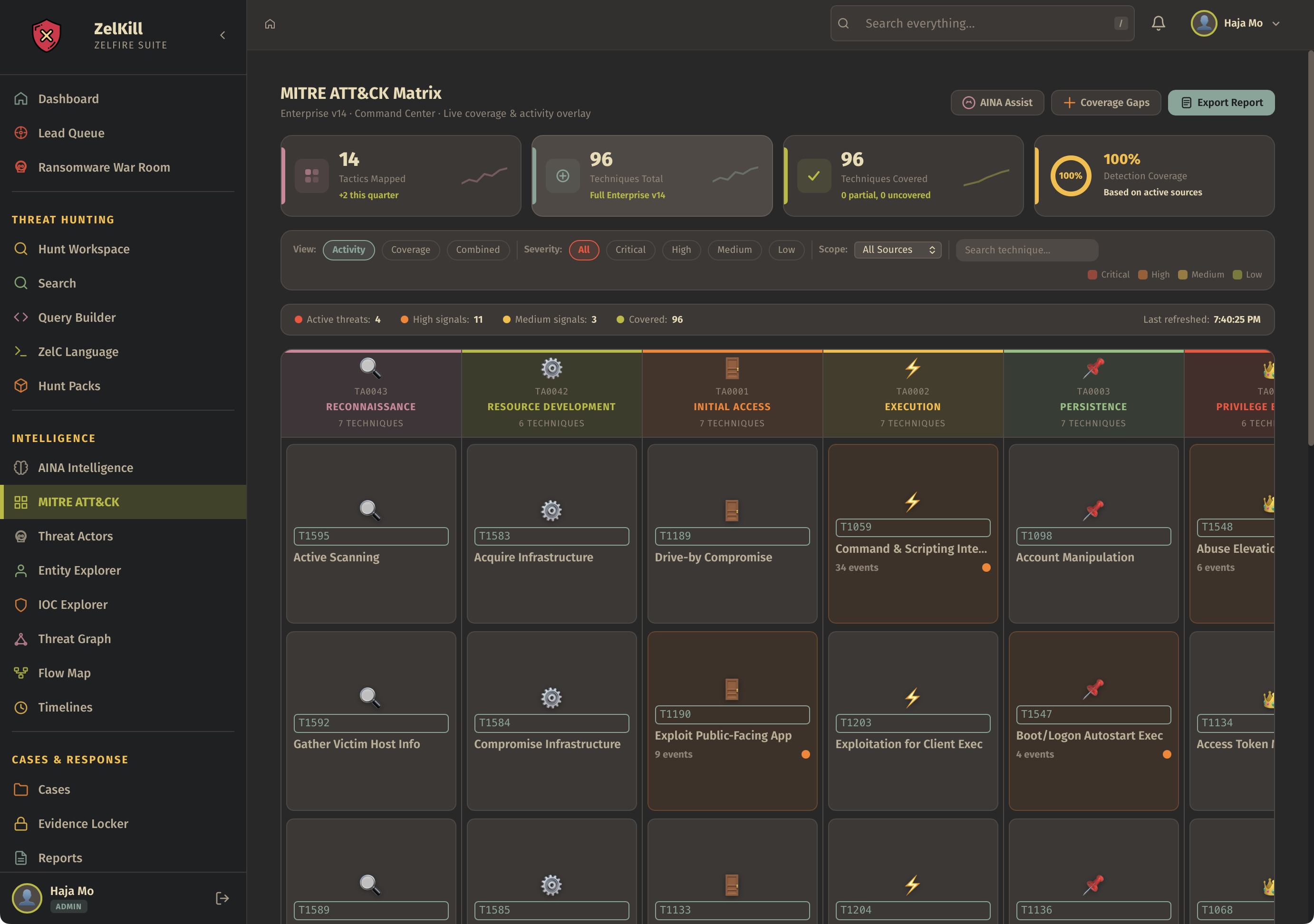
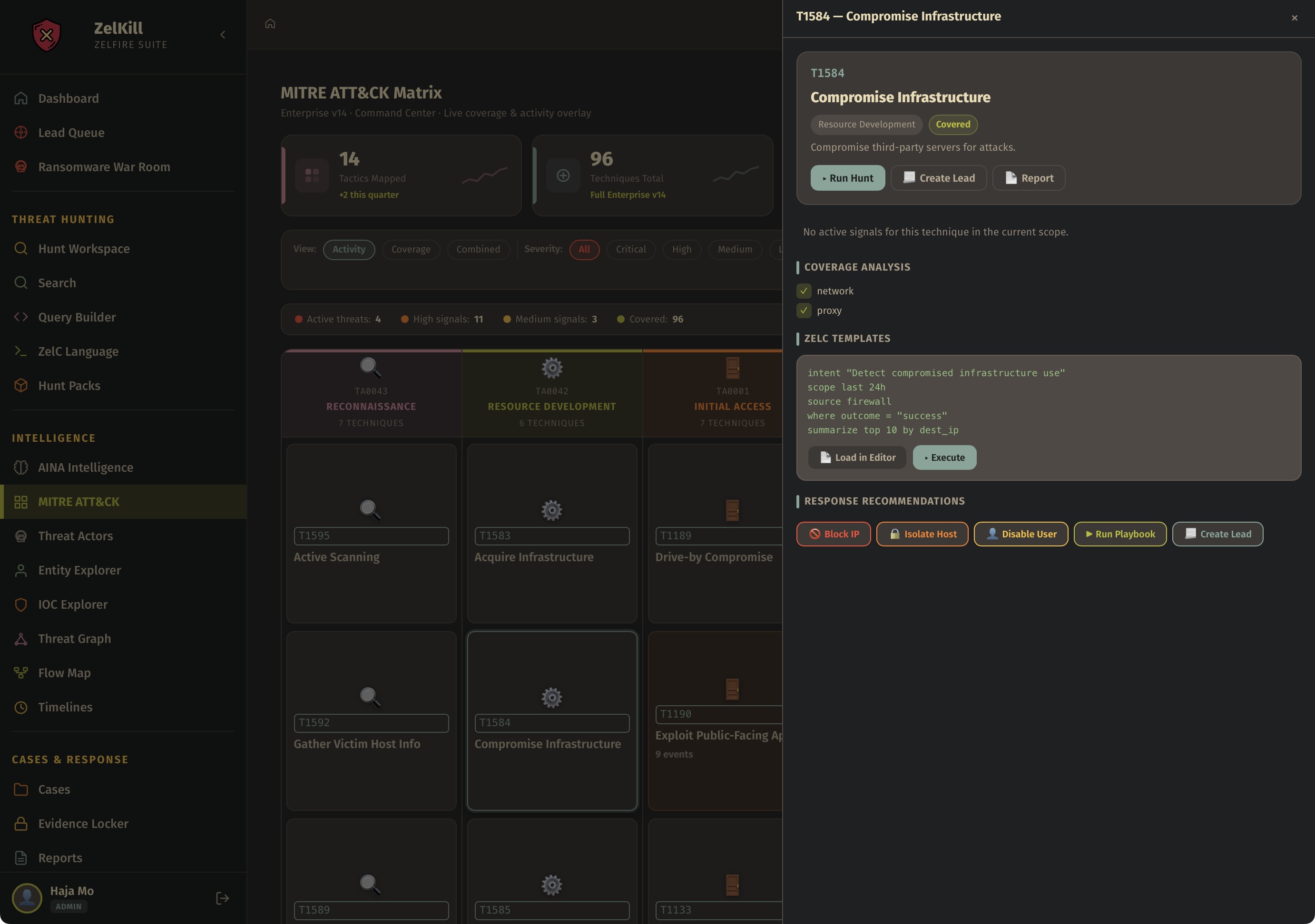
MITRE ATT&CK Mapping Engine

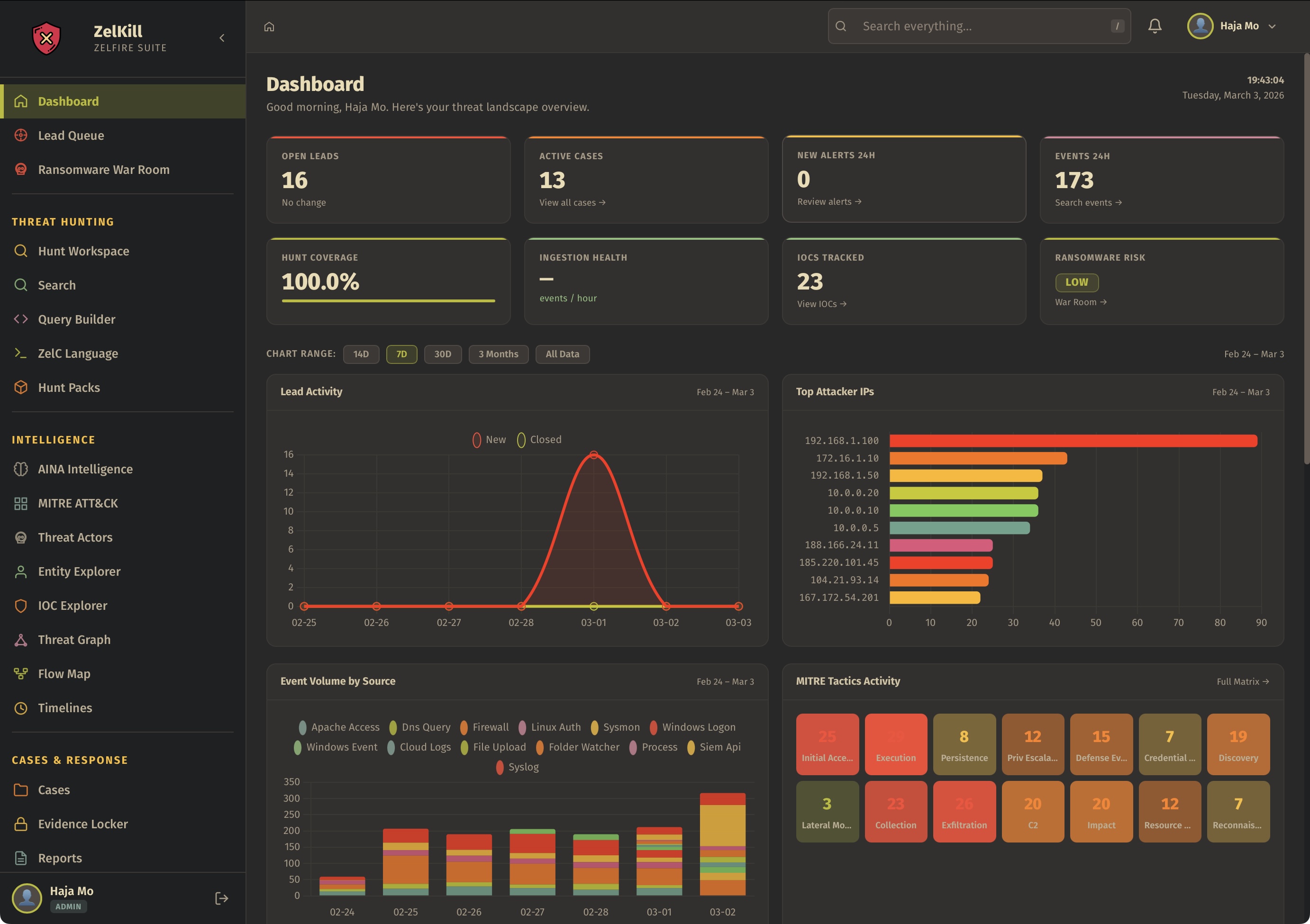
Auto-map observed behavior to tactics and techniques, drill down into evidence, and see what’s active right now.

❝ Your incident, translated into MITRE reality. ❞

12

Coverage Gaps That Tell You What You’re Missing

ZelKill doesn’t just show activity—it shows blind spots. Know which telemetry is missing and what to connect next.

❝ You can’t defend what you can’t see. ❞

13

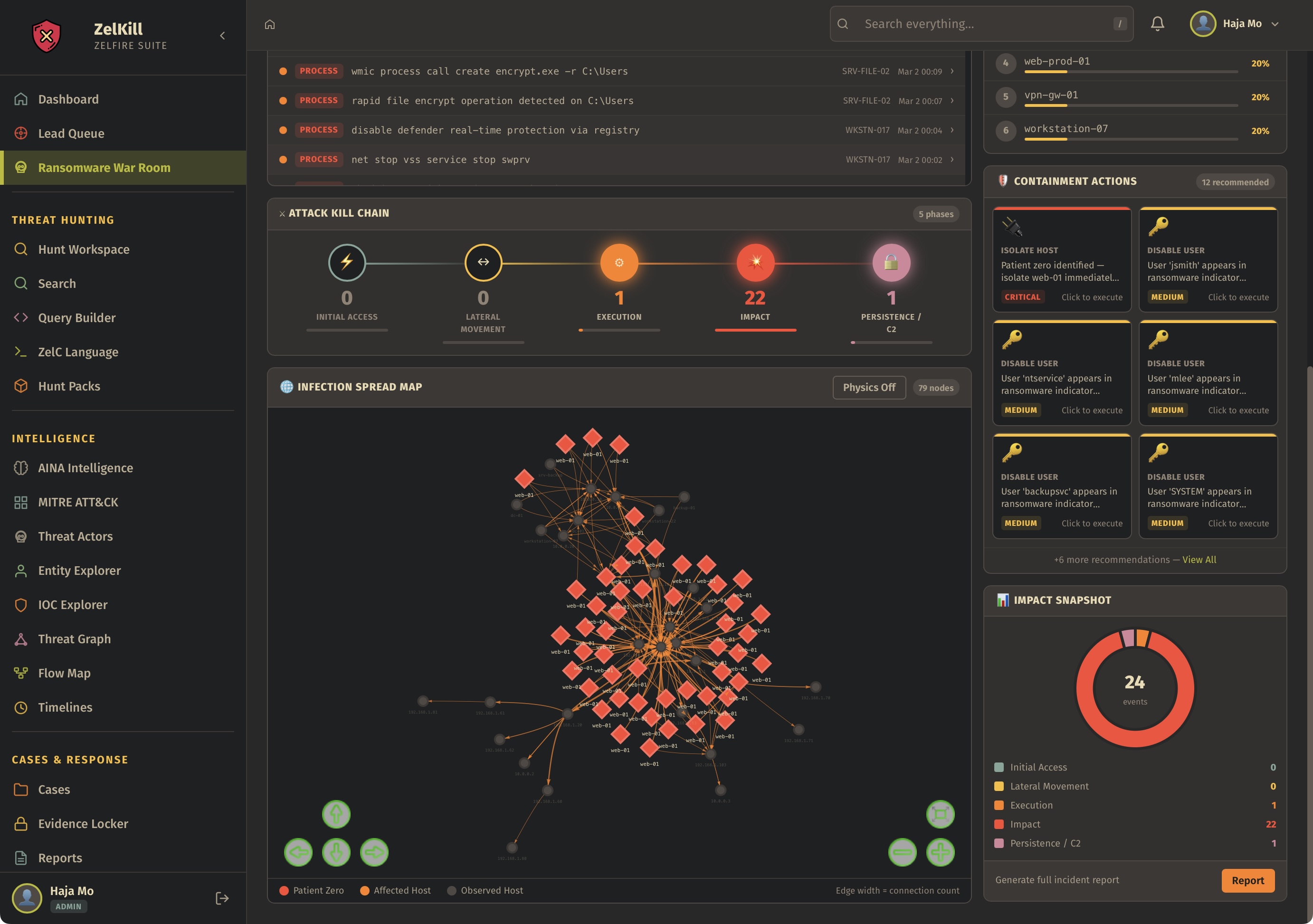
Ransomware War Room

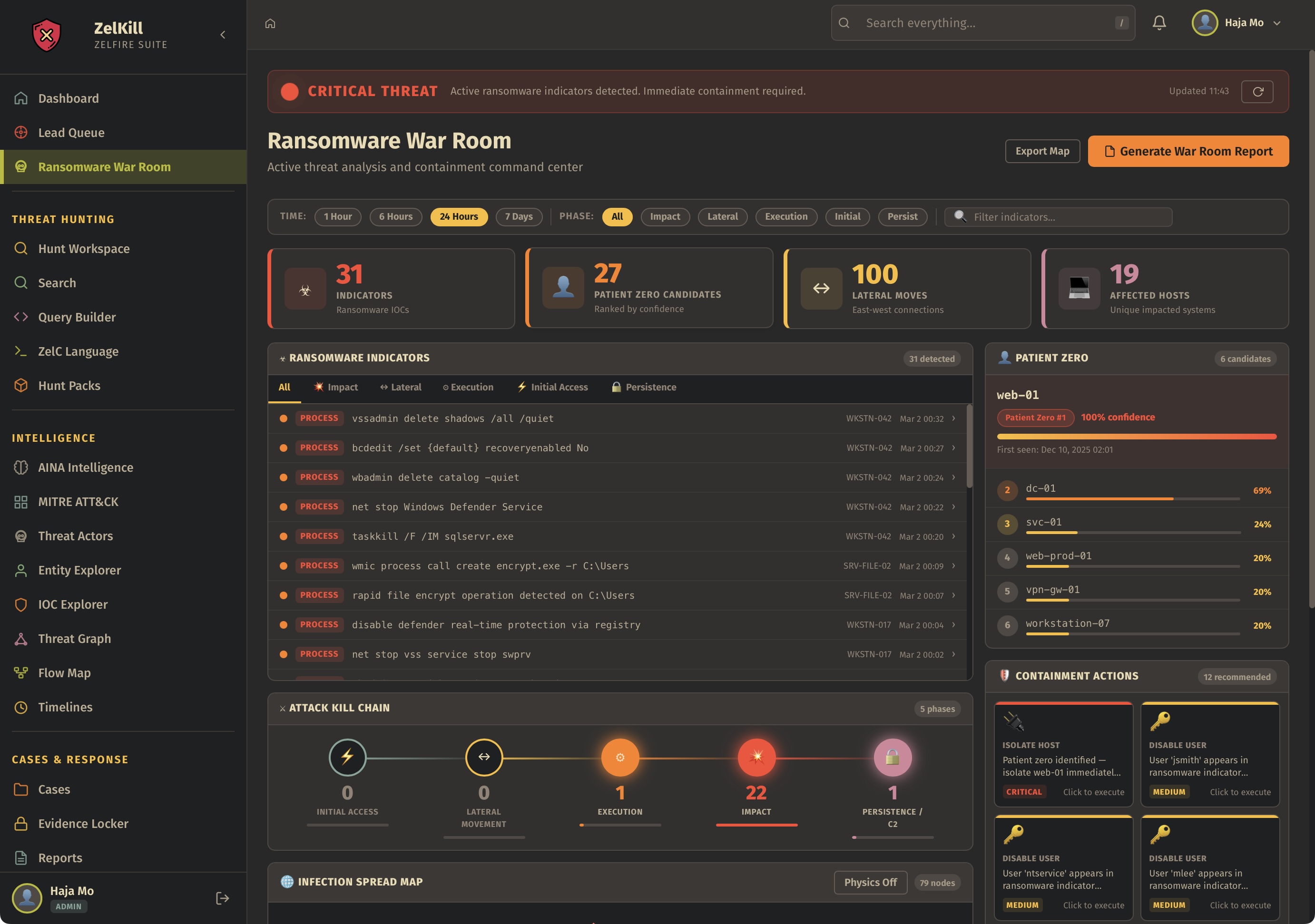
A dedicated command center for ransomware: patient zero ranking, spread mapping, phase timeline, and containment recommendations.

❝ Ransomware demands speed—ZelKill delivers it. ❞

14

Patient Zero Identification

ZelKill ranks patient zero candidates using earliest indicators, blast radius, and correlation strength.

❝ Find where it started—before it spreads. ❞

15

Spread Map and Lateral Movement Visualization

See host-to-host movement, auth paths, and suspected spread routes in one visual map.

❝ Attackers move. ZelKill maps the movement. ❞

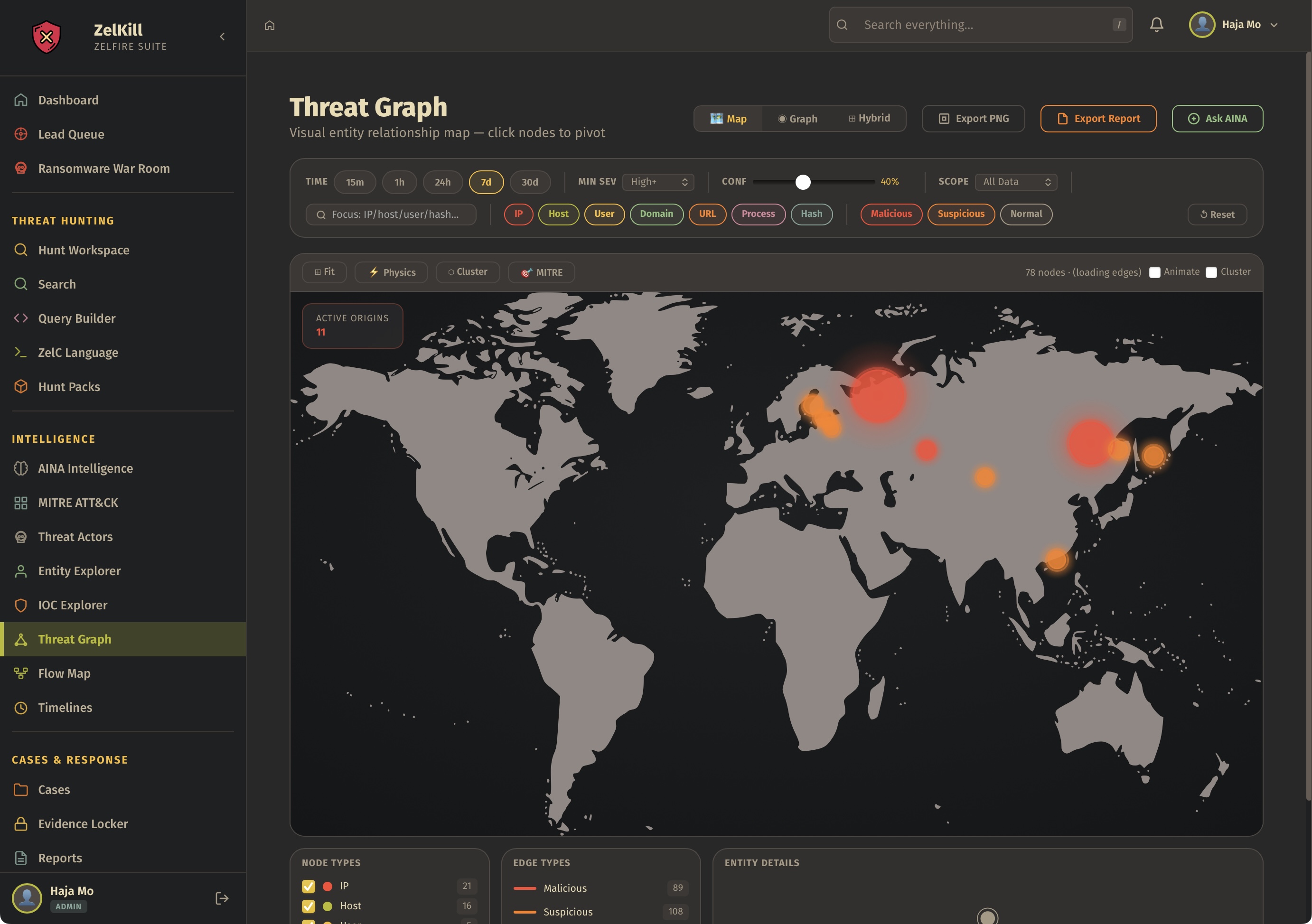
16

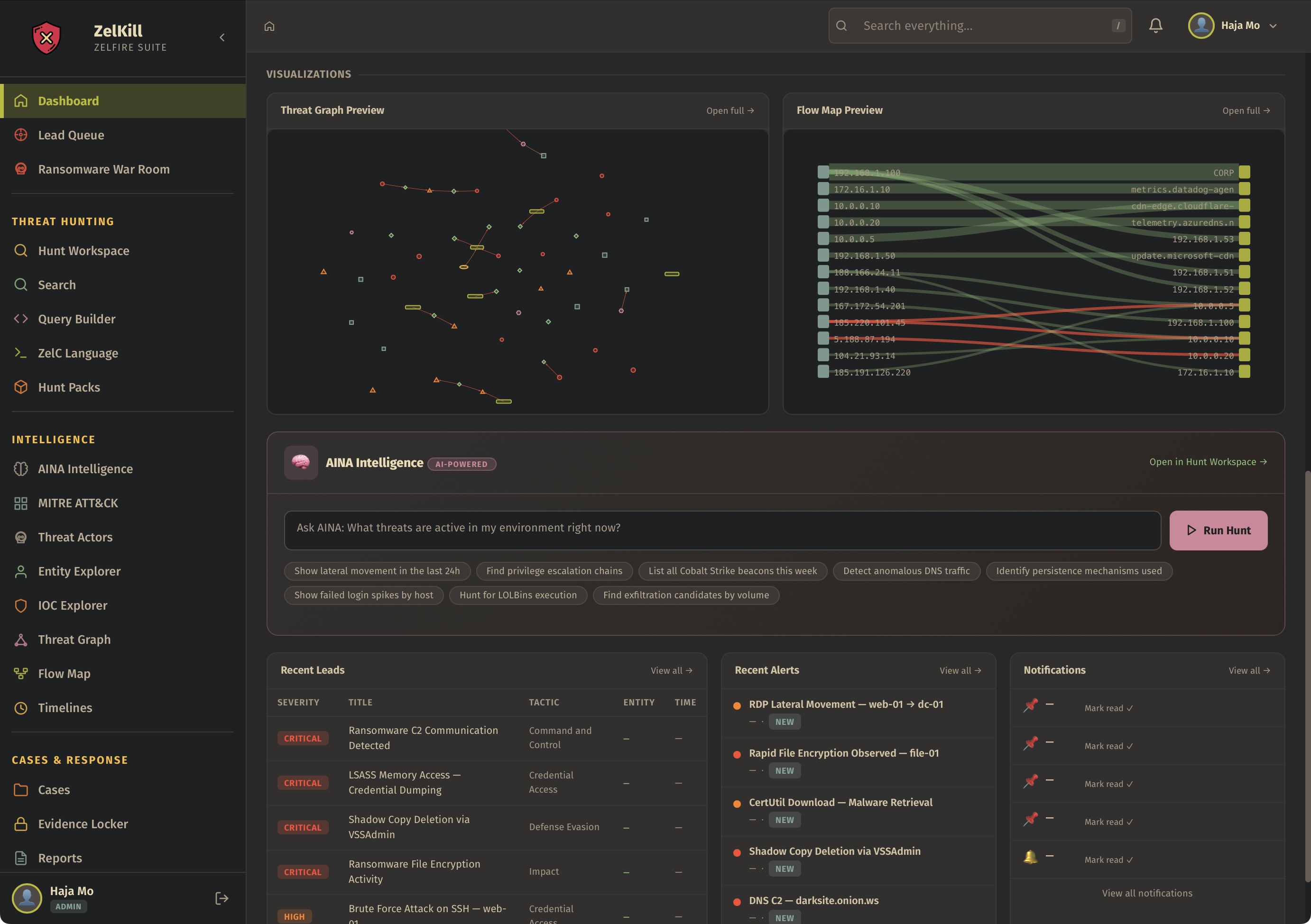
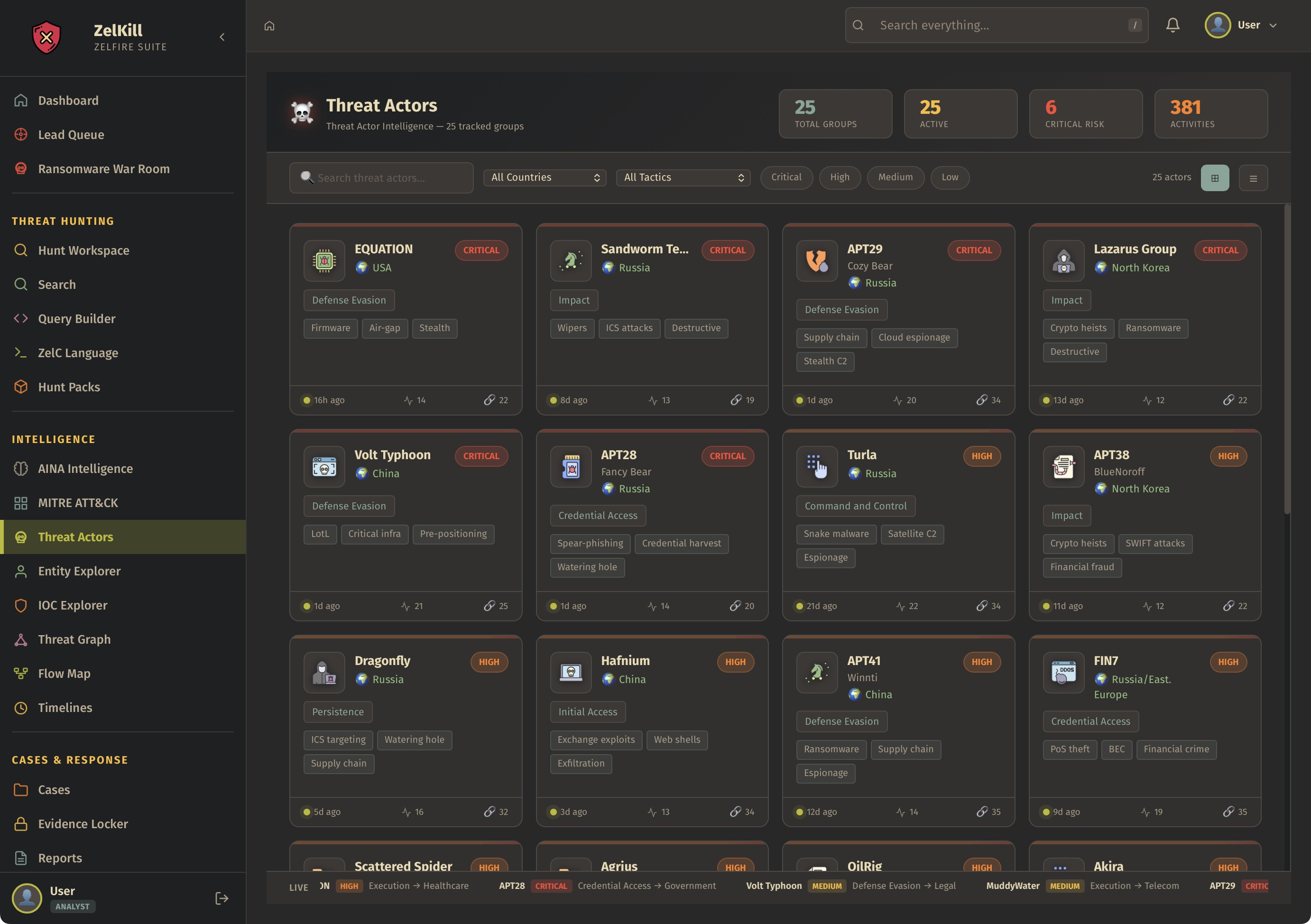
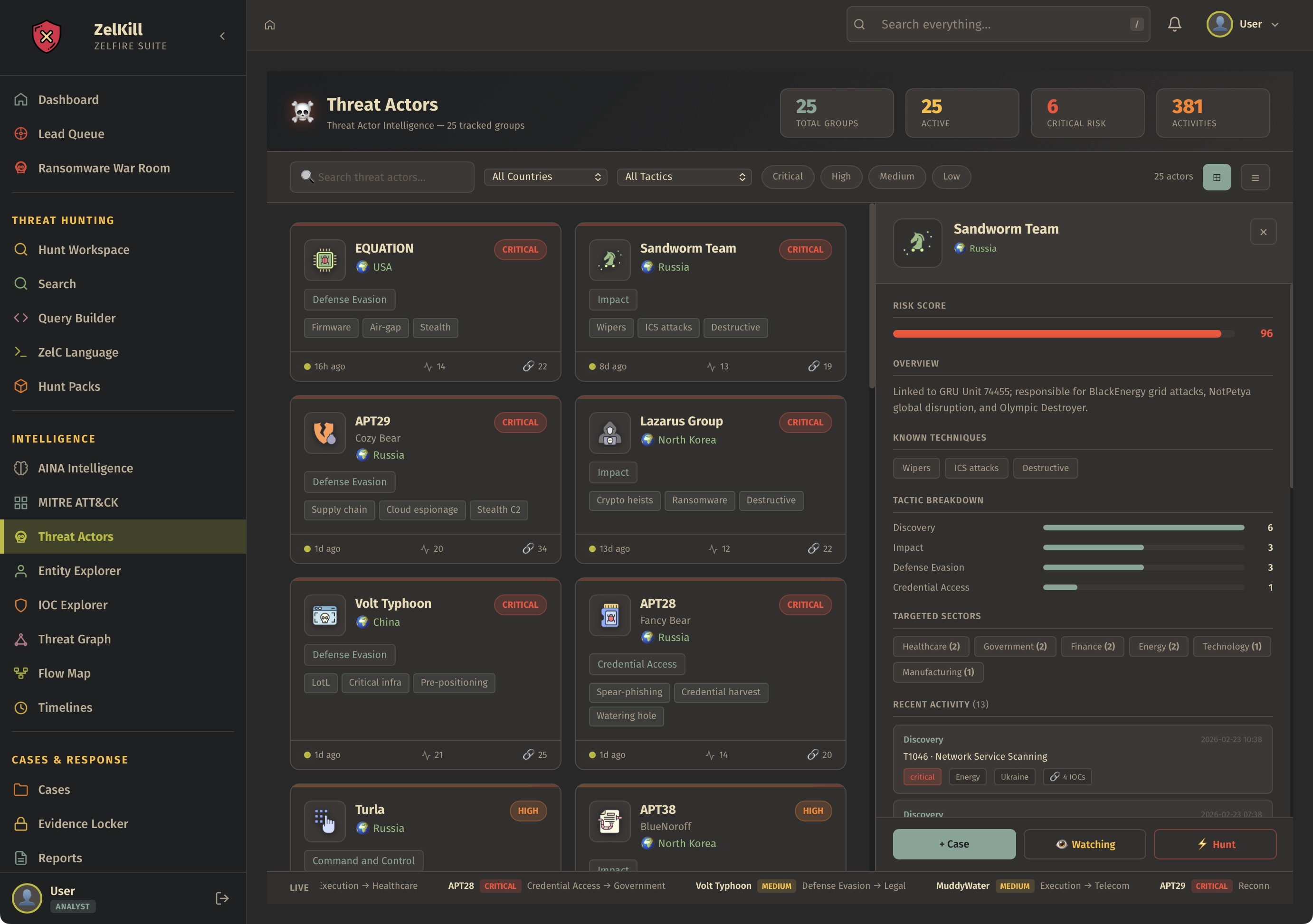
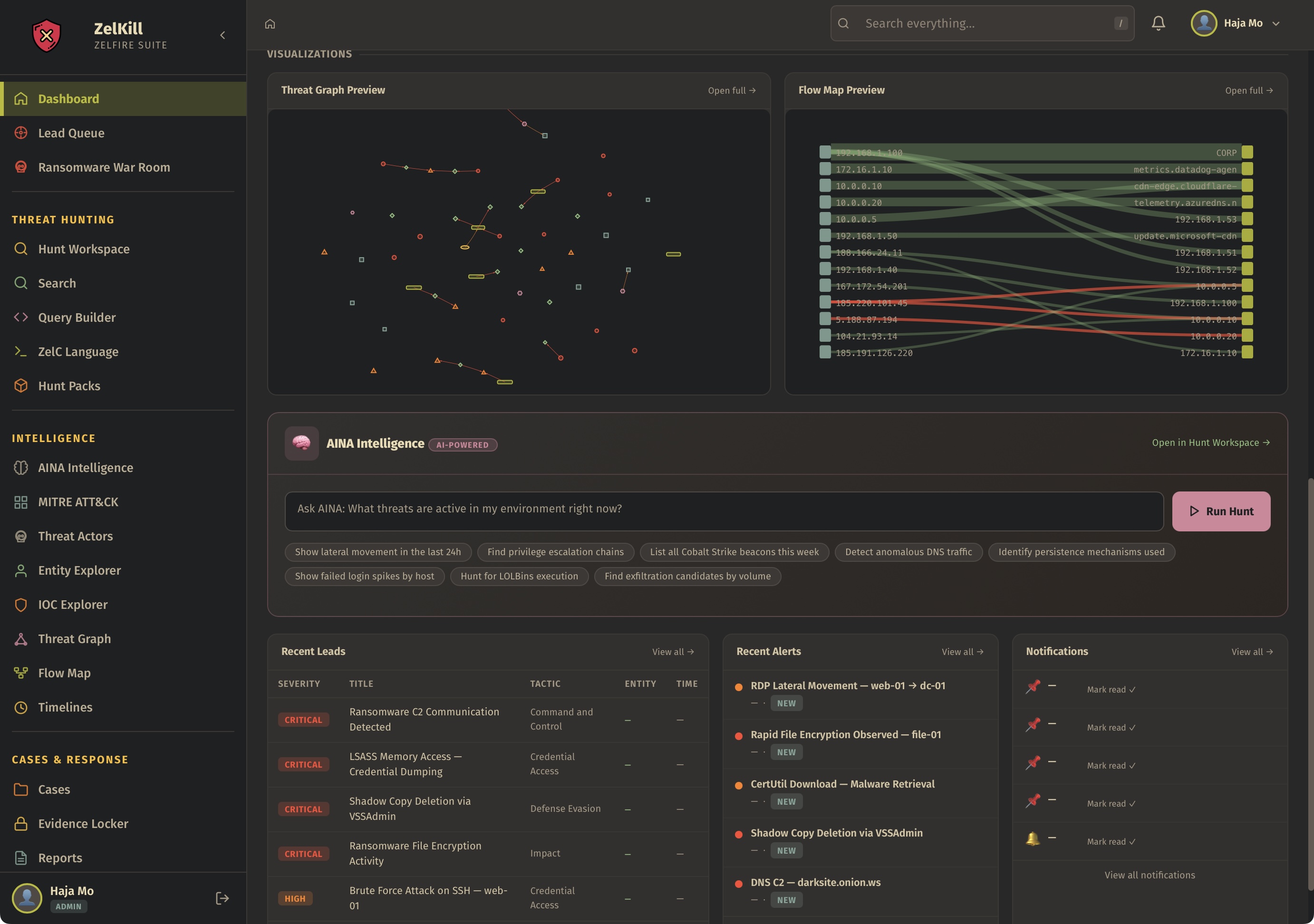
Threat Graph Relationship Intelligence

Visualize entity relationships across IPs, hosts, users, domains, URLs, processes, and hashes. Click to pivot instantly.

❝ Every breach is a graph. ZelKill draws it. ❞

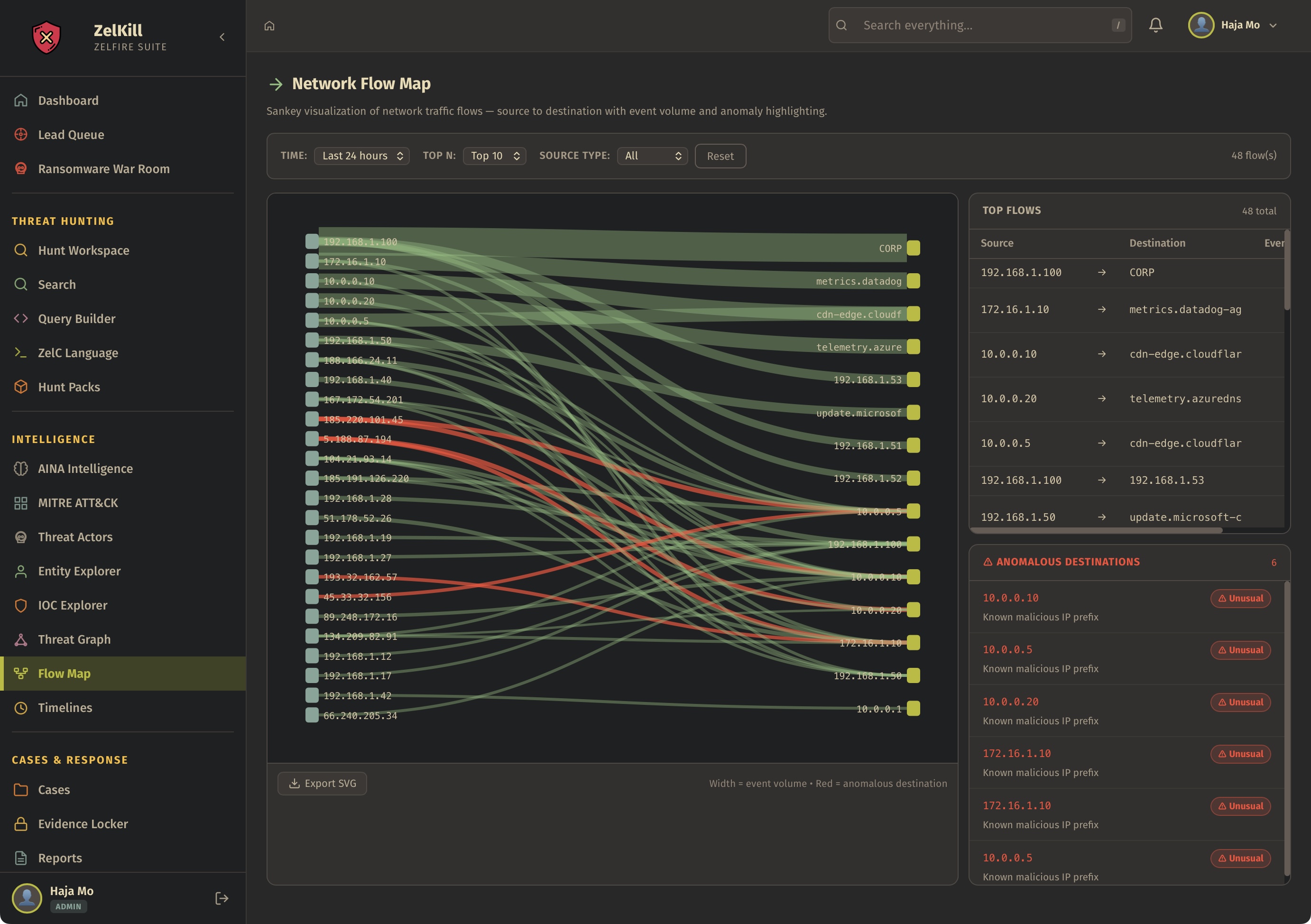
17

Flow Map From-To Clarity

Track where traffic is coming from, where it lands, and where it goes next—so exfil and C2 patterns stand out.

❝ Follow the flow. Find the breach. ❞

18

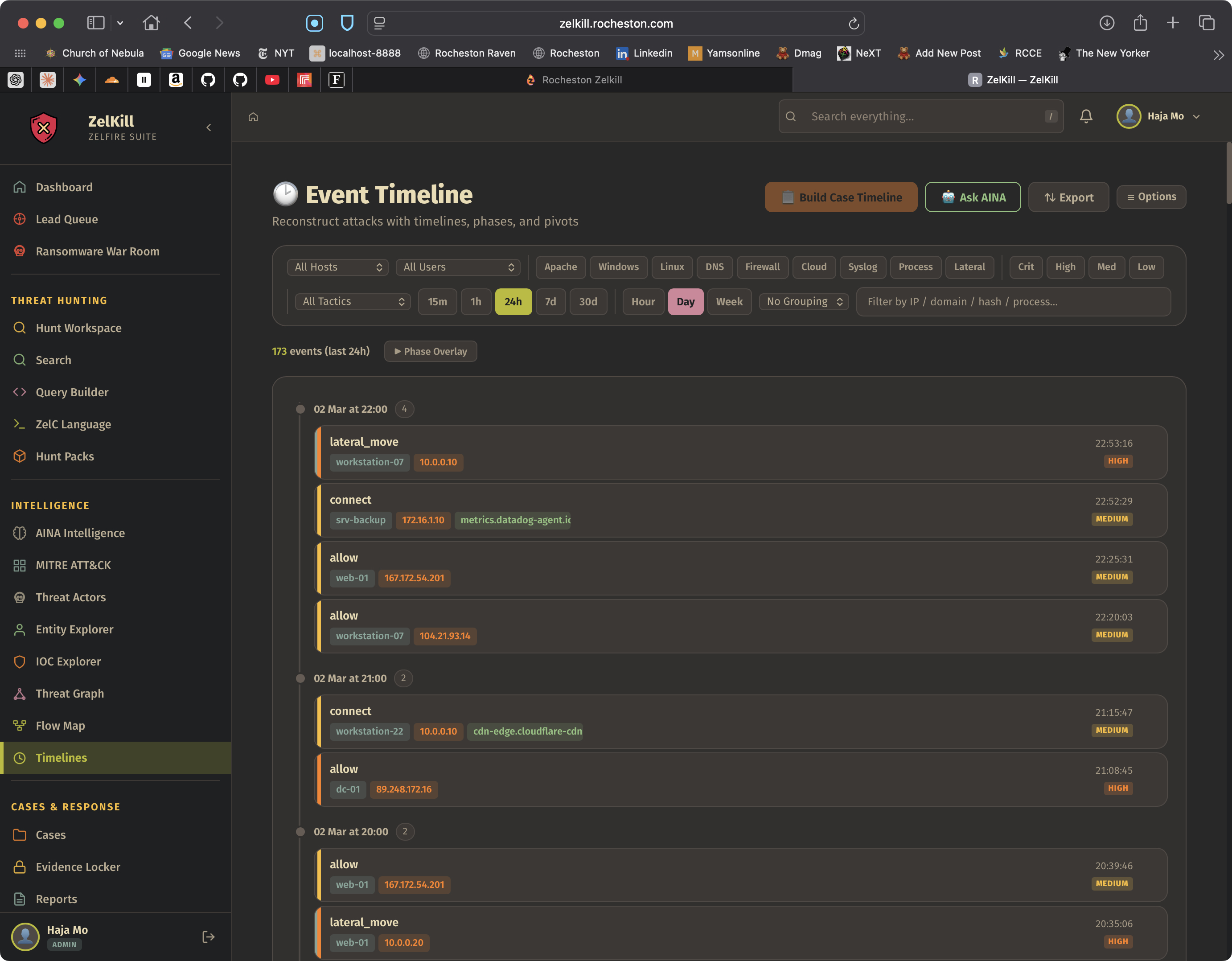
Timeline Command Center

Hour/day/week timelines with swimlanes by host or user make investigation feel fast and intuitive.

❝ Time is the best truth detector. ❞

19

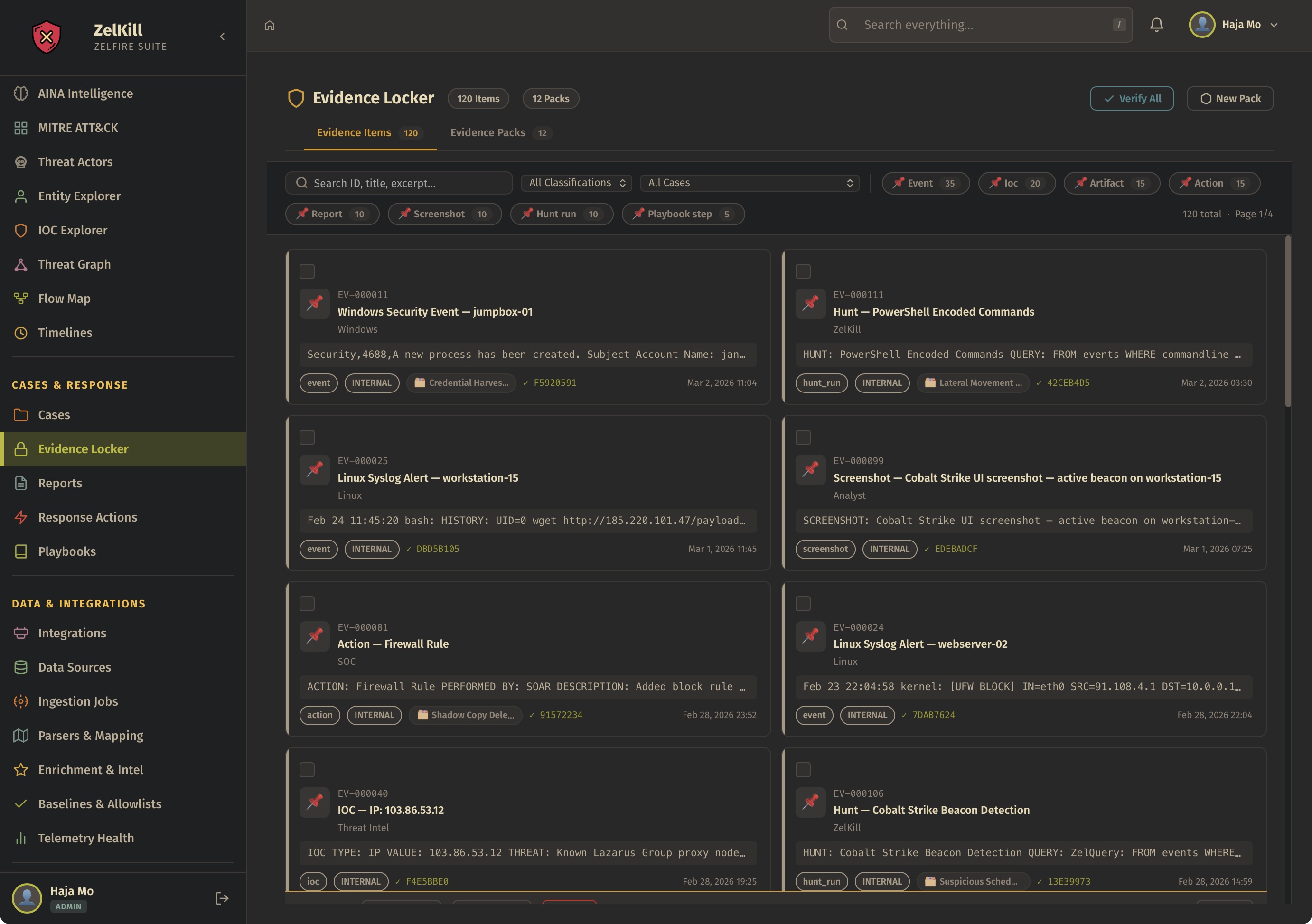
Evidence Locker With Hash Integrity

Every key artifact becomes an evidence item with hashing, chain-of-custody, and export bundles for defensible reporting.

❝ Evidence isn’t a screenshot—it’s a system. ❞

20

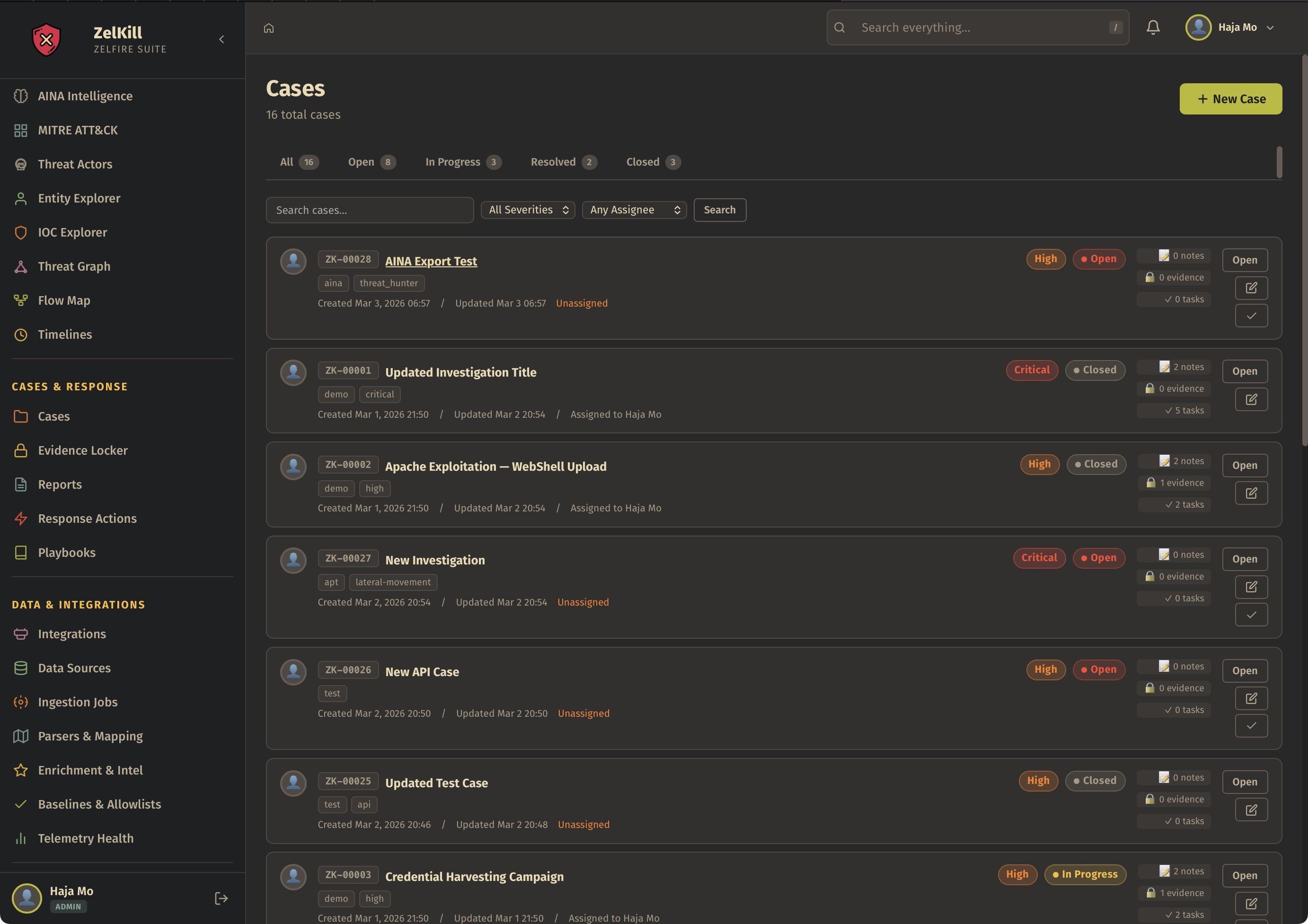
Case Management That Builds a Narrative

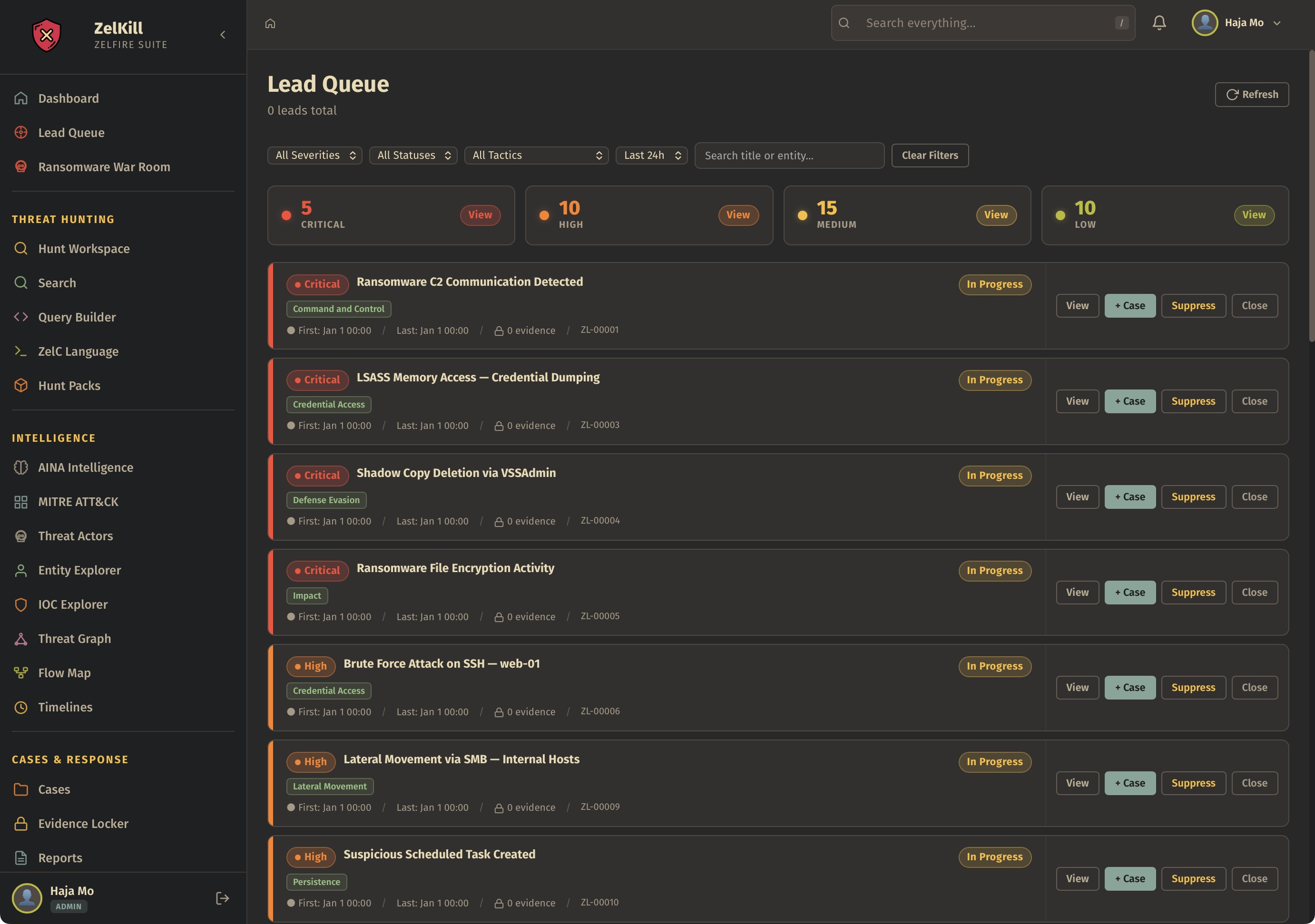
Convert leads into cases, attach evidence, add tasks, track actions, and build a clear incident timeline you can present confidently.

❝ Incidents end when the story is proven. ❞

21

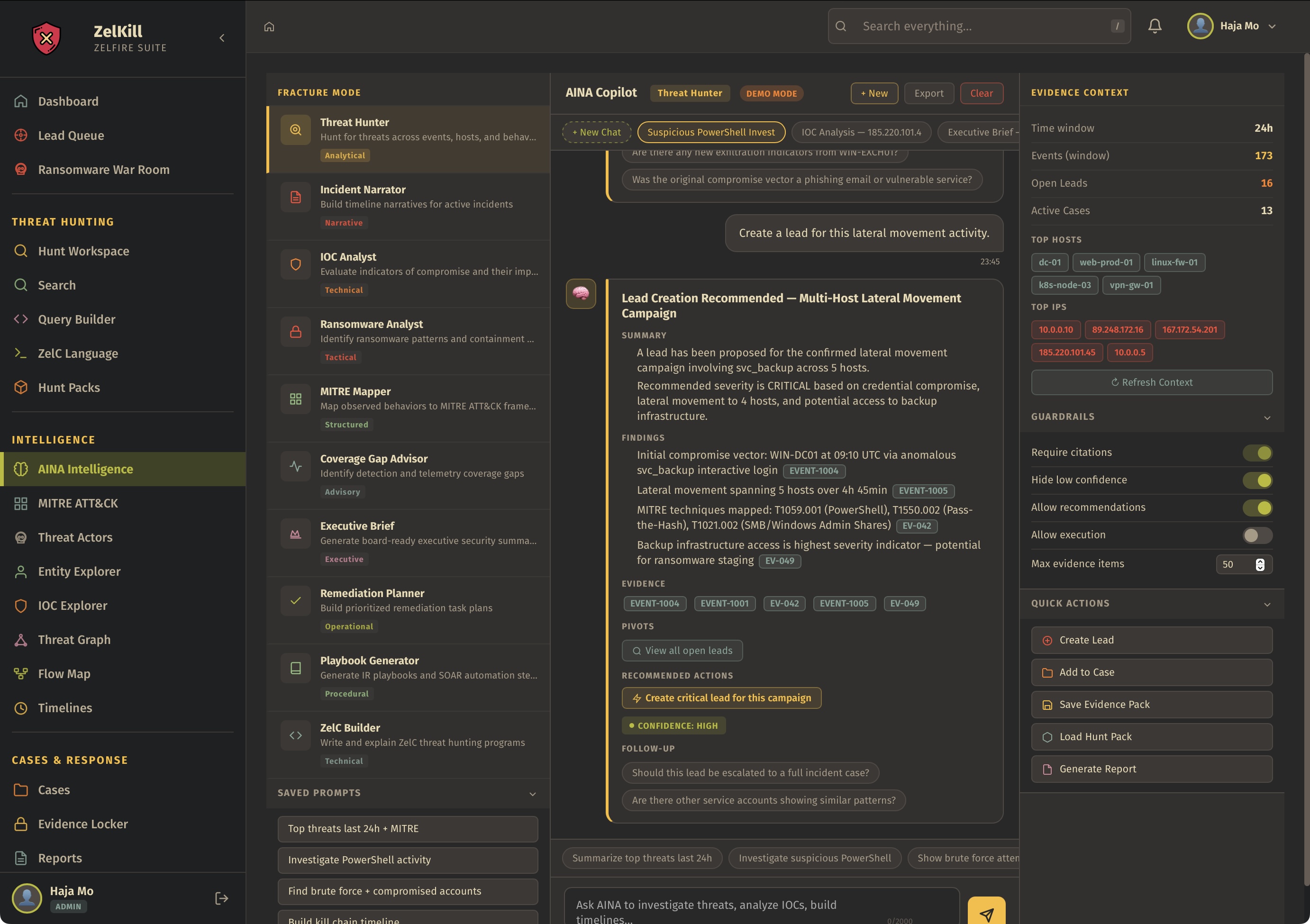
AINA Intelligence Copilot

AINA is built into ZelKill to explain what’s happening, propose pivots, and format outputs cleanly—always tied to evidence IDs.

❝ AI that speaks evidence, not opinions. ❞

22

AINA Fractures (Specialized AI Modes)

Switch AINA into purpose-built modes: Threat Hunter, IOC Analyst, Ransomware Analyst, MITRE Mapper, Coverage Advisor, Executive Brief, Remediation Planner, and more.

❝ One AI—many expert minds. ❞

23

Safe AI Context Packaging

ZelKill never dumps raw logs into AI. It builds compact evidence context packs so output stays accurate, structured, and useful.

❝ The right context creates the right conclusion. ❞

24

Action Broker Orchestration

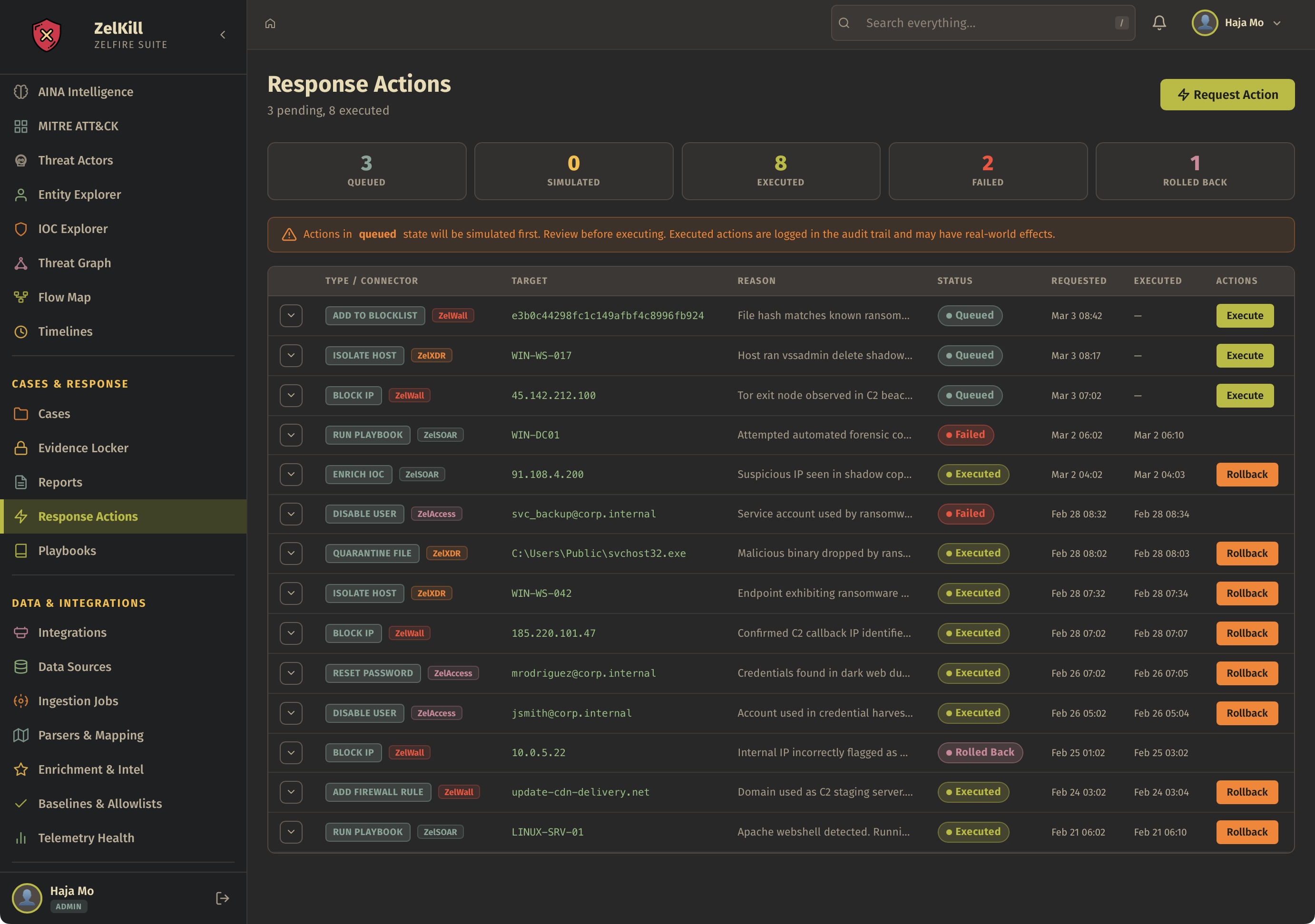
Queue response actions with approvals: block IPs/domains, isolate hosts, disable users, trigger playbooks—tracked with audit trails.

❝ Discover fast. Contain faster. ❞

25

Selfire Native Integrations

ZelKill connects deeply with Zelfire products like ZelWall, ZelXDR, ZelAccess, ZelSOAR, ZelScan, ZelMap, ZelRank, and more—so hunting becomes full-cycle defense.

❝ One suite. One truth. One response layer. ❞

26

Enterprise Integration Catalog

A full catalog of integrations with guided configuration wizards for SIEMs, cloud logs, servers, network devices, identity, email security, and more.

❝ If it creates logs, ZelKill can hunt it. ❞

27

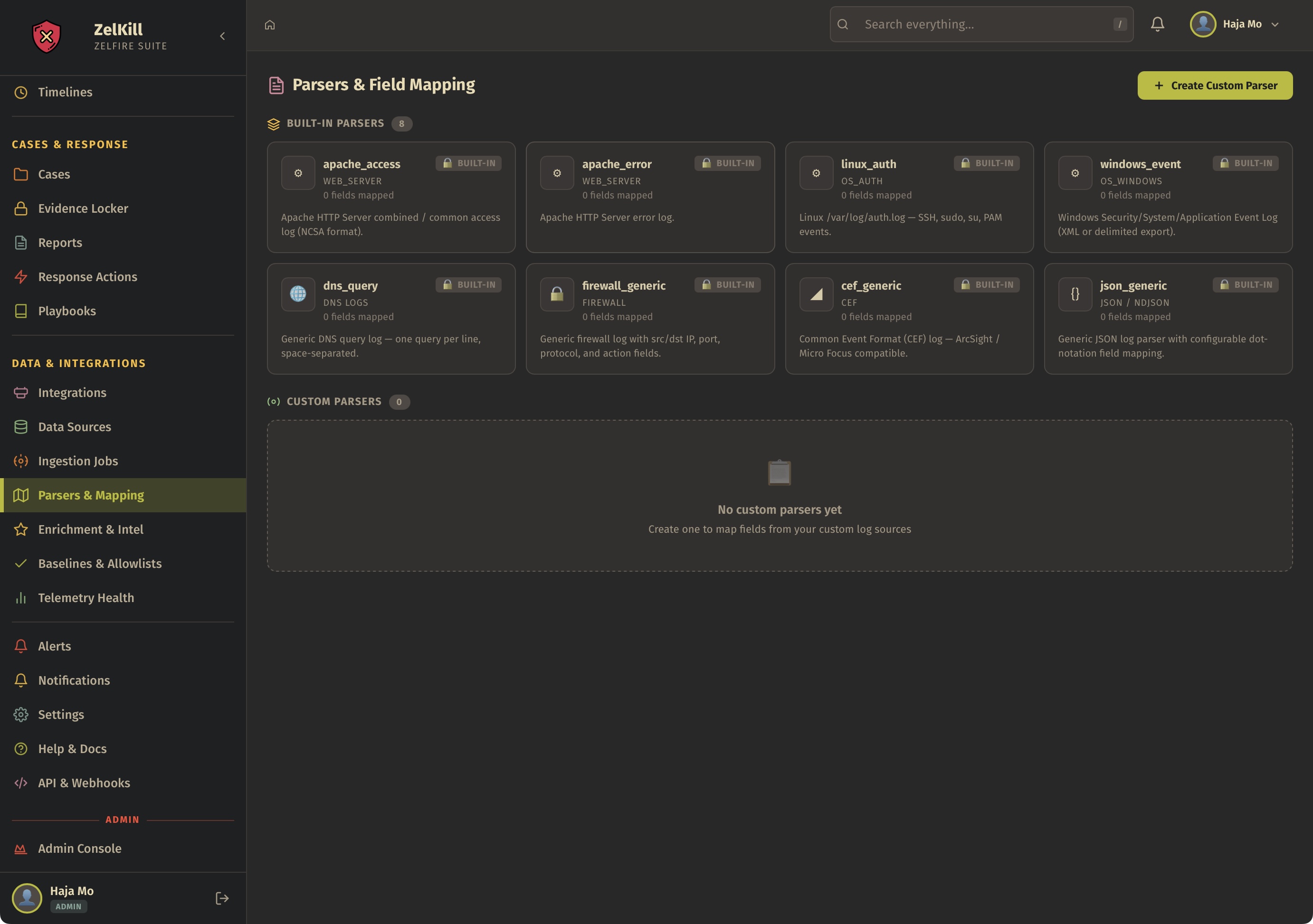
Parser and Mapping Wizard

Unknown log format? ZelKill guides field mapping and saves templates so new sources become searchable instantly.

❝ New telemetry shouldn’t require a new engineer. ❞

28

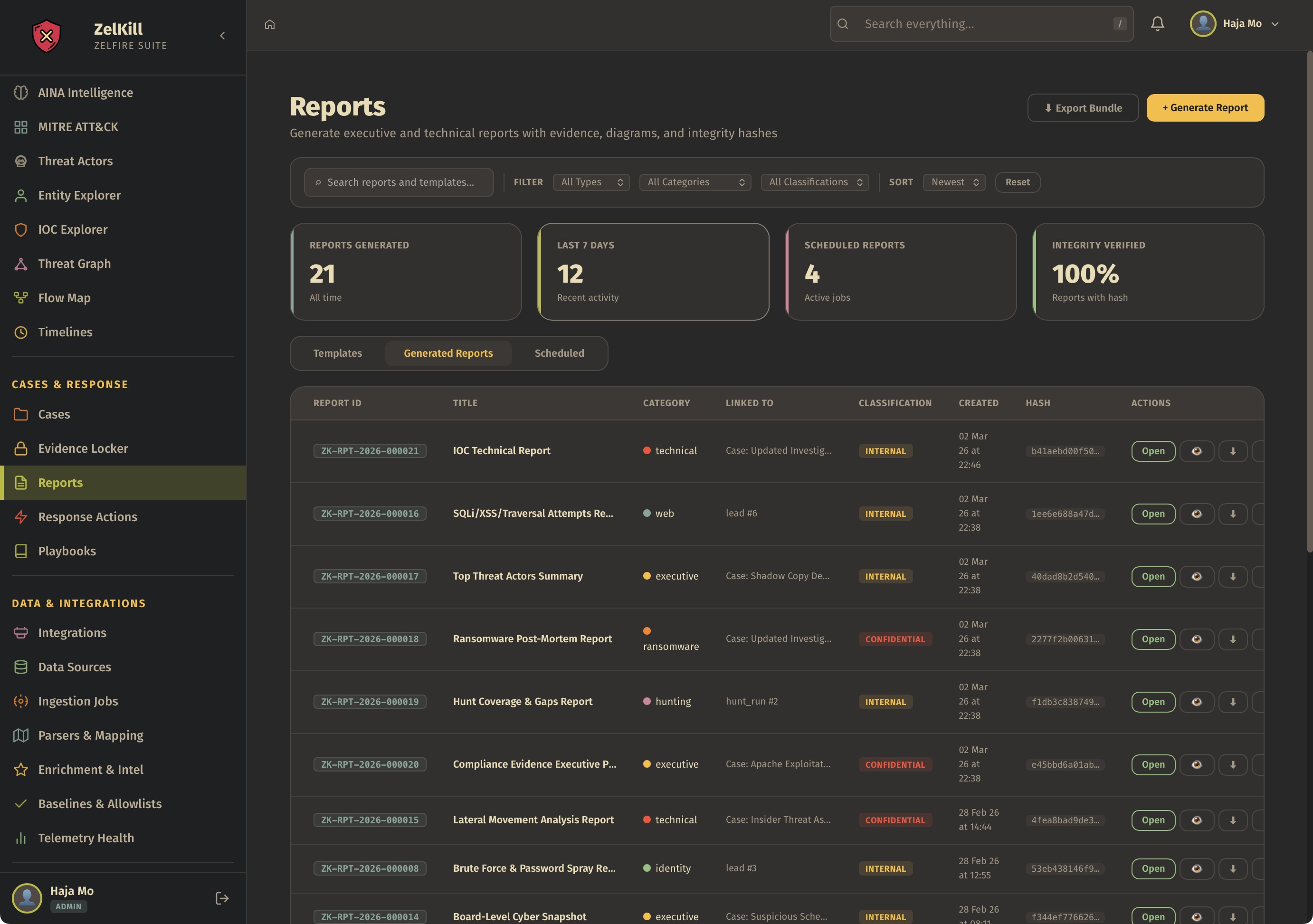
Report Engine With Many Templates

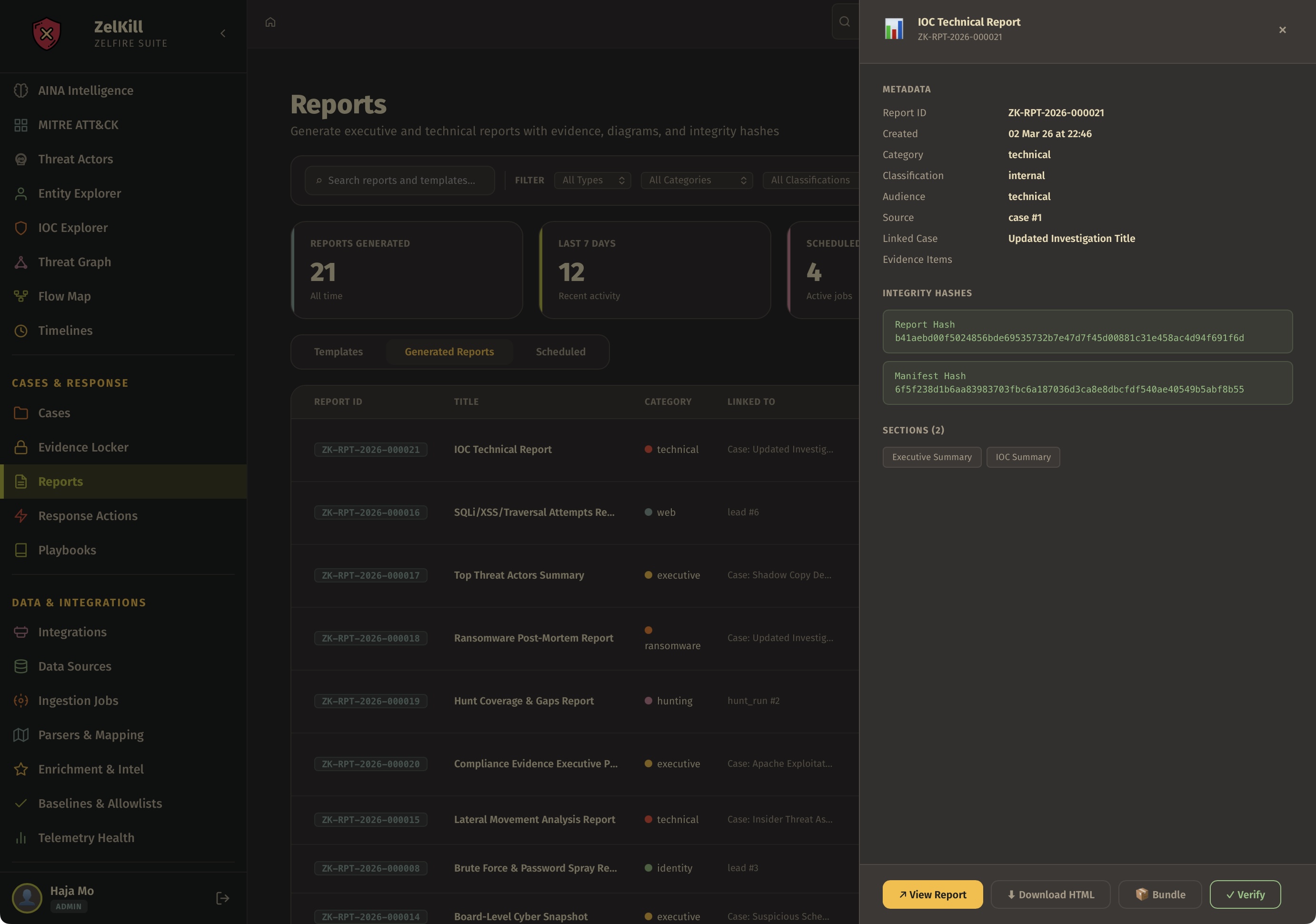
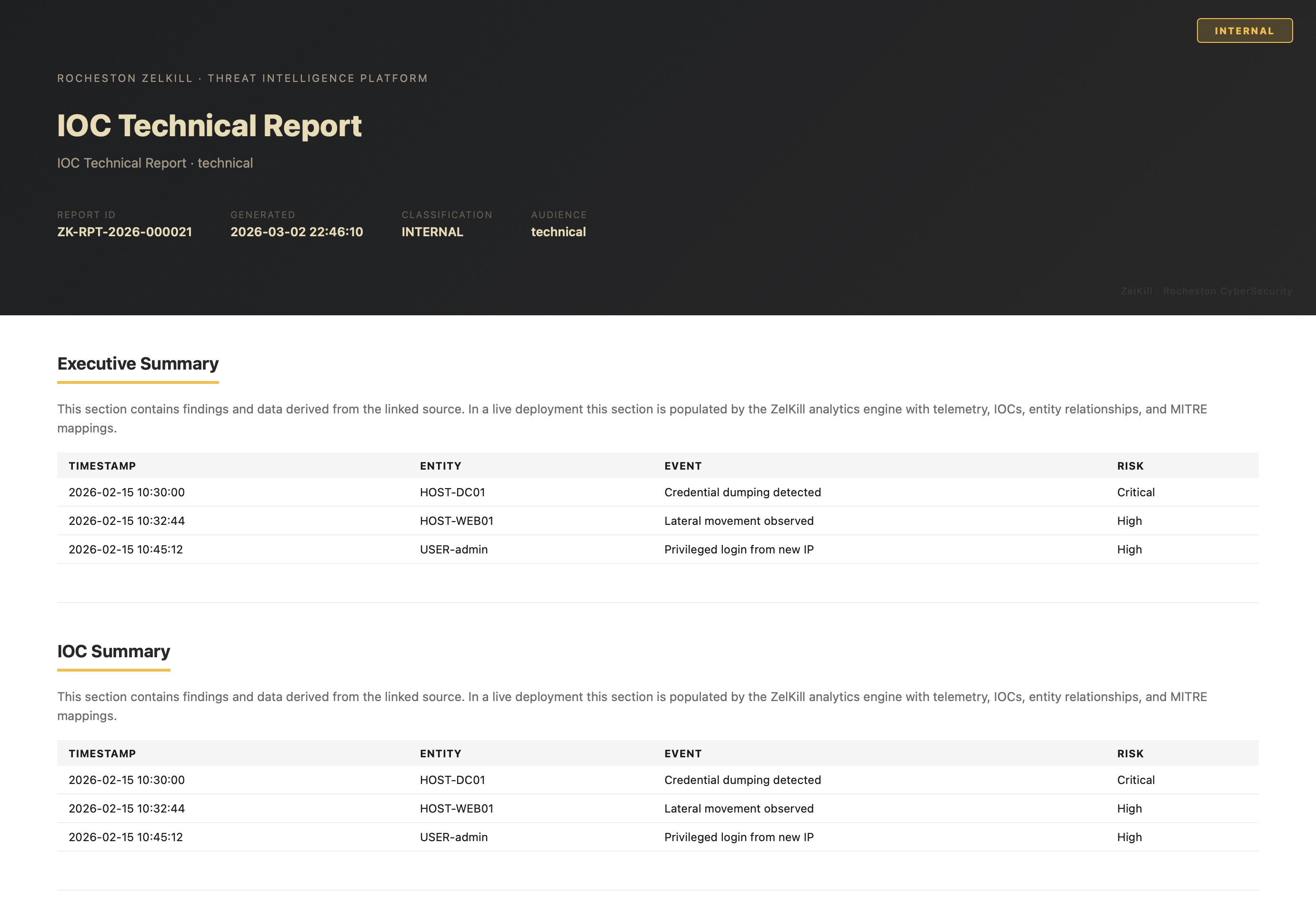
Generate executive briefs, technical incident reports, IOC reports, ransomware reports, MITRE reports, hunt summaries, and post-mortems—beautiful and branded.

❝ Reports that look like leadership-level evidence. ❞

29

Automation: Scheduled Hunts and Alerts

Run hunts continuously, generate alerts/leads by thresholds, and stay ahead of threats without manual effort.

❝ The best hunt is the one already running. ❞

30

Licensed Exclusively to RCCE Students

ZelKill is licensed exclusively to RCCE students to power hands-on, realistic enterprise threat hunting—built to train the next generation at the highest level.

❝ Built for the most advanced cybersecurity training ecosystem. ❞

UNDER THE HOOD

Technical specifications.

Architecture, integrations, security controls, and operational details for ZelKill.

🔌 Universal Ingestion Engine

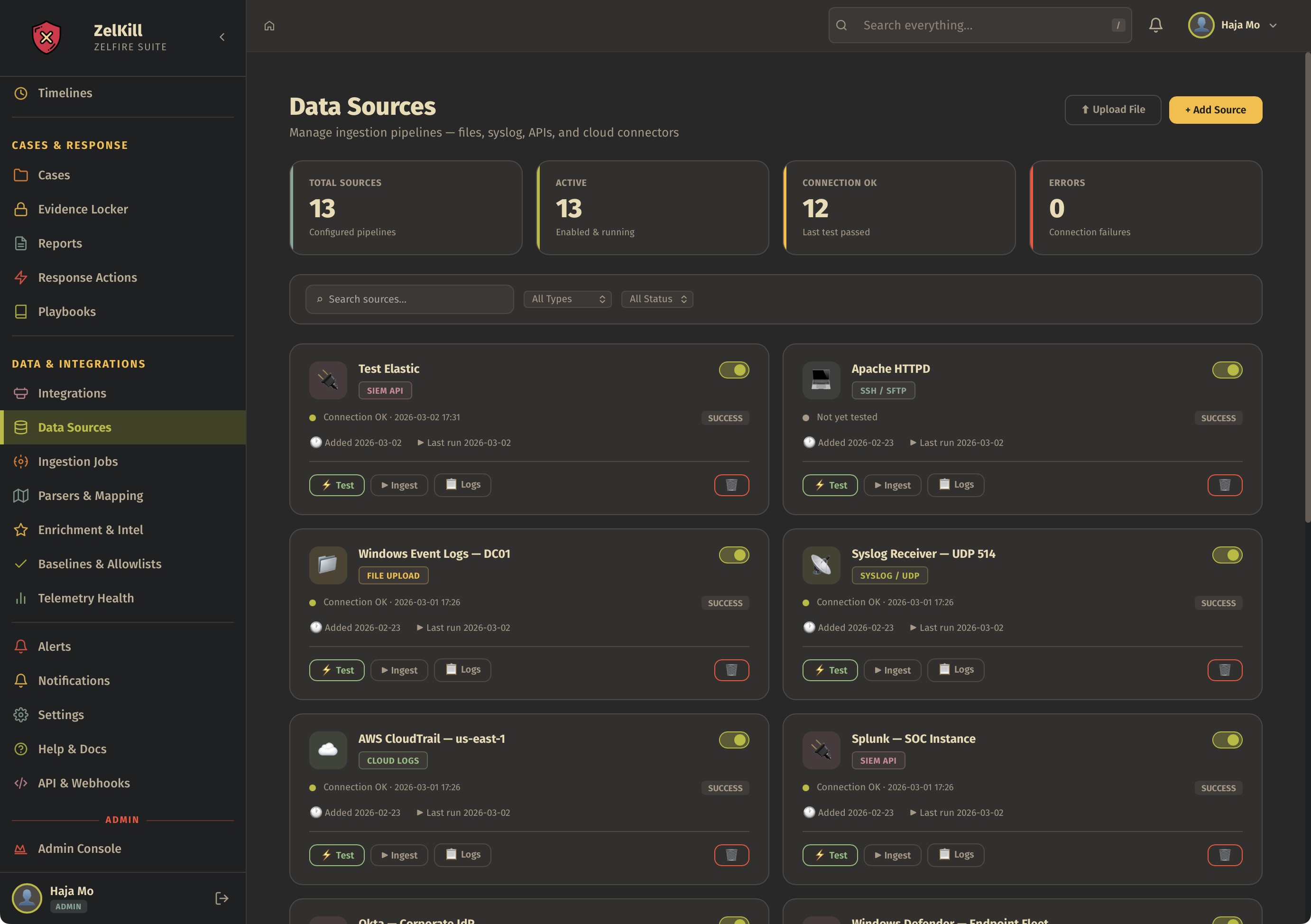
Connect to any SIEM, server, cloud, identity provider, or security device. Ingest via API pull, webhook push, syslog, SFTP file pulls, cloud buckets, folder watchers, or bulk uploads.

📄 Multi-Format Log Support

Parse and normalize JSON, NDJSON, CSV, Syslog, CEF, LEEF, Apache/Nginx formats, IIS W3C, and compressed bundles (ZIP/GZ) so hunts work across every environment.

🧩 Schema Normalization Layer

All incoming logs convert into one hunting schema (time, host, user, IP, domain, URL, action, outcome, severity, confidence). This enables fast cross-source correlation without custom glue.

🪄 No-Code Field Mapping Wizard

If a log format is unfamiliar, ZelKill opens a mapping wizard to bind fields to the ZelKill schema. Save mapping templates per integration and reuse them instantly.

🚀 High-Speed Search + Full-Text Indexing

Search millions of events with fast indexes and full-text search across command lines, URLs, domains, and scripts for instant investigation pivots.

🧱 Drag-and-Drop Hunt Builder

Build hunts visually by dragging blocks into a pipeline: scope, filters, correlation, outputs, and actions. Validate, estimate, and run without writing queries.

📦 100+ Hunt Packs Library

A massive library of prebuilt hunts covering ransomware, brute force, web attacks, lateral movement, persistence, C2, exfiltration, identity abuse, and cloud threats. Load and run in one click.

🧾 ZelC Language Templates

Write intent-based ZelC scripts or choose from a large template library. Safety-check before execution, then run and produce evidence-linked outputs.

🔗 Correlation + Sequence Hunting

Correlate by host/user/IP/domain/hash within time windows and detect sequences (Event A then Event B) to rebuild real attack chains.

📊 Rarity Mode + Baseline Compare

Spot first-seen and low-prevalence entities instantly. Compare current activity against historical baselines to highlight true anomalies.

🗺️ MITRE ATT&CK Mapping Engine

Auto-map observed behaviors to tactics and techniques, show activity heat, drill into technique evidence, and identify coverage gaps.

🚨 Ransomware War Room

Dedicated ransomware workspace with patient zero ranking, spread mapping, phase timeline (Initial Access → Impact), and containment recommendations.

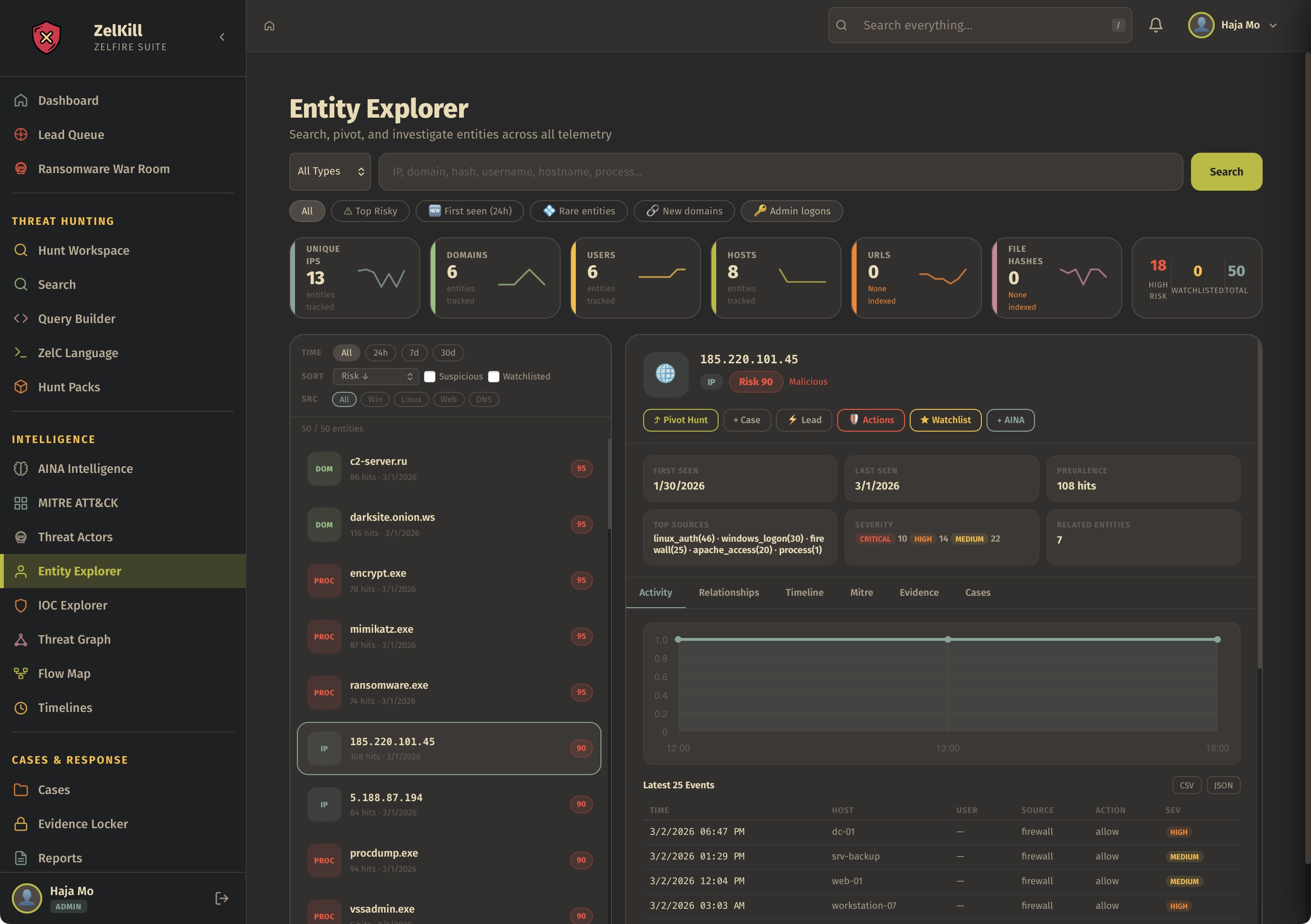
🕸️ Threat Graph Relationship Map

Interactive entity relationship graph (IP ↔ host ↔ user ↔ domain ↔ process ↔ hash). Click nodes for pivots, evidence, and action recommendations.

🧭 Flow Map Intelligence

From-to traffic flow diagrams that reveal who talked to what, where the data moved, and which paths look abnormal.

🕰️ Event Timeline Command Center

Hour/day/week timelines with swimlanes by host or user, phase overlays, fast filtering, and one-click conversion into case narratives.

🤖 AINA Intelligence Copilot

Evidence-driven AI assistant that explains findings, suggests pivots, and drafts professional outputs. Every claim is tied to evidence IDs, never vague AI text.

🧠 AINA Fractures (Specialized Modes)

Switch AINA into specialized modes like Threat Hunter, IOC Analyst, Ransomware Analyst, MITRE Mapper, Coverage Advisor, Executive Brief, and Remediation Planner.

🕹️ Action Broker Orchestration

Queue containment actions with approvals: block IPs/domains, isolate hosts, disable users, trigger playbooks, and track full audit trails.

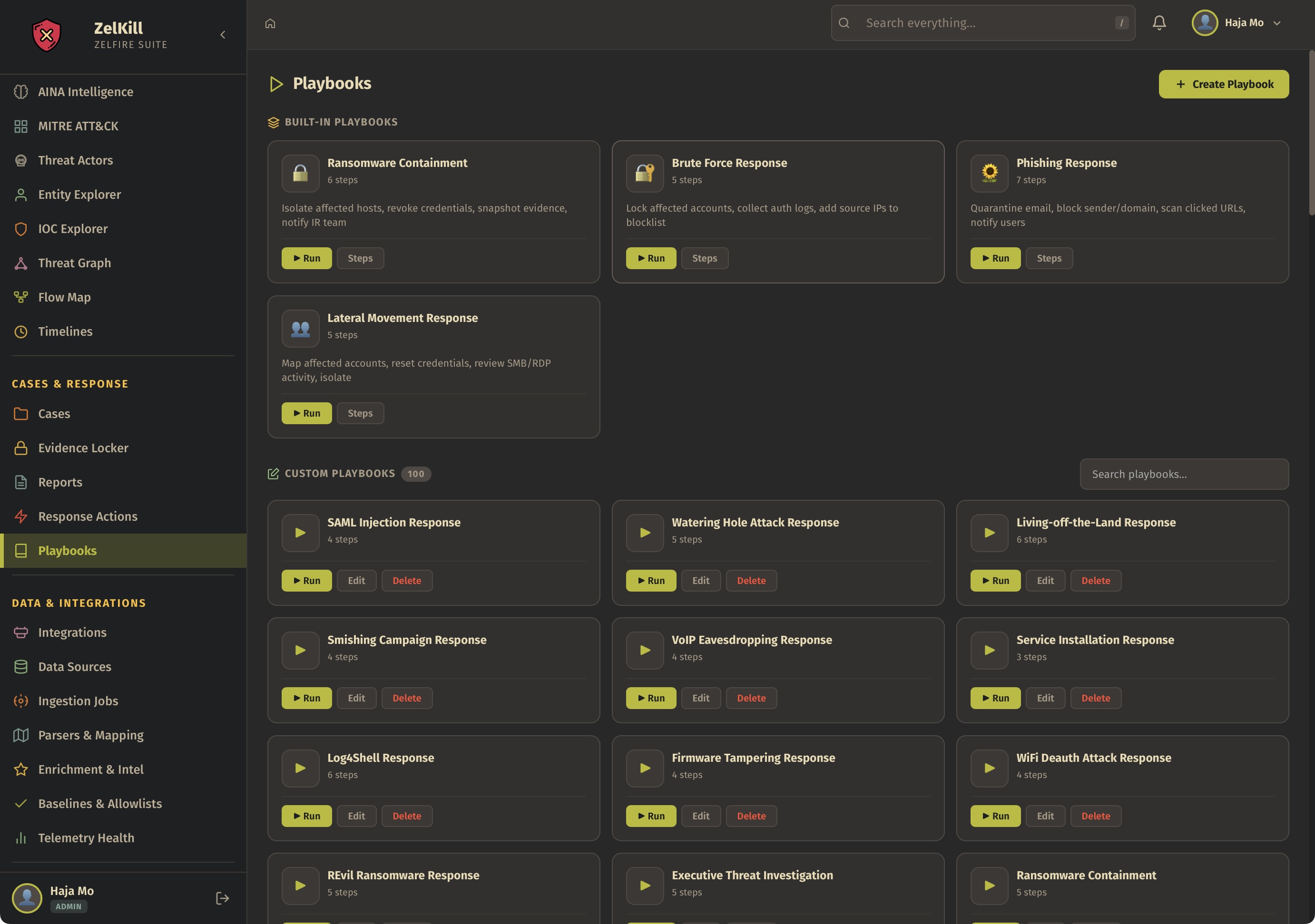
📚 100 Response Playbooks

Built-in playbooks with step-by-step execution for ransomware, phishing, brute force, lateral movement, persistence, C2, exfiltration, and cloud incidents.

🔒 Evidence Locker with Hash Integrity

Every evidence item is hashed (SHA-256), chained to custody logs, and exportable as evidence packs with manifests and integrity verification.

🗂️ Case Management + Narrative Builder

Convert leads to cases, build timelines, attach evidence, assign tasks, track actions taken, and produce complete incident narratives.

🧾 Report Engine with Many Templates

Generate executive briefs, technical incident reports, IOC reports, MITRE reports, ransomware reports, hunt run summaries, and post-mortems with branded output.

🏷️ Branded Report Shell + Verification Hashes

Reports include cover pages, headers/footers, classification labels, report IDs, and integrity hashes for defensible documentation.

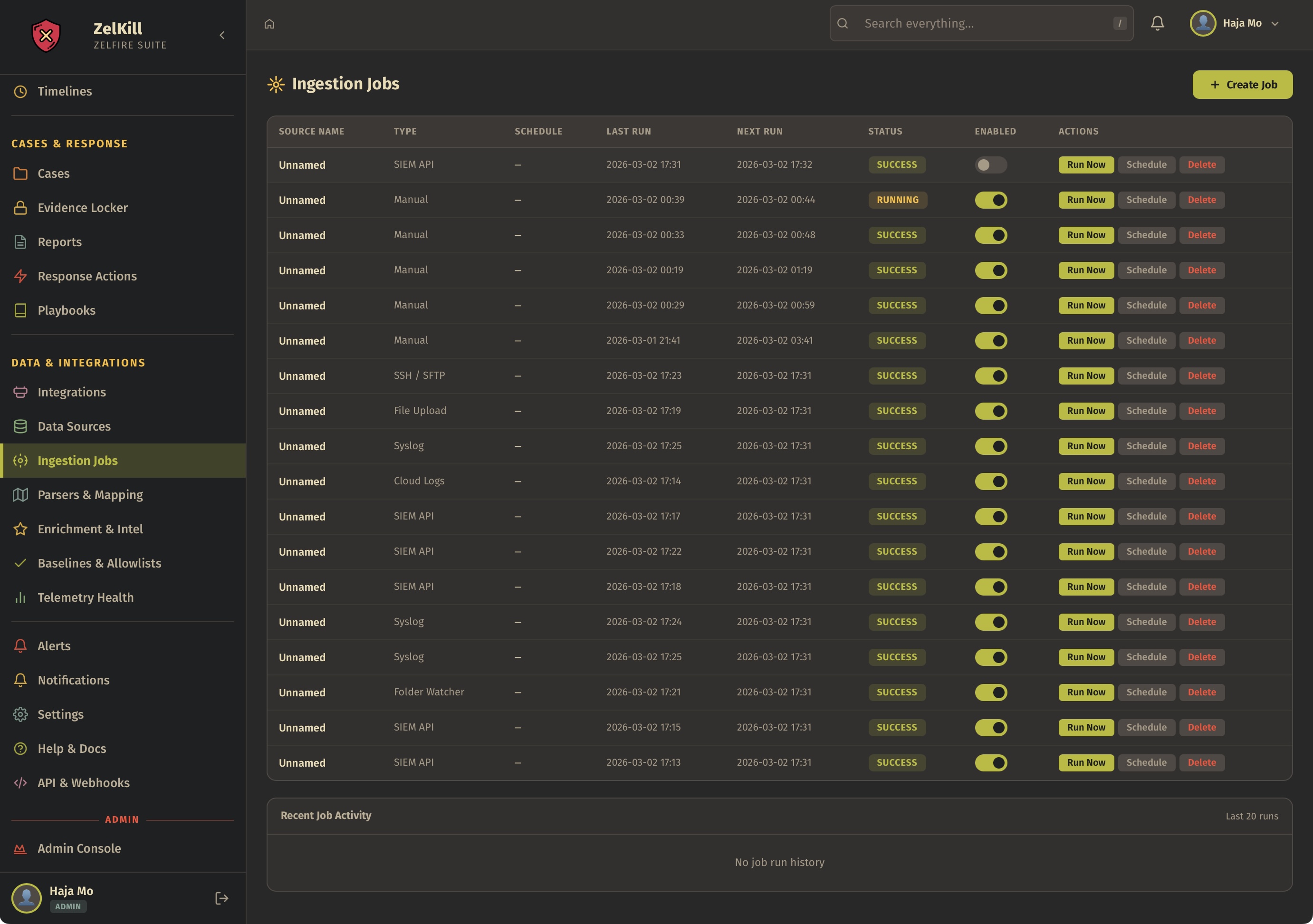
⏱️ Scheduled Hunts + Scheduled Reports

Run hunts automatically on a schedule, generate leads/alerts by thresholds, and produce recurring security briefings without manual work.

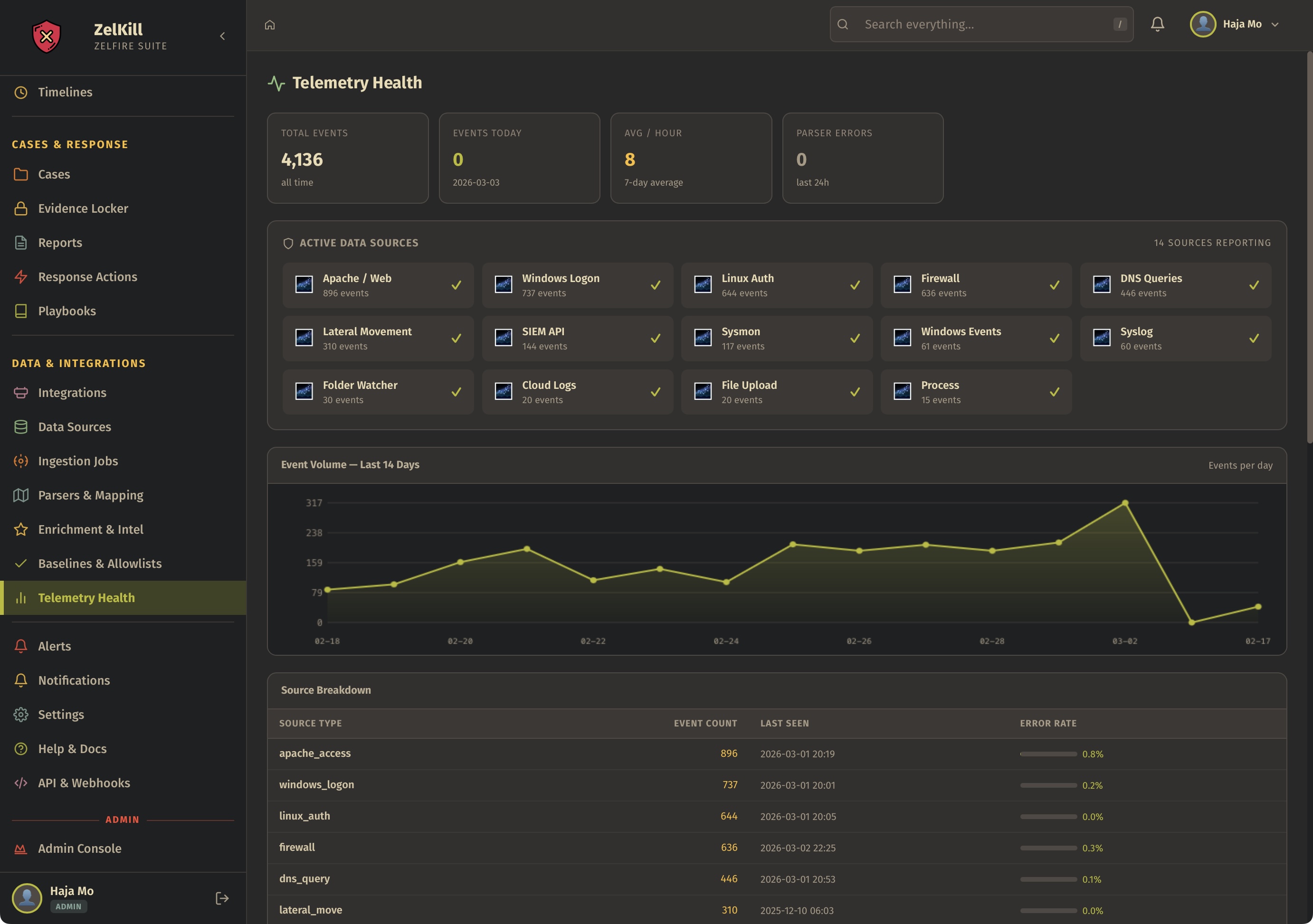
📈 Telemetry Health Dashboard

Monitor ingestion job health, parser errors, coverage gaps, and event volumes so you always know what data you have and what you’re missing.

🏢 Multi-Tenant Data Isolation

Each user sees only their own events, hunts, cases, reports, evidence, and integrations, built for secure multi-user environments.

🔐 Role-Based Access Controls

Roles for Admin, Hunter, Analyst, Auditor, and Read-only ensure sensitive actions and exports are controlled and auditable.

🗝️ Secure Secrets Storage

Integration tokens, webhook secrets, and AI keys are stored encrypted at rest with strict access controls and audit logging.

🧩 Zelfire Native Integrations

Deep native connectors for ZelAccess, ZelWall, ZelXDR, ZelSOAR, ZelScan, ZelMap, ZelPosture, Vulnerability Vines, ZelTester, ZelCloud, ZelDrift, ZelRank, ZelZero-Trust, and ZelExploits.

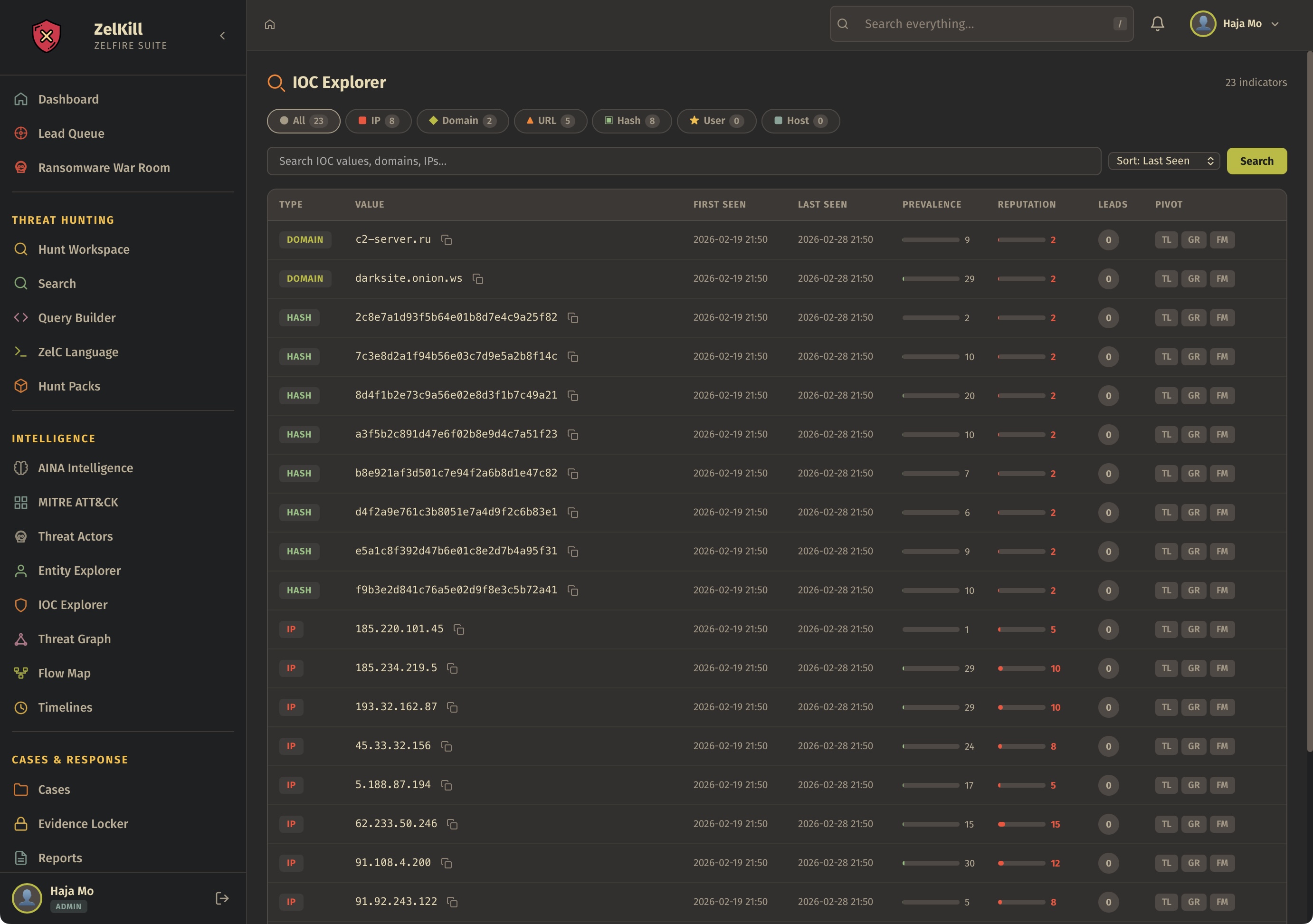
🗂️ Enterprise-Grade Integrations Catalog

A full integration catalog with guided configuration wizards for SIEMs, cloud logs, servers, network devices, proxies, DNS, identity providers, and email security logs.

THE DETAILS THAT MATTER

ZelKill FAQ.

Answers about the product, its capabilities, and how it fits into your security workflow.

What is Rocheston ZelKill?
Rocheston ZelKill is an AI-driven threat hunting, investigation, and response orchestration platform inside the Rocheston Zelfire Suite. It ingests logs from almost any environment, normalizes them into one hunting schema, correlates activity across sources, visualizes attack paths, produces evidence-linked outputs, and enables controlled containment actions.
What problem does ZelKill solve?
Most threat hunting tools are too complex and slow: painful integrations, hard query languages, siloed ecosystems, and investigations that turn into manual spreadsheets. ZelKill solves this by making ingestion universal, hunting visual, correlation fast, AI evidence-driven, reporting defensible, and response orchestration integrated.
Is ZelKill a SIEM?
ZelKill is a threat hunting and investigation platform that can ingest SIEM exports and streams, but it is built for hunting velocity and investigation clarity, not just log warehousing. Its priority is correlation, pivots, narratives, evidence integrity, and fast containment workflows.
Does ZelKill lock me into a cloud ecosystem?
No. ZelKill is designed to avoid vendor lock-in. You can ingest from any SIEM, any server, any cloud, any identity provider, any network device, and offline incident bundles.
What types of data can ZelKill ingest?
ZelKill can ingest SIEM logs, web server logs (Apache/Nginx/IIS), Windows logs (Security/Sysmon/PowerShell), Linux logs (auth/syslog/auditd/sudo/cron), network logs (DNS/proxy/firewall/VPN/IDS/IPS/flows), identity logs (sign-ins/MFA/OAuth/privilege), cloud audit logs, endpoint/EDR exports, email/SaaS audit exports, and incident ZIP/GZ bundles.
What ingestion methods are supported?
API pull connectors, webhook push endpoints, syslog receiver (UDP/TCP/TLS), SSH/SFTP file pulls, cloud bucket pulls (S3/Azure Blob/GCS), folder watchers, manual uploads (CSV/JSON/NDJSON/EVTX/ZIP/GZ), and optional log bus integrations like Kafka for advanced deployments.
What log formats does ZelKill support?
JSON, NDJSON, CSV, Syslog variants, CEF, LEEF, Apache/Nginx combined formats, IIS W3C, EVTX bundle imports, and compressed archives (ZIP/GZ).
What happens after logs are ingested?
ZelKill parses and normalizes logs into a unified schema, indexes them for fast search, extracts entities (IPs/domains/URLs/hashes/users/hosts/processes), computes first-seen/last-seen/prevalence, applies enrichment where configured, and prepares data for hunts, correlations, and AI analysis.
What is the ZelKill normalized schema?
A consistent hunting schema such as time, source type, host, user, src_ip/dest_ip, domain/url, process/parent_process/commandline/hash (when available), action/outcome, severity/confidence, tags, and technique/tactic mapping where possible.
How does ZelKill handle unknown log formats?
ZelKill uses a no-code field mapping wizard that lets users map key fields (timestamp, host, user, IPs, domain/url, action/outcome, severity/confidence). The mapping is saved as a reusable parser template per integration.
What is the Drag-and-Drop Hunt Builder?
A visual pipeline builder where users drag blocks into a hunt plan: scope, filters, correlation/sequence, outputs, and optional actions. It validates the plan, estimates cost, runs it, and returns results with pivots and evidence capture.
What are Hunt Packs?
Hunt Packs are prebuilt hunt “boxes” that cover major threats (ransomware, brute force, web attacks, lateral movement, persistence, C2, exfiltration, identity abuse, cloud compromise). Users can preview, load into the builder, and run instantly.
How many hunt packs does ZelKill include?
ZelKill is designed to ship with about 100+ hunt packs by default, covering practical attack patterns across web, identity, endpoint, network, and cloud sources.
What is ZelC Language?
ZelC is Rocheston’s modern cybersecurity language for the agentic era. Users write intent-based scripts that go through a safety check, then execute in a controlled way to produce structured, evidence-linked results. ZelC can also generate hunt programs, recommended pivots, and report drafts.
Does ZelKill support correlation across sources?
Yes. ZelKill correlates across Apache, Windows, Linux, DNS, firewall, proxy, cloud, and identity sources by linking activity through shared entities (IP, user, host, domain, hash) and time windows.
Does ZelKill support sequence hunting (A then B)?
Yes. ZelKill supports sequence logic such as “Event A then Event B within X minutes,” enabling detection of attacker progression rather than isolated signals.
What is Rarity Mode?
Rarity Mode highlights first-seen and low-prevalence entities and behaviors so the unusual rises above the noise. This is especially powerful for new domains, rare processes, and unusual admin access patterns.
Does ZelKill support baseline comparisons?
Yes. ZelKill compares current activity to historical behavior to show what changed, where spikes occurred, and which entities are newly abnormal.
Does ZelKill support MITRE ATT&CK mapping?
Yes. ZelKill maps observed behavior to tactics and techniques, provides an activity heat view, and offers drilldowns to technique evidence, impacted hosts/users, and technique timelines.
Does ZelKill show MITRE coverage gaps?
Yes. ZelKill can show which techniques are covered by current telemetry and hunts, which are blind spots, what data sources are missing, and which hunts/templates should be enabled next.
What is the Ransomware War Room?
A dedicated ransomware command center with indicator feeds, patient zero ranking, spread mapping, kill chain phase timeline, containment recommendations, and ransomware-specific reporting.
How does ZelKill identify patient zero?
ZelKill ranks patient zero candidates using earliest indicator timestamps, indicator volume and severity, correlation strength to lateral movement, and the number of linked suspicious entities.
Does ZelKill visualize lateral movement and spread?
Yes. ZelKill builds spread maps from auth paths, SMB/RDP patterns, remote service creation signals, and correlated host-to-host edges.
What is the Threat Graph?
An interactive relationship map connecting IPs, hosts, users, domains, URLs, processes, and hashes. Clicking nodes and edges reveals evidence, pivots, and investigative pathways.
What is the Flow Map?
A from-to visual that shows Source → Host → Destination patterns, making exfil routes, suspicious outbound paths, and C2 flows easier to spot.
What is the Event Timeline?
A timeline command center with hour/day/week views, swimlanes by host/user/source/technique, phase overlays, fast filtering, and selection-to-case narrative building.
What is Evidence Locker?
A forensic-grade evidence vault where every evidence item is hashed (SHA-256), tracked with chain-of-custody logs, linked to cases/leads/hunts/playbooks/actions, and exportable as evidence packs with manifests and verification hashes.
What are Evidence Packs?
Evidence Packs bundle multiple evidence items into a verifiable export package with manifest.json (including per-item hashes), a manifest hash, and a structured export bundle with verification instructions.
Does ZelKill support case management?
Yes. ZelKill converts leads into cases, builds incident timelines, attaches evidence and tasks, tracks actions taken, and exports full case packages and reports.
What are ZelKill Playbooks?
ZelKill includes about 100 built-in response playbooks with step-by-step workflows across ransomware, phishing, brute force, lateral movement, persistence, C2, exfiltration, and cloud incidents, with approvals and evidence attachment.
What is the Action Broker?
The Action Broker is ZelKill’s response orchestration layer. It queues and tracks actions like blocking IPs/domains, isolating hosts, disabling users, scanning artifacts, and triggering automation playbooks, all with confirmations and audit trails.
Does ZelKill execute actions automatically?
ZelKill can recommend actions instantly, but execution requires explicit confirmation, a reason entry, linked evidence IDs, and audit logging. This keeps response safe and defensible.
Does ZelKill integrate with Zelfire products?
Yes. ZelKill supports native integrations with ZelAccess, ZelWall, ZelXDR, ZelSOAR, ZelScan, ZelMap, ZelPosture, Vulnerability Vines, ZelTester, ZelCloud, ZelDrift, ZelRank, ZelZero-Trust, and ZelExploits.
What is AINA inside ZelKill?
AINA is Rocheston’s AI intelligence layer integrated into ZelKill. It translates questions into hunt steps, analyzes evidence context, explains findings clearly, suggests pivots, and generates structured outputs and remediation plans.
Does ZelKill send raw logs to AI?
No. ZelKill builds an evidence context pack from database queries: aggregates plus bounded representative samples, always with evidence IDs. This prevents hallucinations and keeps AI outputs precise.
What are AINA Fractures?
AINA Fractures are specialized modes like Threat Hunter, IOC Analyst, Ransomware Analyst, MITRE Mapper, Coverage Gap Advisor, Executive Brief Writer, and Remediation Planner, each with a strict output format and purpose.
Can users chat with AINA?
Yes. Users can ask AINA questions like “Investigate this IP,” “Build a kill chain timeline,” or “Show coverage gaps,” and receive structured results with evidence chips and pivot buttons.
How does ZelKill keep AI output clean and professional?
ZelKill renders AI outputs into structured sections (Summary, Findings, Evidence, Pivots, Recommended Actions, Confidence, Next Questions) instead of dumping raw text. Evidence is always shown as clickable ID chips.
What reports can ZelKill generate?
Executive briefs, technical incident reports, IOC reports, MITRE mapping reports, threat graph reports, ransomware war room reports, hunt run summaries, telemetry health reports, coverage gap reports, and post-mortem reports.
Do reports include integrity hashes and verification?
Yes. Reports include report IDs, report hashes, manifest hashes, optional classification markings, and export bundles with verification instructions.
Does ZelKill support scheduled hunts and alerts?
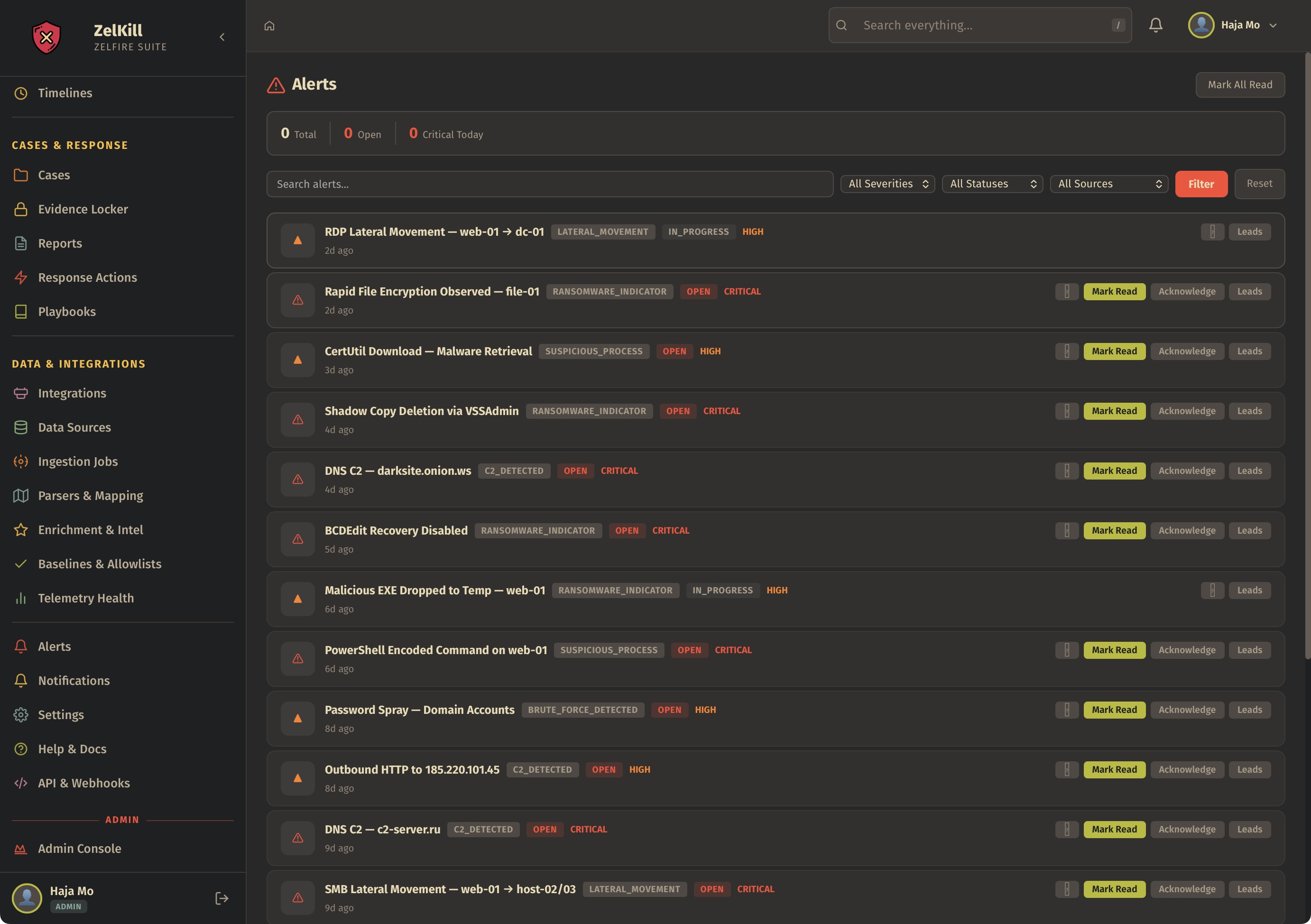
Yes. ZelKill can run scheduled hunts and generate alerts, notifications, and leads based on thresholds and anomaly rules.
Does ZelKill monitor ingestion and telemetry health?
Yes. ZelKill tracks ingestion job status, parser errors, event volume trends, and missing sources to prevent blind hunting.
How does ZelKill enforce data separation per user?
All tenant data is stored with user_id and every query is scoped accordingly. Each user sees only their own events, hunts, cases, evidence, reports, integrations, and AI history.
Does ZelKill support RBAC roles?
Yes. Roles like Admin, Hunter, Analyst, Auditor, and Read-only control access to exports, actions, configuration, and sensitive features.
Does ZelKill support 2FA?
Yes. Users can enable TOTP-based 2FA and store backup codes securely.
How are secrets protected?
Integration tokens, webhook secrets, and AI keys are stored encrypted at rest and never shown in plain text after saving. Changes are recorded in the audit log.
Can ZelKill ingest offline incident bundles after an attack?
Yes. Users can upload ZIP/GZ incident bundles (web logs, auth logs, firewall/proxy logs, EVTX exports). ZelKill parses, normalizes, and builds investigations from them.
Can I export hunt results?
Yes. Hunt results can be exported as CSV/JSON, added to Evidence Locker, bundled into evidence packs, or converted into branded reports with integrity hashes.
Can ZelKill automatically create leads from hunts?
Yes. Hunts can include thresholds (results > X, severity >= Y) that automatically create leads with evidence attached.
Who is ZelKill licensed to?
Rocheston ZelKill is licensed exclusively to RCCE students as part of the Rocheston advanced cybersecurity training ecosystem.
Who built Rocheston ZelKill?
Rocheston ZelKill is built by Haja Mo and is part of the Rocheston Zelfire Suite.
Why is ZelKill considered faster than typical threat hunting tools?
Because it removes friction: universal ingestion, visual hunt building, prebuilt hunt packs, instant pivots, correlation, clean AI outputs, evidence integrity, and integrated orchestration all in one flow.
What makes ZelKill different from typical SIEM dashboards?
ZelKill focuses on investigation speed and defensible conclusions: correlation, narratives, evidence packs, MITRE drilldowns, ransomware war room, and safe orchestration—without drowning users in disconnected dashboards.
Does ZelKill support compliance-ready evidence workflows?
Yes. Evidence hashing, chain-of-custody logging, branded reports with hashes, and export bundles are designed for defensible documentation and audit readiness.
Can ZelKill recommend containment actions based on findings?
Yes. ZelKill can recommend blocks, isolation, account actions, and playbooks, always tied to evidence and requiring confirmation before execution.
How do integration wizards work?
Users select an integration box, choose a connection method (API/webhook/syslog/SFTP/bucket/upload), test connection, map fields if needed, schedule ingestion, and run now to populate events.
What makes ZelKill “enterprise-grade” for integrations?
A full catalog of connectors, multiple ingestion methods, mapping templates, job scheduling, telemetry health monitoring, and the ability to ingest from SIEMs and raw infrastructure logs without lock-in.
Can ZelKill work with Zelfire actions even if external systems are used for logs?
Yes. Even if logs come from external SIEMs or systems, ZelKill can still orchestrate containment through Zelfire products (ZelWall, ZelXDR, ZelAccess, ZelSOAR) using the Action Broker.
Does ZelKill support executive-ready output?
Yes. Executive templates, executive brief fracture mode, branded report shells, and clean narratives make ZelKill output board-ready while still linking to technical evidence.
What is the simplest way to start using ZelKill?
Connect 3 sources first: Apache/IIS web logs, Windows auth logs, and firewall/DNS logs. Then run Hunt Packs, enable scheduled hunts, and use AINA to guide pivots and produce evidence-linked reports.

Part of a connected security ecosystem.

Explore how AINA connects intelligence across Zelfire, and find the products that complement your workflow.

Meet AINA
Detect & respond

ZelMap

Attack surface intelligence

Discover assets, understand exposure, and prioritize the risks that need attention.

Detect & respond

ZelXDR

Detection & response

Correlate endpoint, network, identity, and cloud signals into a connected incident view.

LET’S CONNECT YOUR DEFENSE

Put Zelfire to work.

Explore the products, see the workflows, and talk to Rocheston about your security environment.

Request a demo

Product screenshot