ROCHESTONZelfire.

IDENTITY & ACCESS

ZelAccess

One identity. Clear control.

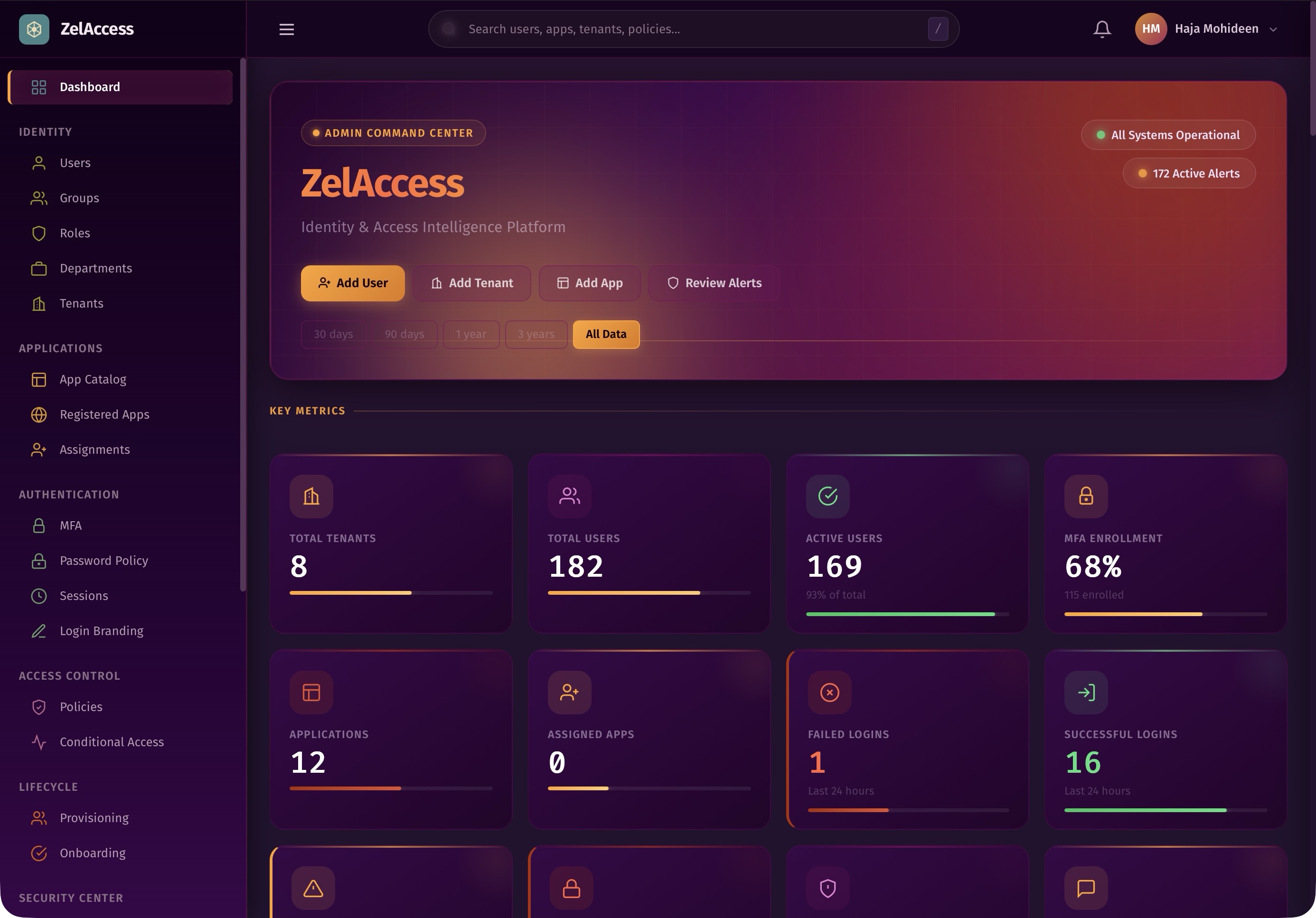
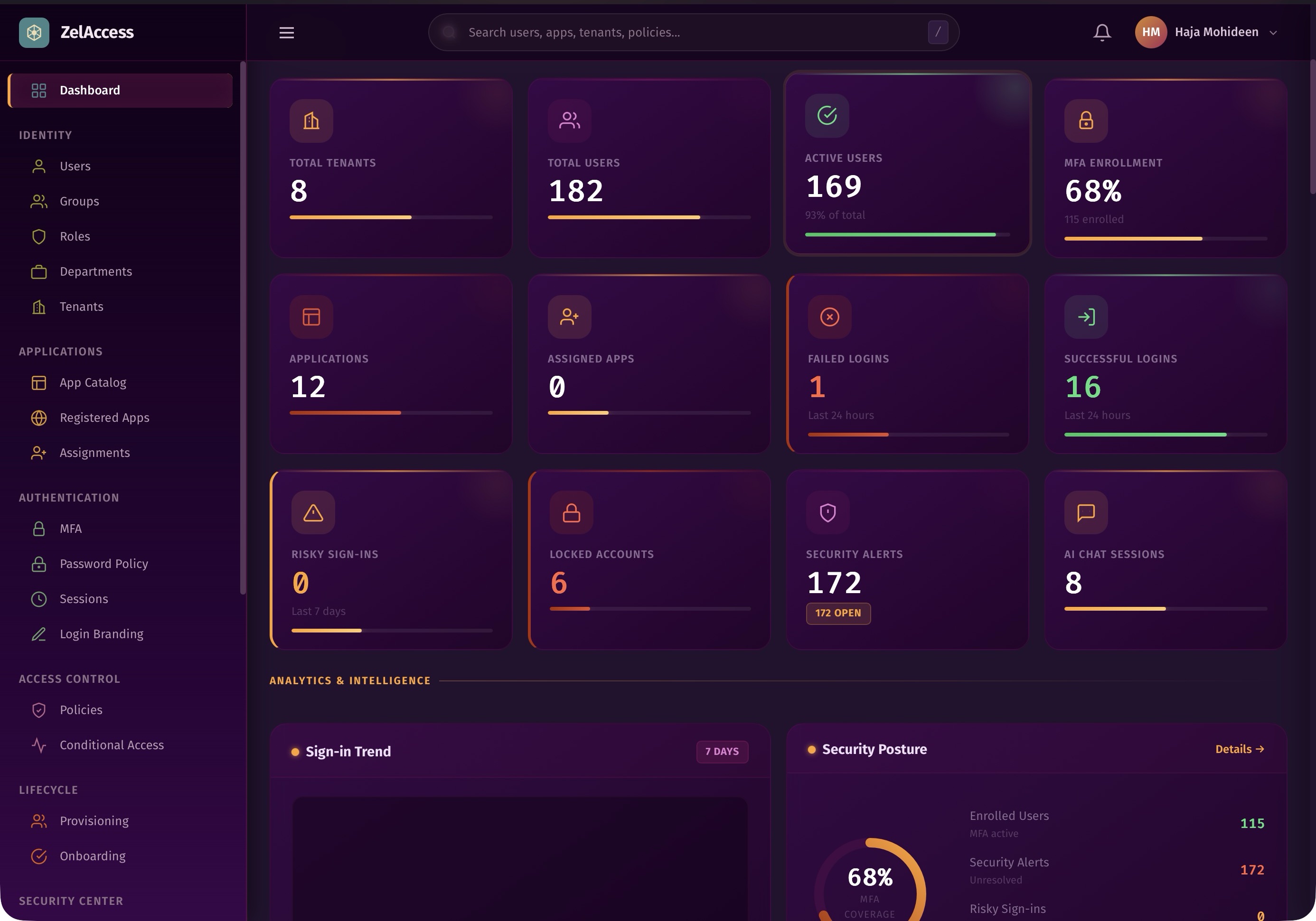
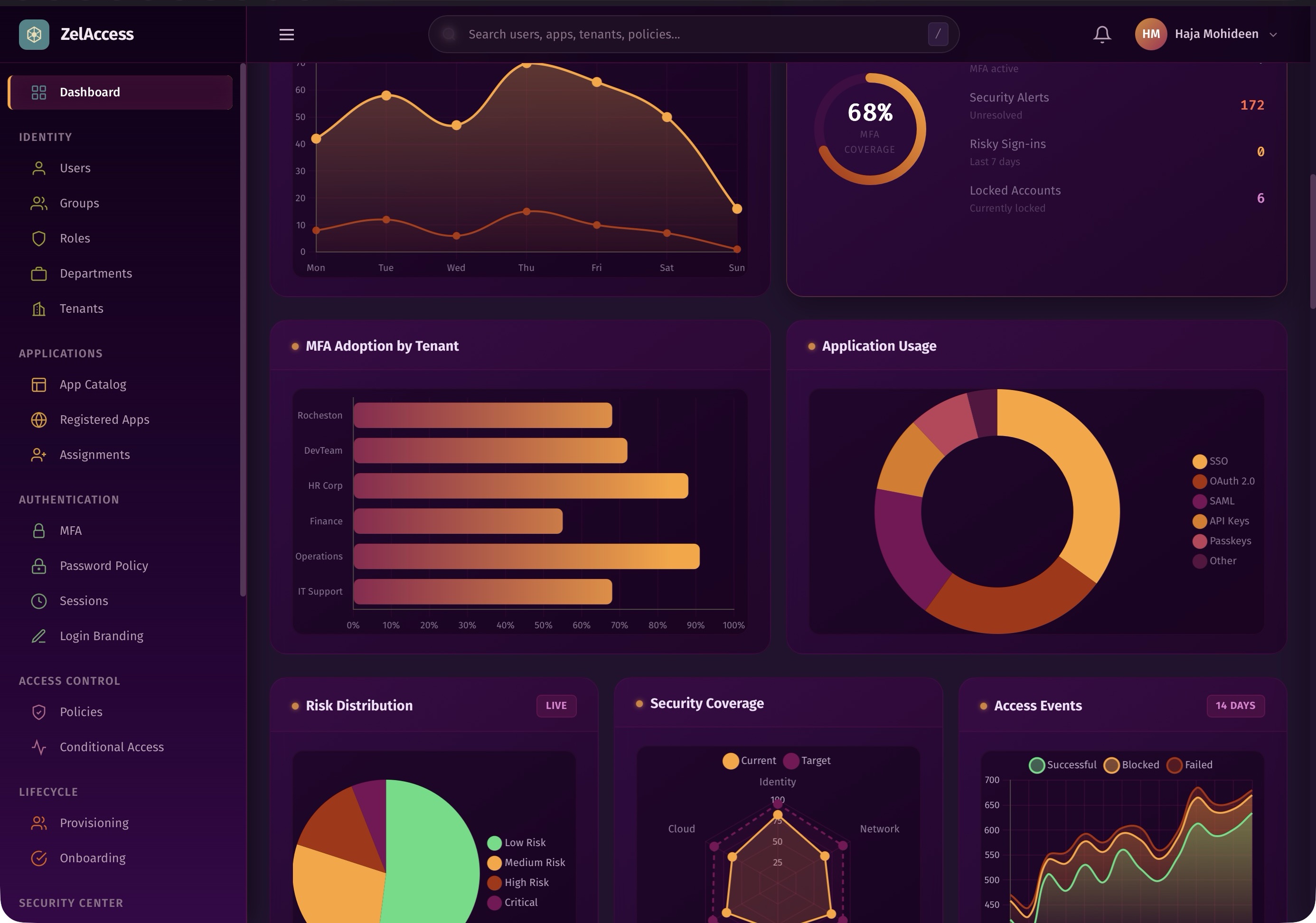
ZelAccess centralizes authentication and access control with single sign-on, role management, and policy enforcement. AINA monitors identity behavior and highlights risky access patterns to support least-privilege decisions across the ecosystem.

ZelAccess

Identity & access

ROCHESTON ZELFIRE ECOSYSTEM

BUILT FOR YOUR WORKFLOW

What you can do.

Single sign-on

Bring authentication into a centralized identity platform.

Roles and policies

Manage access permissions and apply least-privilege controls.

Identity intelligence

Review behavior and risky access patterns with AINA context.

THE COMPLETE PRODUCT GUIDE

Explore ZelAccess.

Get to know the capabilities, workflows, and intelligence behind the product.

01

About ZelAccess

Rocheston ZelAccess centralizes authentication, access control, lifecycle automation, and identity security across the full Zelfire suite.

ZelAccess is the identity control plane of the Zelfire suite, delivering centralized SSO, MFA, access governance, lifecycle automation, provisioning, session control, and identity threat visibility across every Zelfire product.

Why ZelAccess?

  • Centralized identity authority
  • Adaptive, policy‑driven access
  • Lifecycle orchestration & provisioning
  • Identity risk visibility with AINA
02

Features

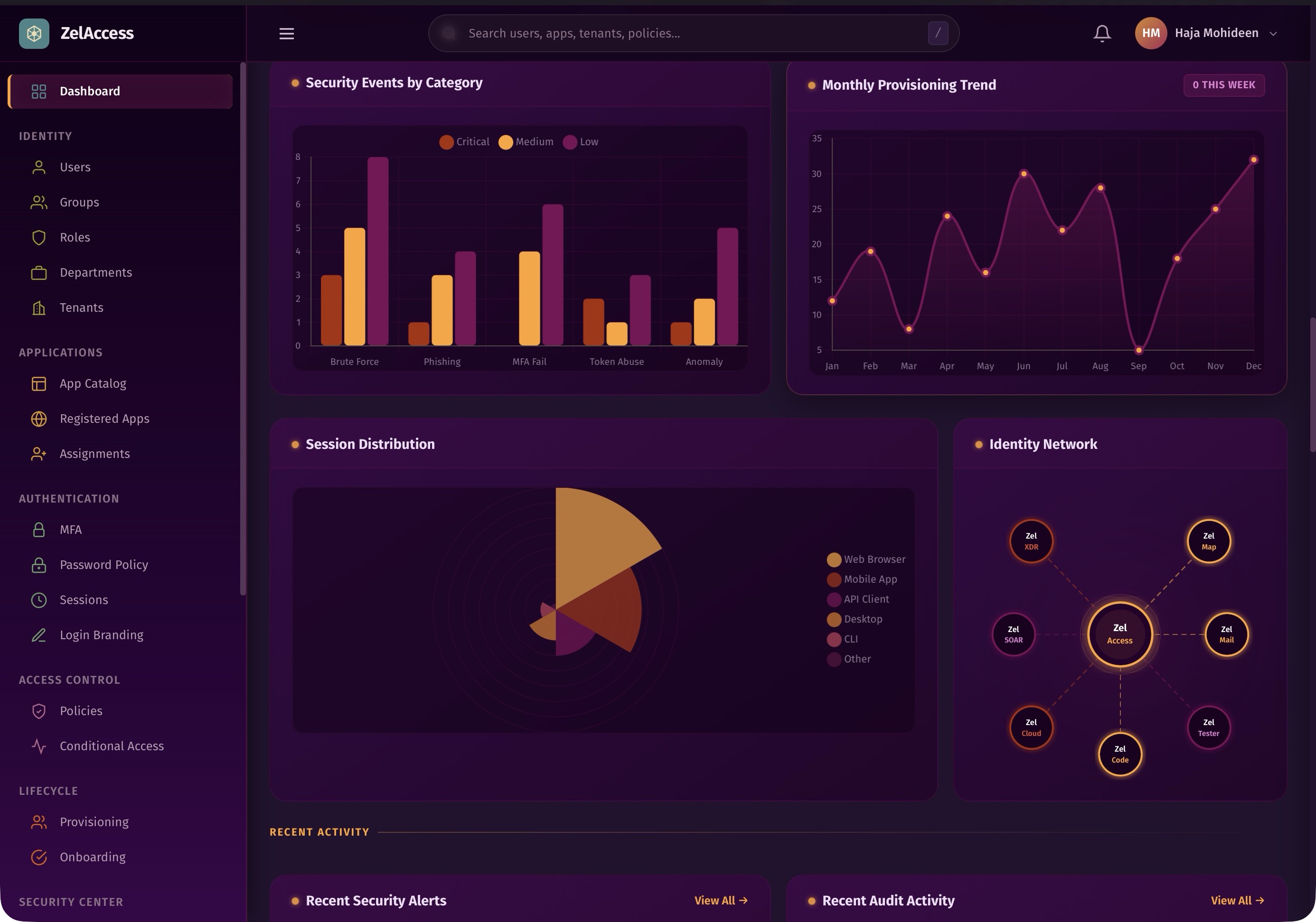
ZelAccess is the identity and access foundation of the Zelfire suite. It unifies SSO, MFA, lifecycle automation, policy enforcement, provisioning, session control, and identity security into one operational platform.

Centralized SSO & MFA

Single sign‑on across Zelfire apps with strong multi‑factor enforcement and adaptive step‑up controls.

Lifecycle Orchestration

Onboarding, role change, and offboarding workflows with assignments, policy application, and provisioning.

Access Policies

Role‑ and attribute‑based policy engine with conditional access for risk‑aware, real‑time decisions.

Sessions & Risk

Live session visibility, risky sign‑in detection, anomaly monitoring, and rapid response actions.

Directory & Provisioning

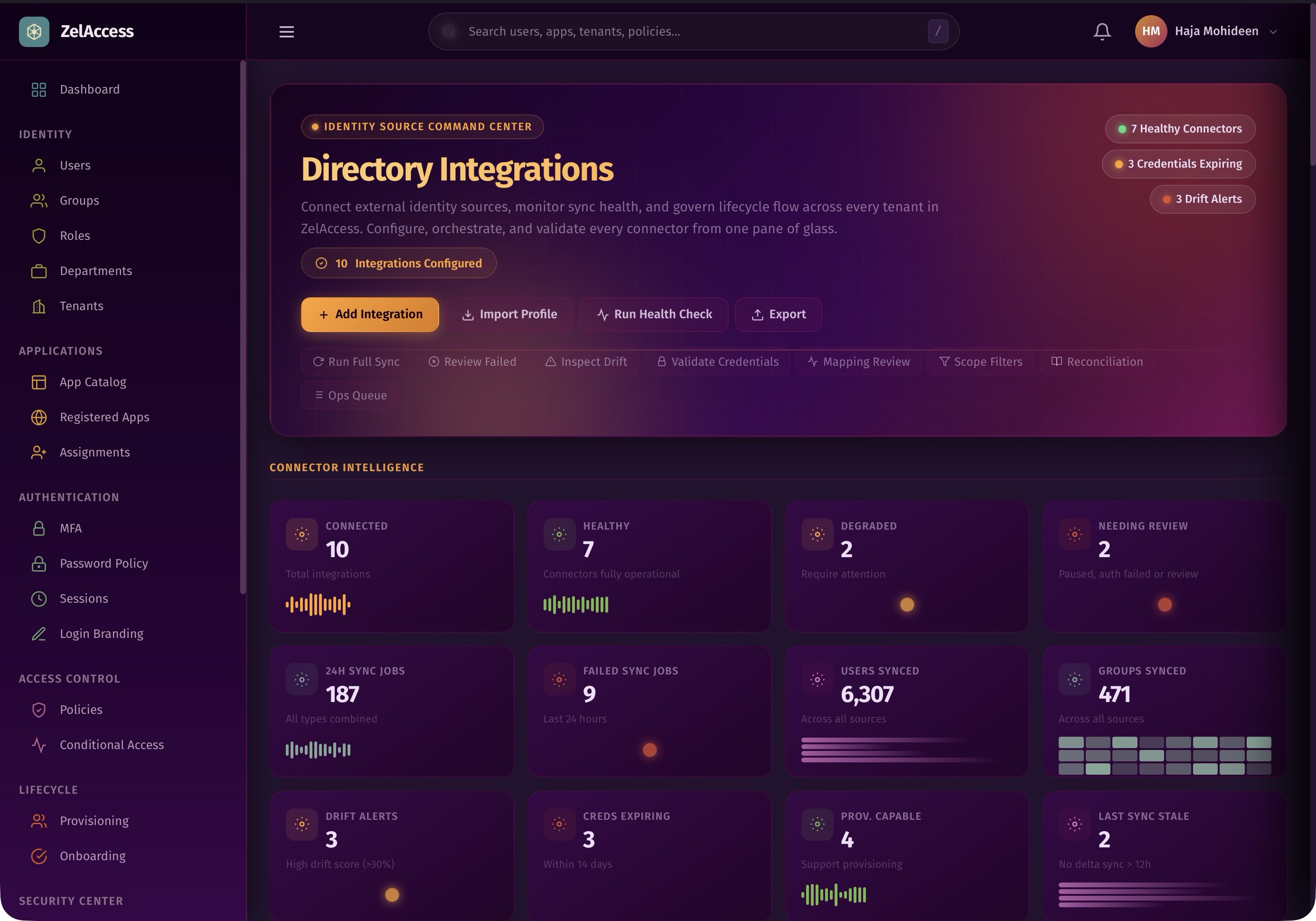
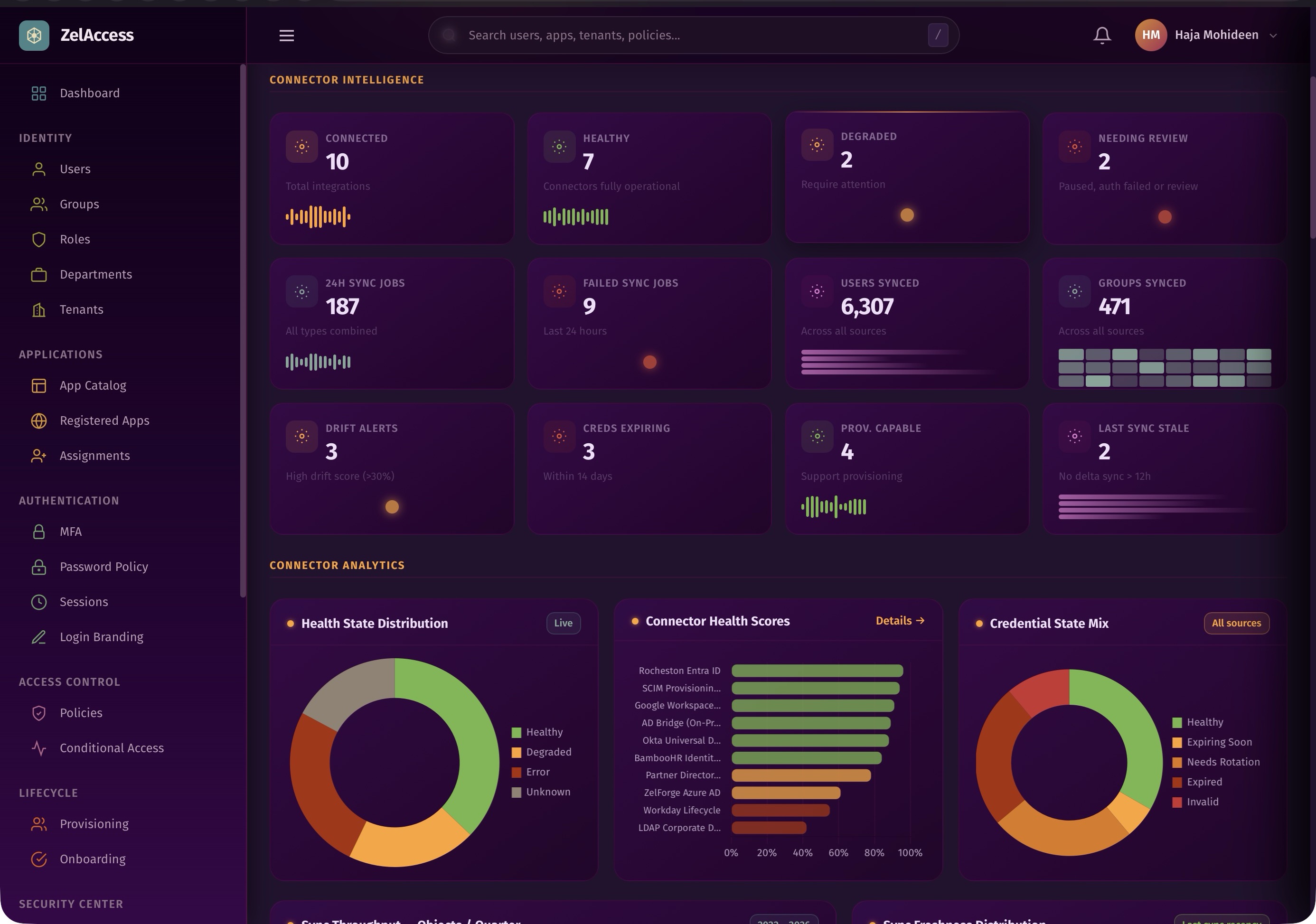
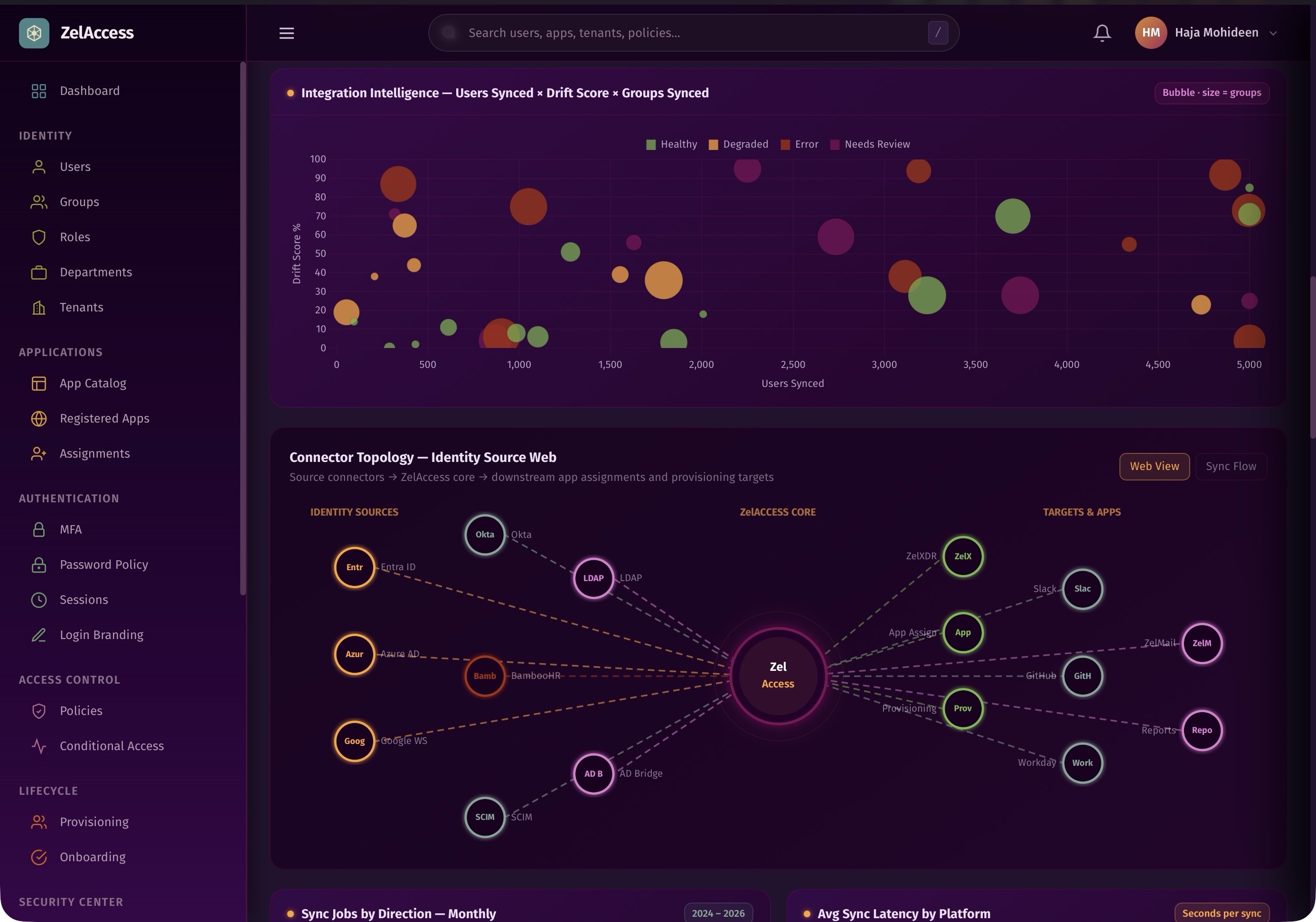
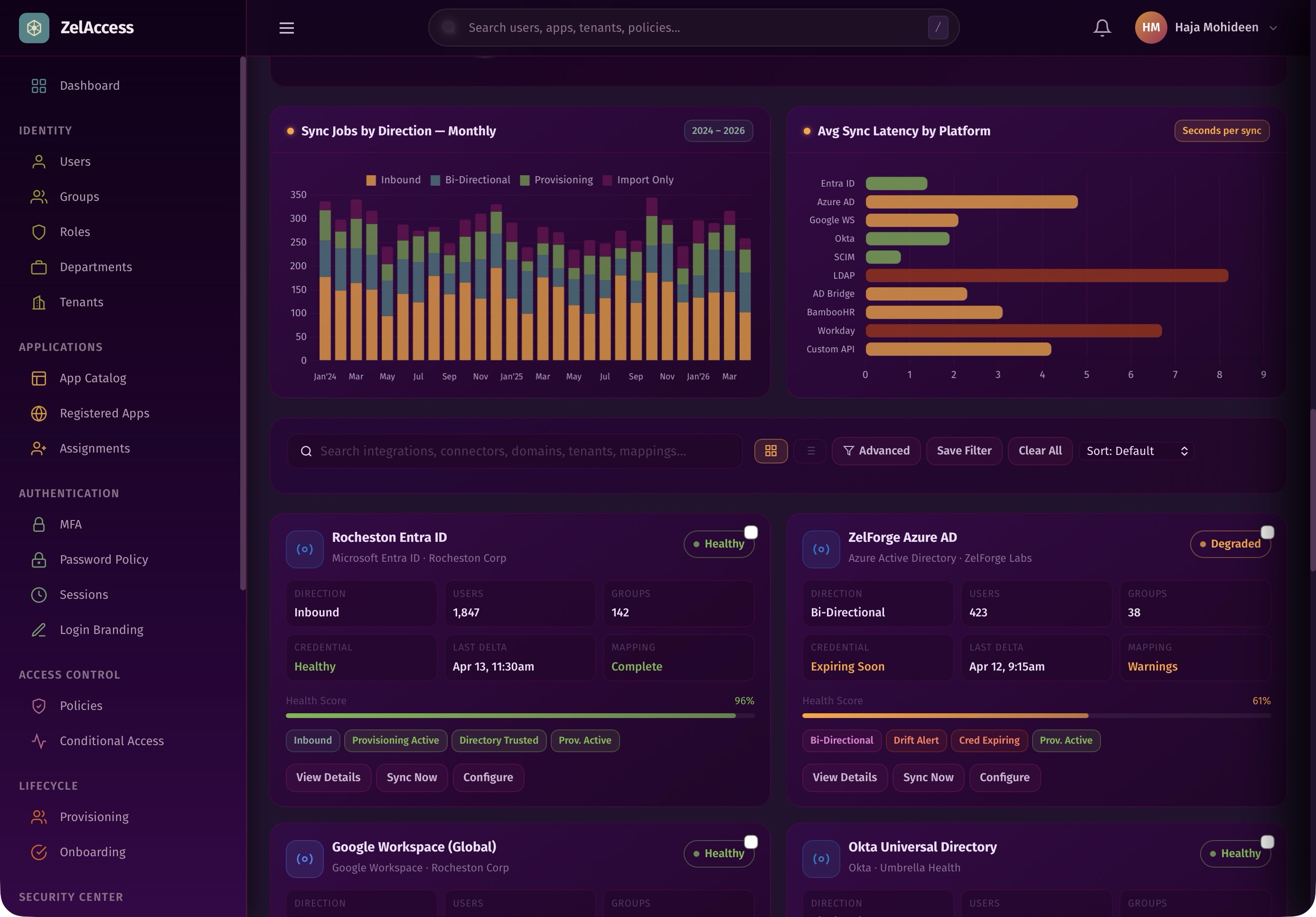
SCIM and directory integrations with health monitoring, drift analysis, and remediation workflows.

AINA Intelligence

AI‑assisted insights to explain policies, compare tenants, summarize risk, and recommend improvements.

UNDER THE HOOD

Technical specifications.

Architecture, integrations, security controls, and operational details for ZelAccess.

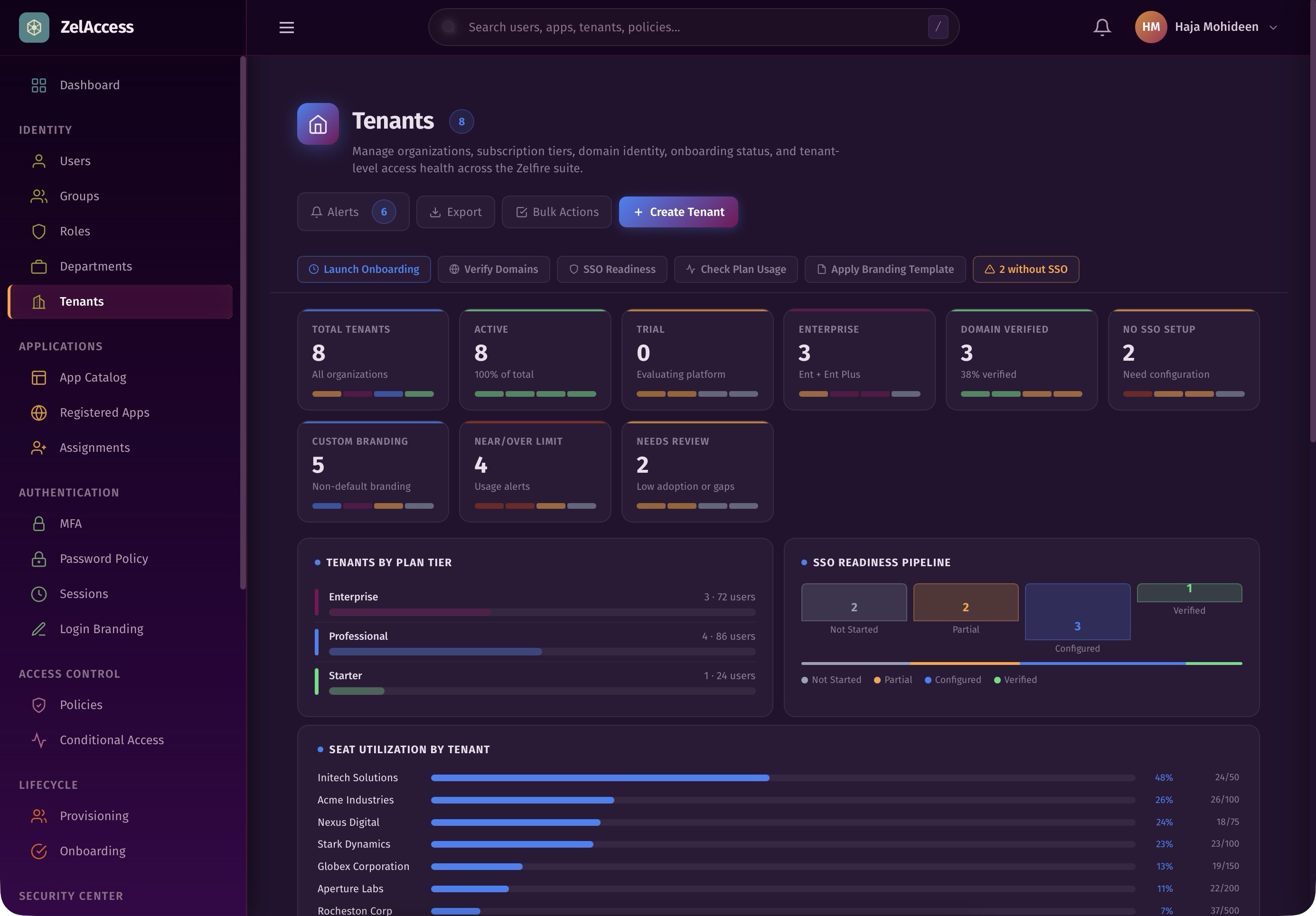
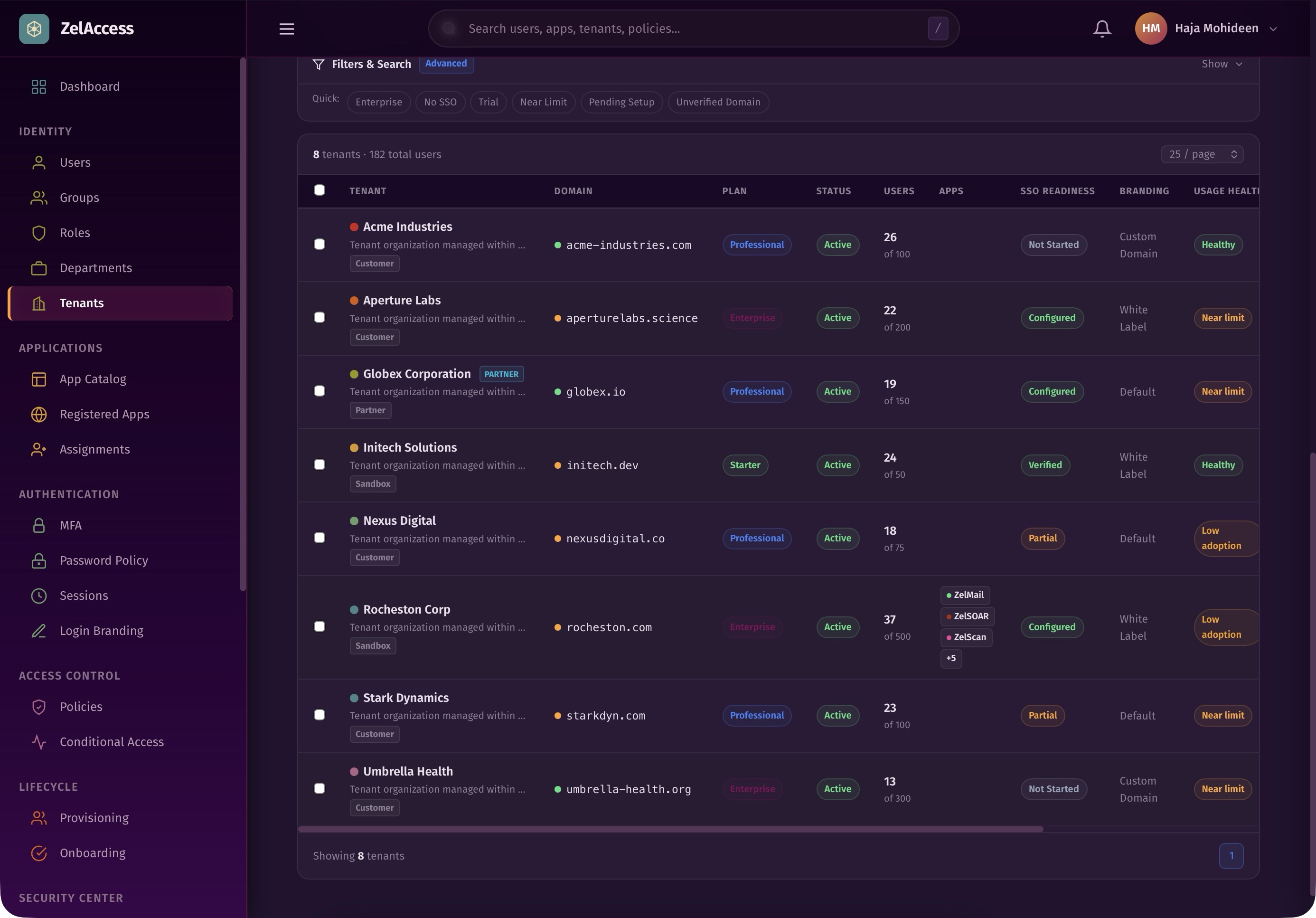
Identity and tenant architecture
  • Multi-tenant identity platform with strict tenant isolation
  • Global super admin, tenant admin, and self-service controls
  • Central directory, tenant-aware visibility, branding and settings
  • Domain/login readiness, cross-tenant analytics, reusable templates
Authentication and SSO
  • Central IdP with OIDC, OAuth2, SAML and SCIM provisioning
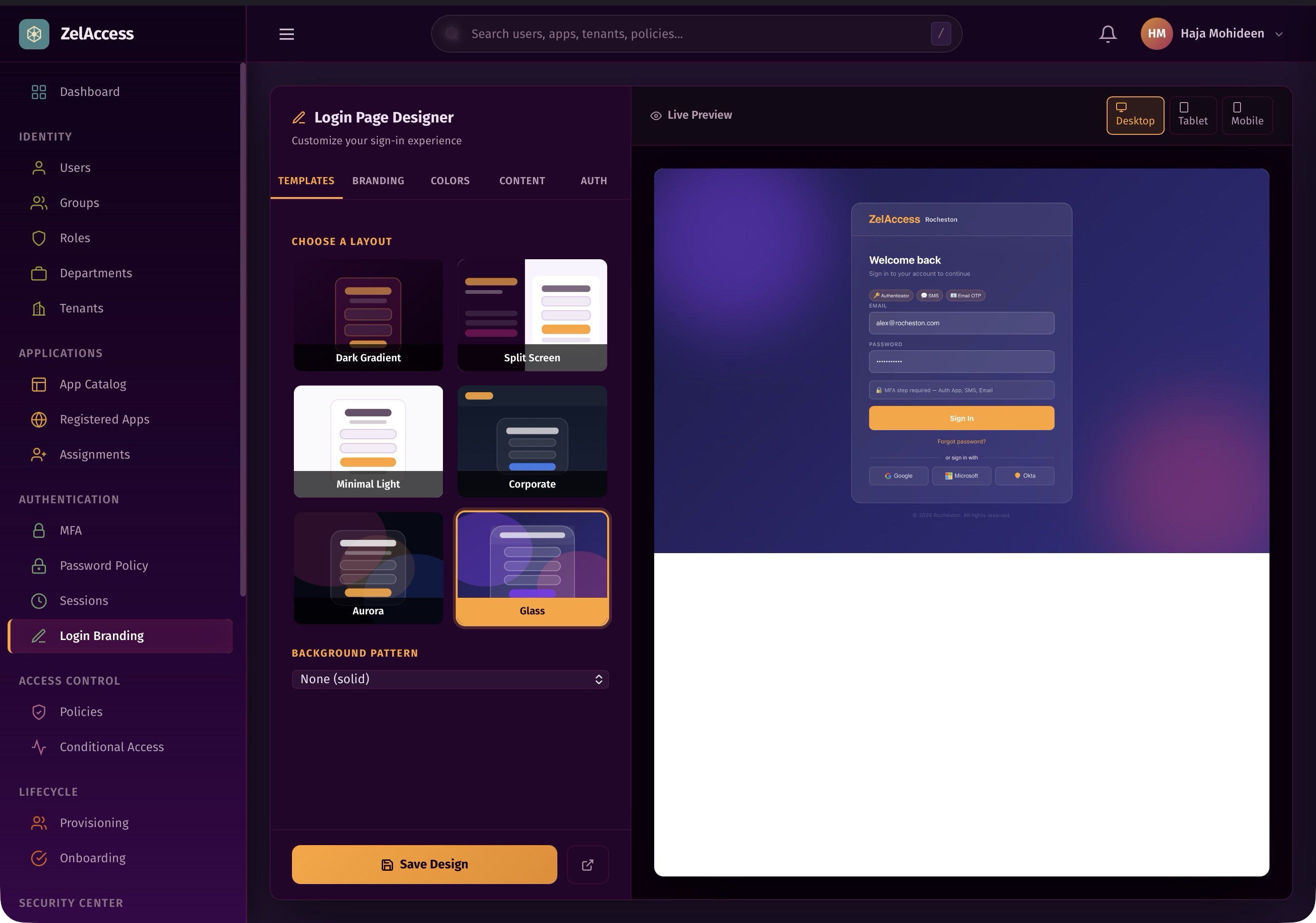
  • Universal/hosted sign-in and branded experiences
  • Auth code + PKCE, single/global logout, session reuse
  • Token issuance/validation/revocation, refresh control, silent sign-in
User and directory management
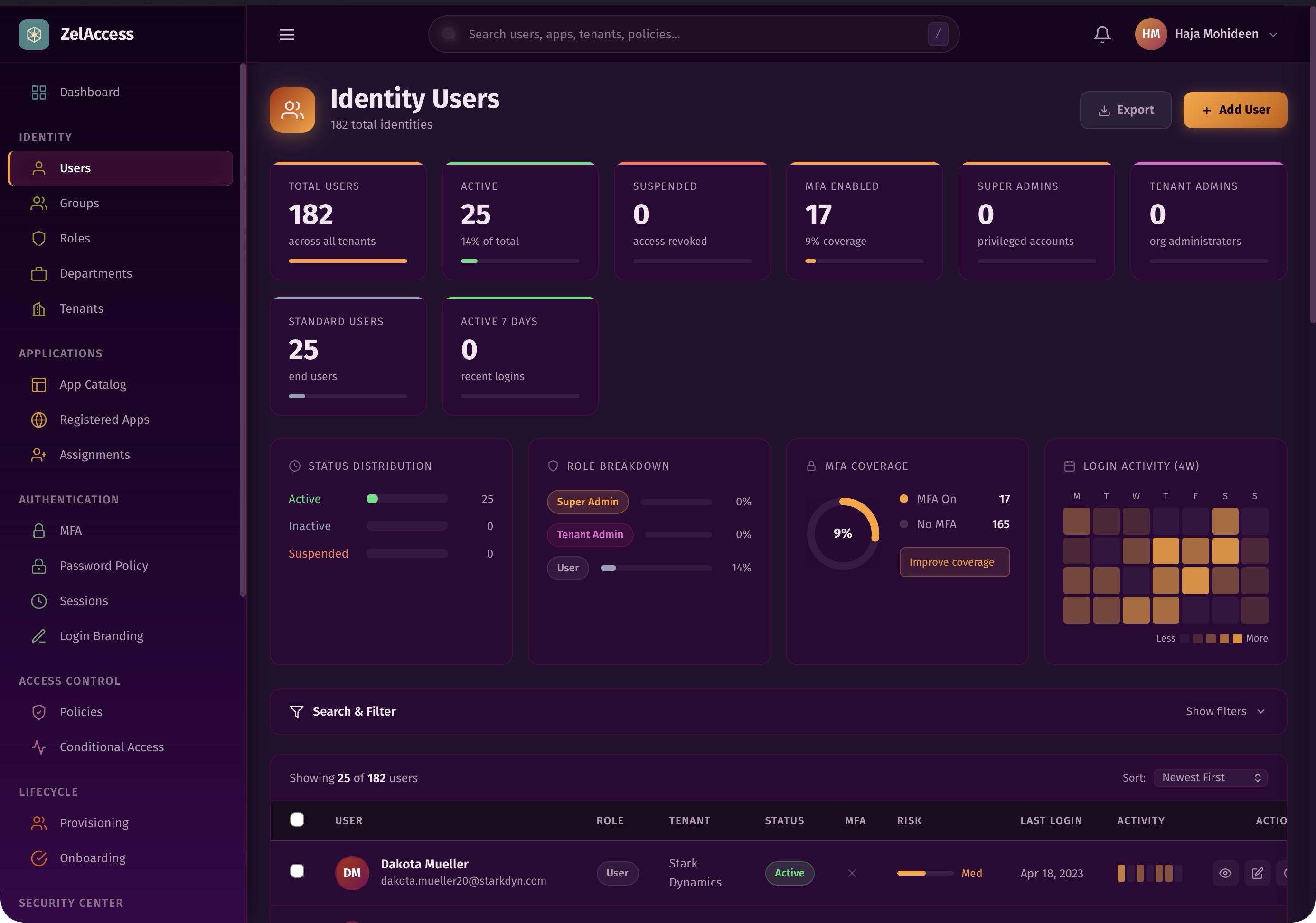
  • User lifecycle: invite, activate, suspend, reset
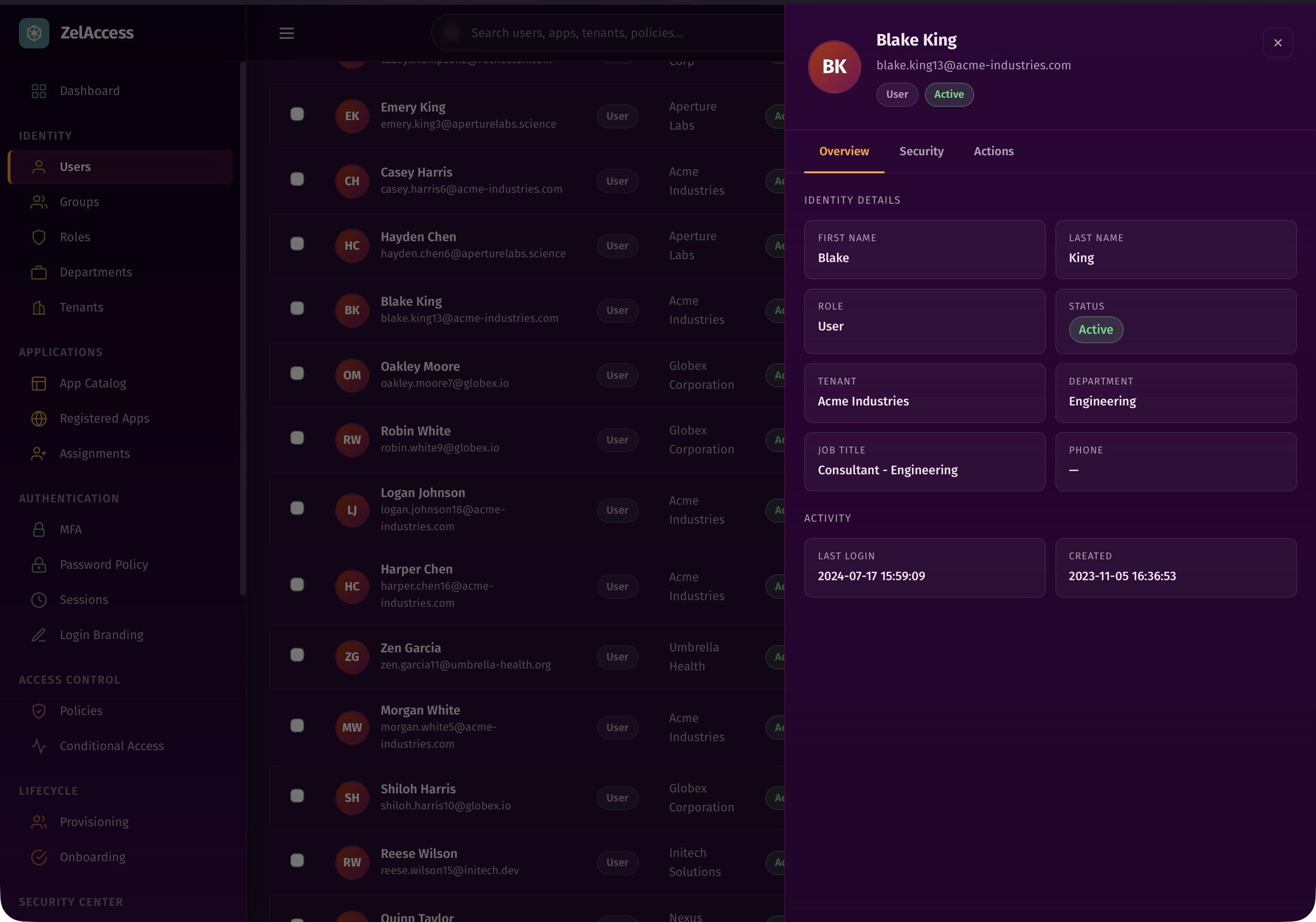
  • Roles, groups, app assignments; session and sign-in history
  • Guests and service accounts; dynamic/static attributes
  • Lifecycle state and comprehensive audit history
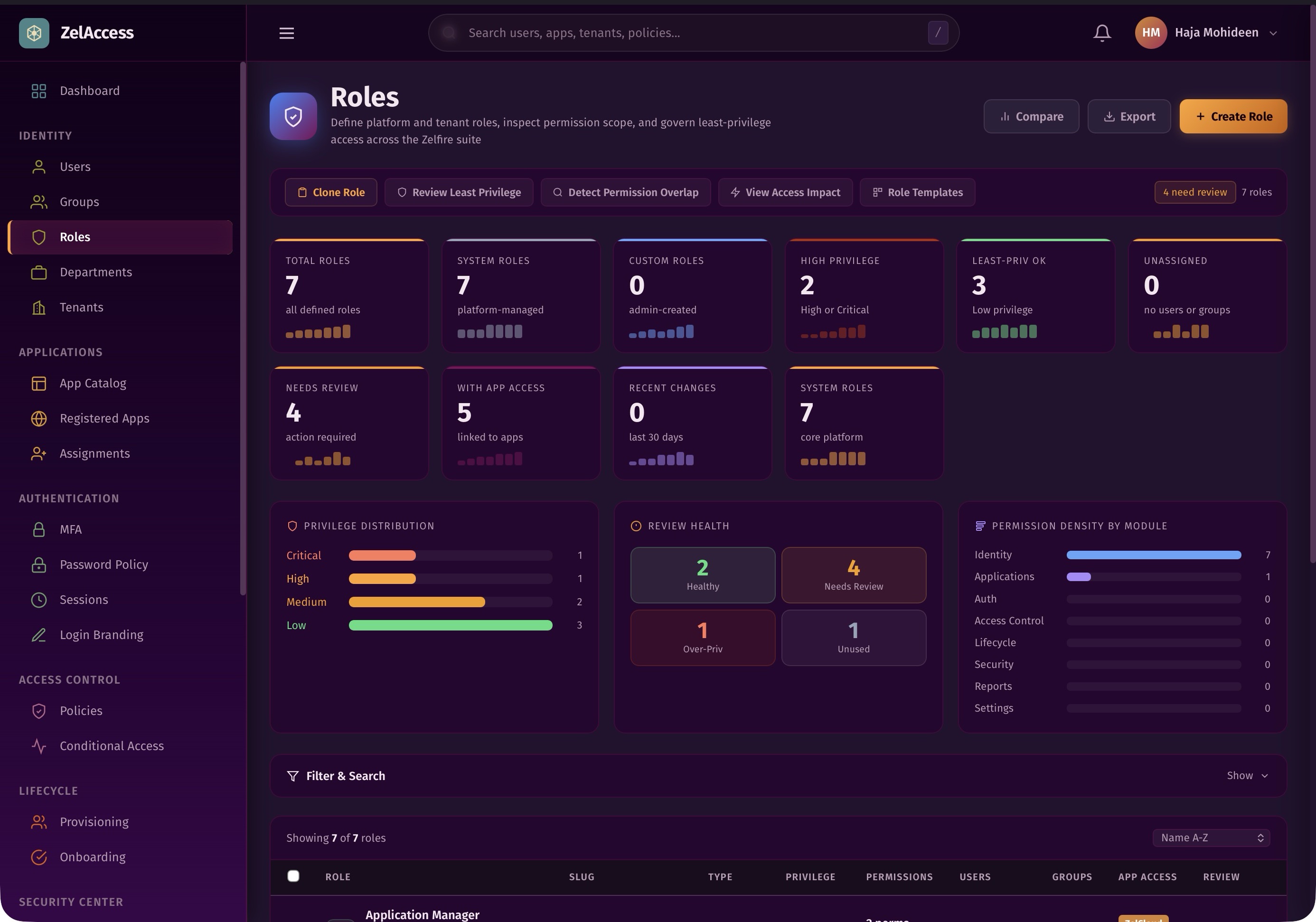
Roles and authorization
  • System/custom/tenant roles with templates and bundles
  • Fine-grained permissions, tiering, privilege scoring
  • Least-privilege reviews, high-privilege detection
  • Assignments, impact analysis, and governance states
Groups and membership
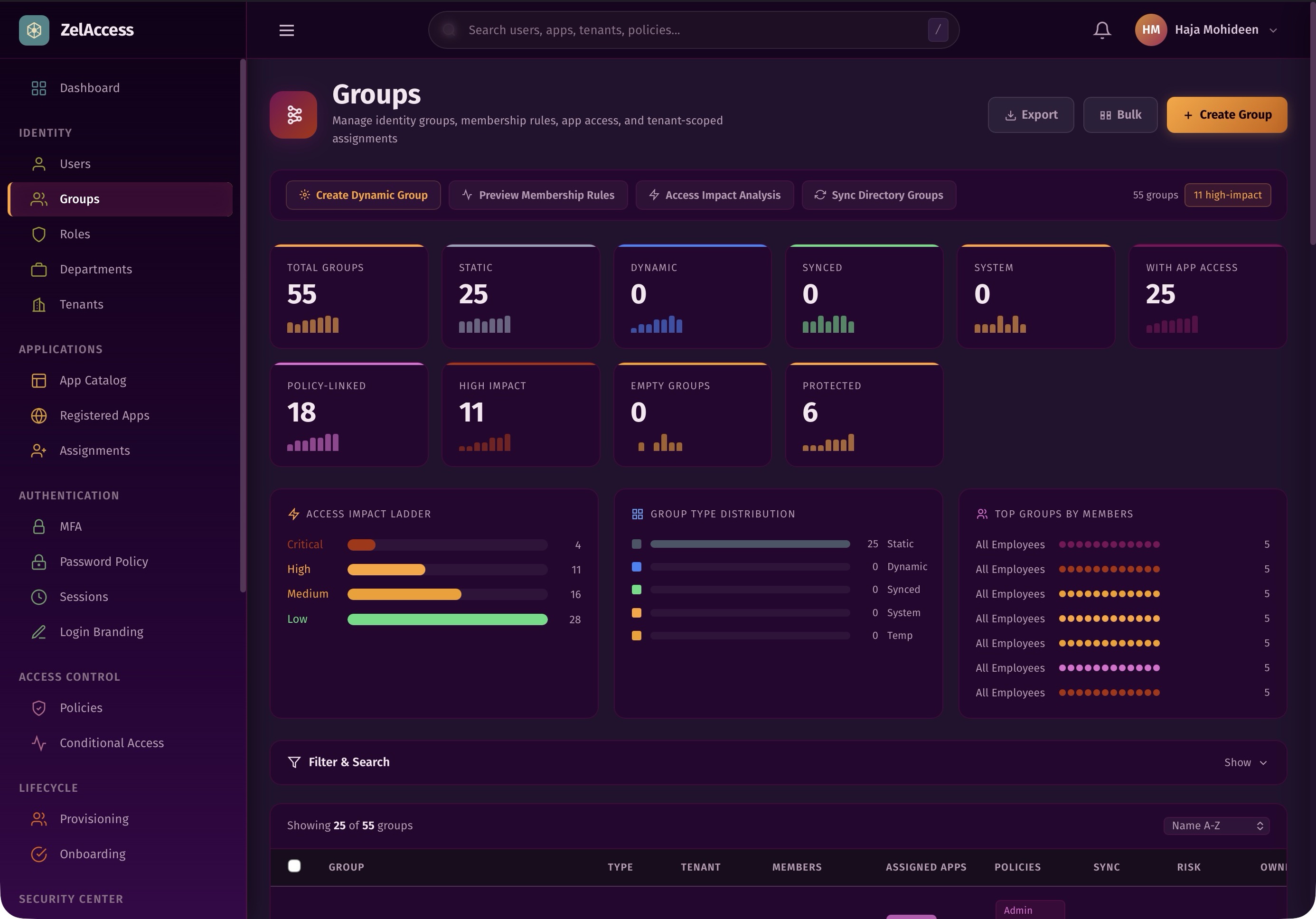
  • Static and dynamic groups with rule-based membership
  • Synced/protected groups; owners; mapping to roles/apps/policies
  • Membership preview/trends; health scoring and lifecycle
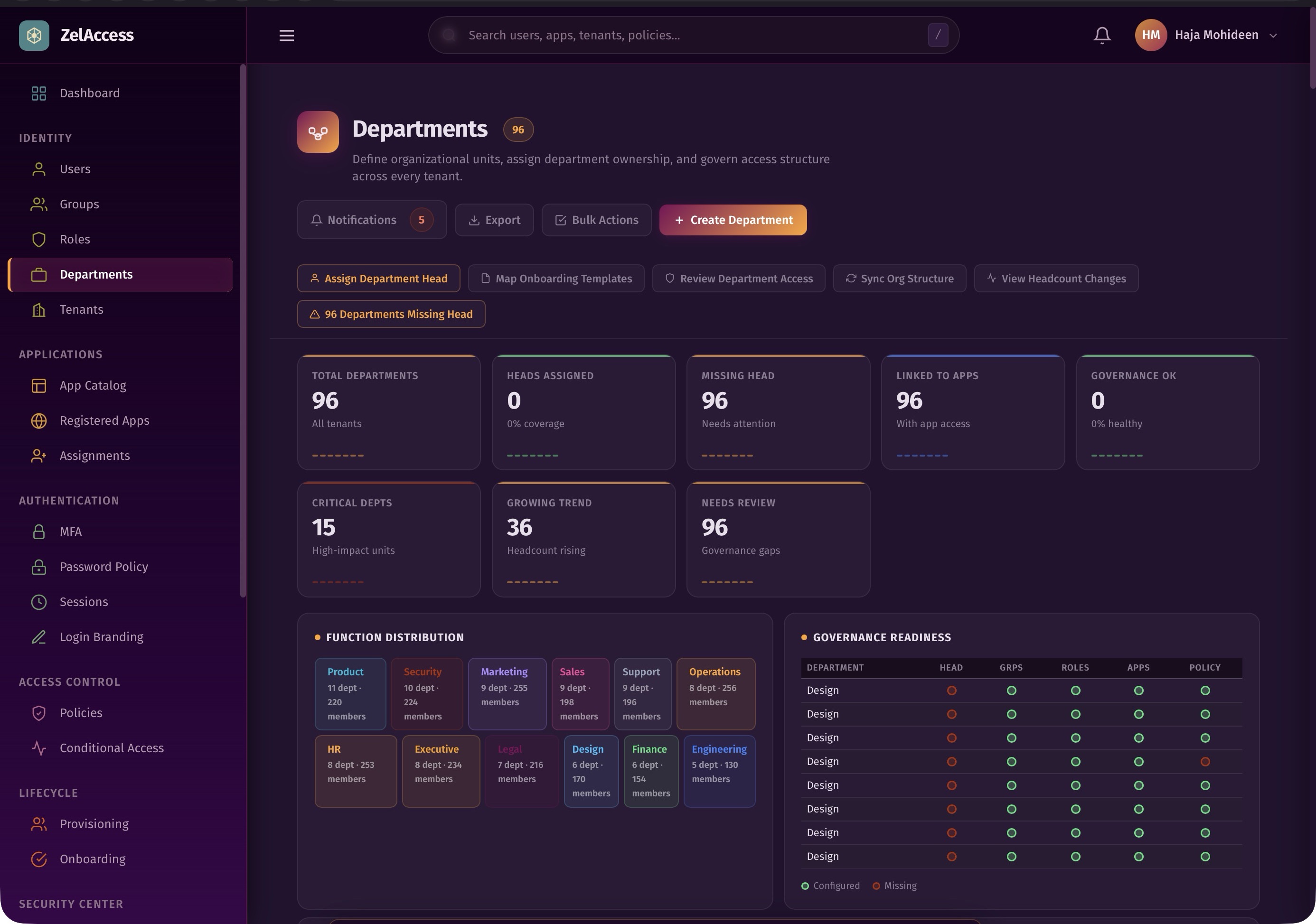
Departments and org structure
  • Directory with heads/backup approvers; templates and hierarchy
  • Department-linked groups, roles, apps, policies, lifecycle
  • Governance health, headcount, joiner/leaver, drift visibility
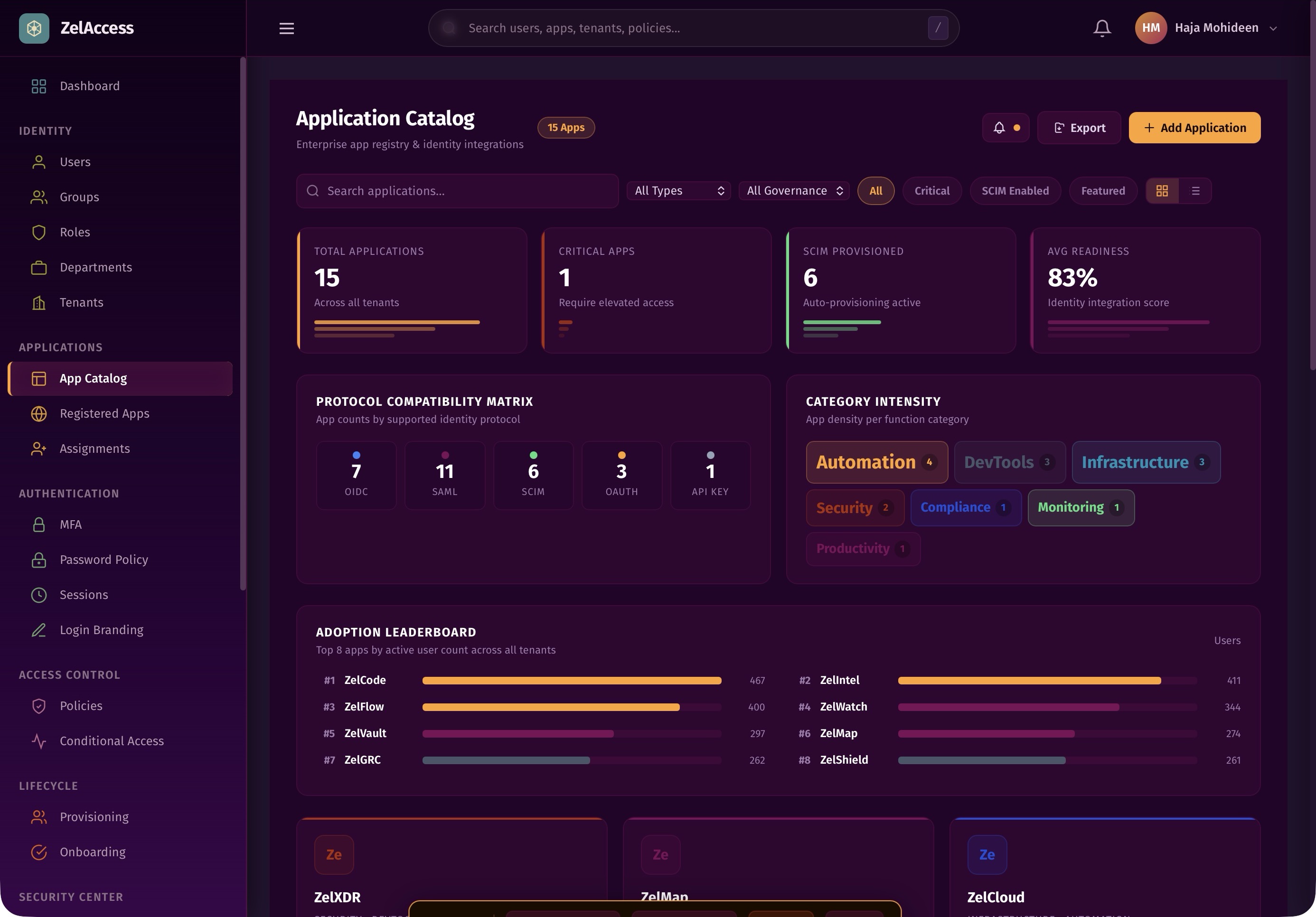
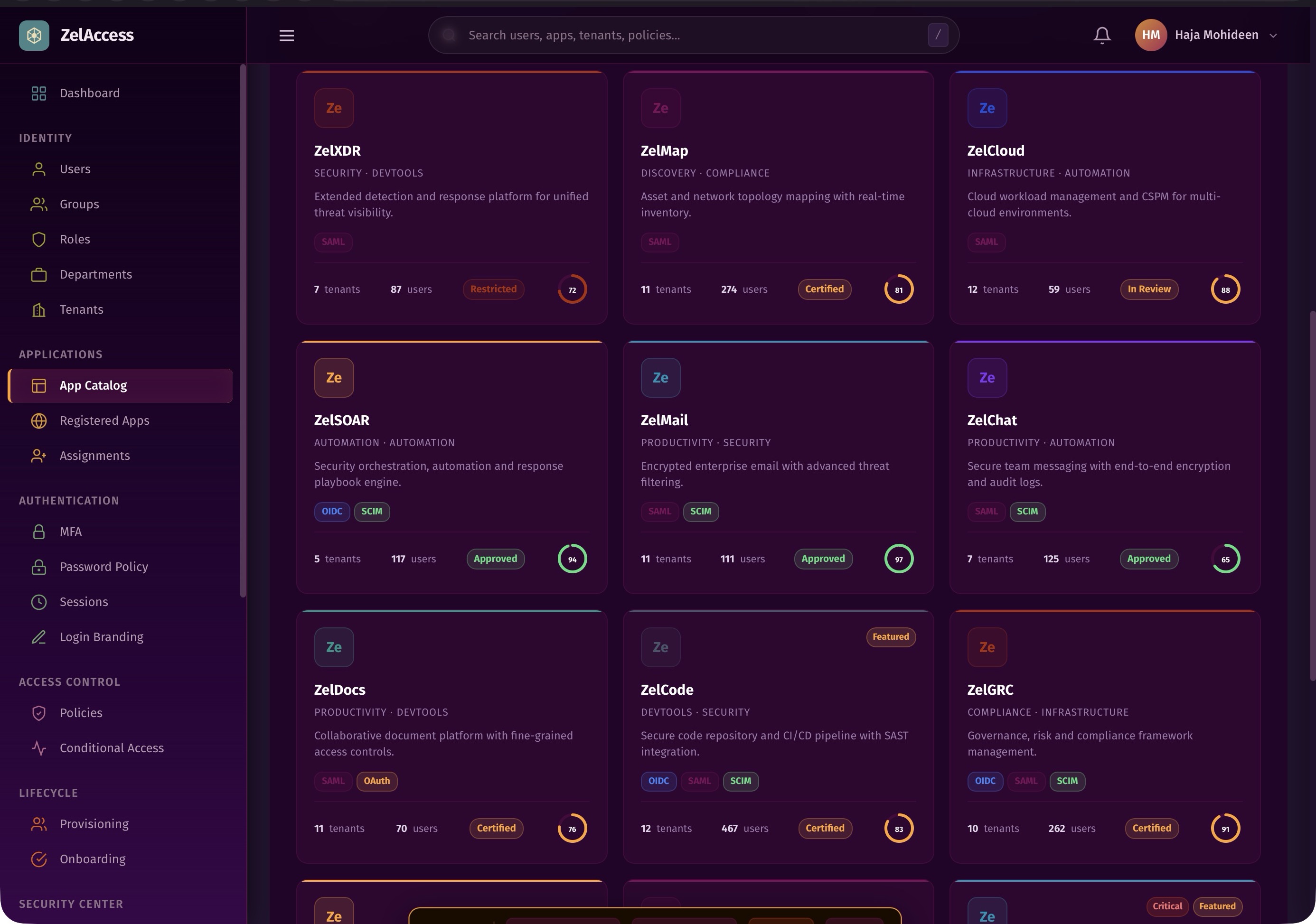
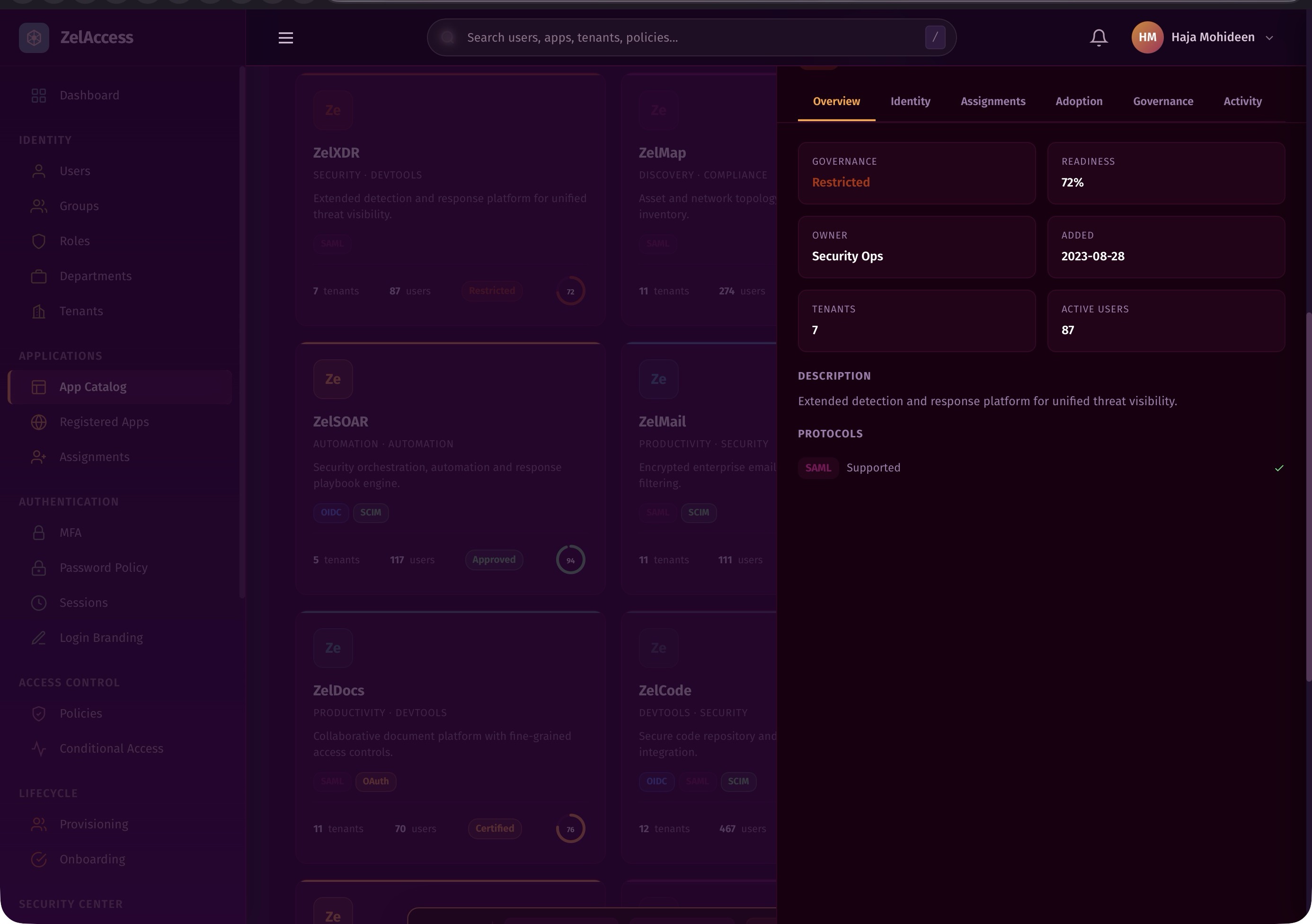
Application catalog
  • Discovery catalog and marketplace with categories/badges
  • Readiness, adoption, reach, provisioning/sync support visibility
  • Owners, governance reviews, filters, card/list, rich detail
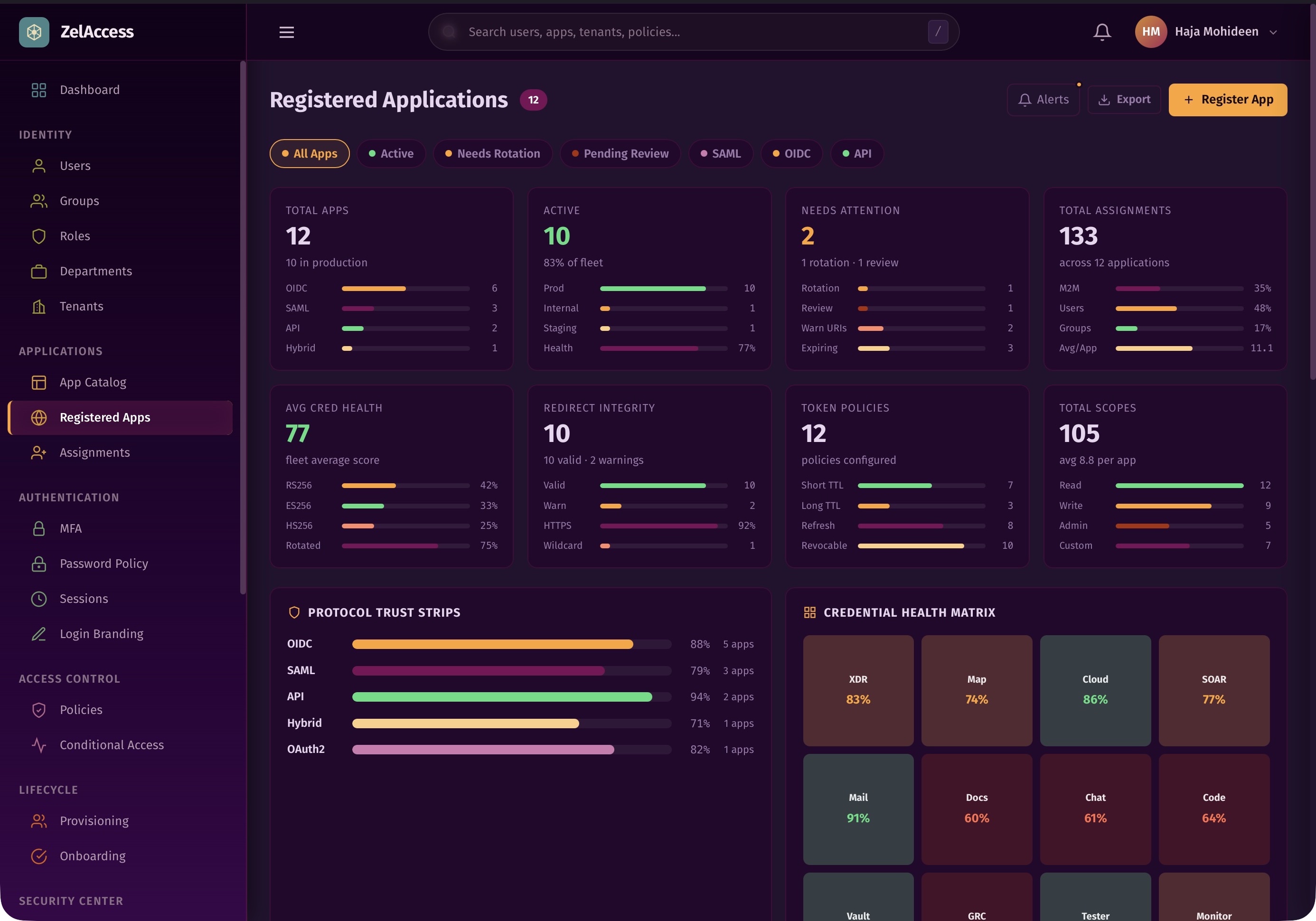
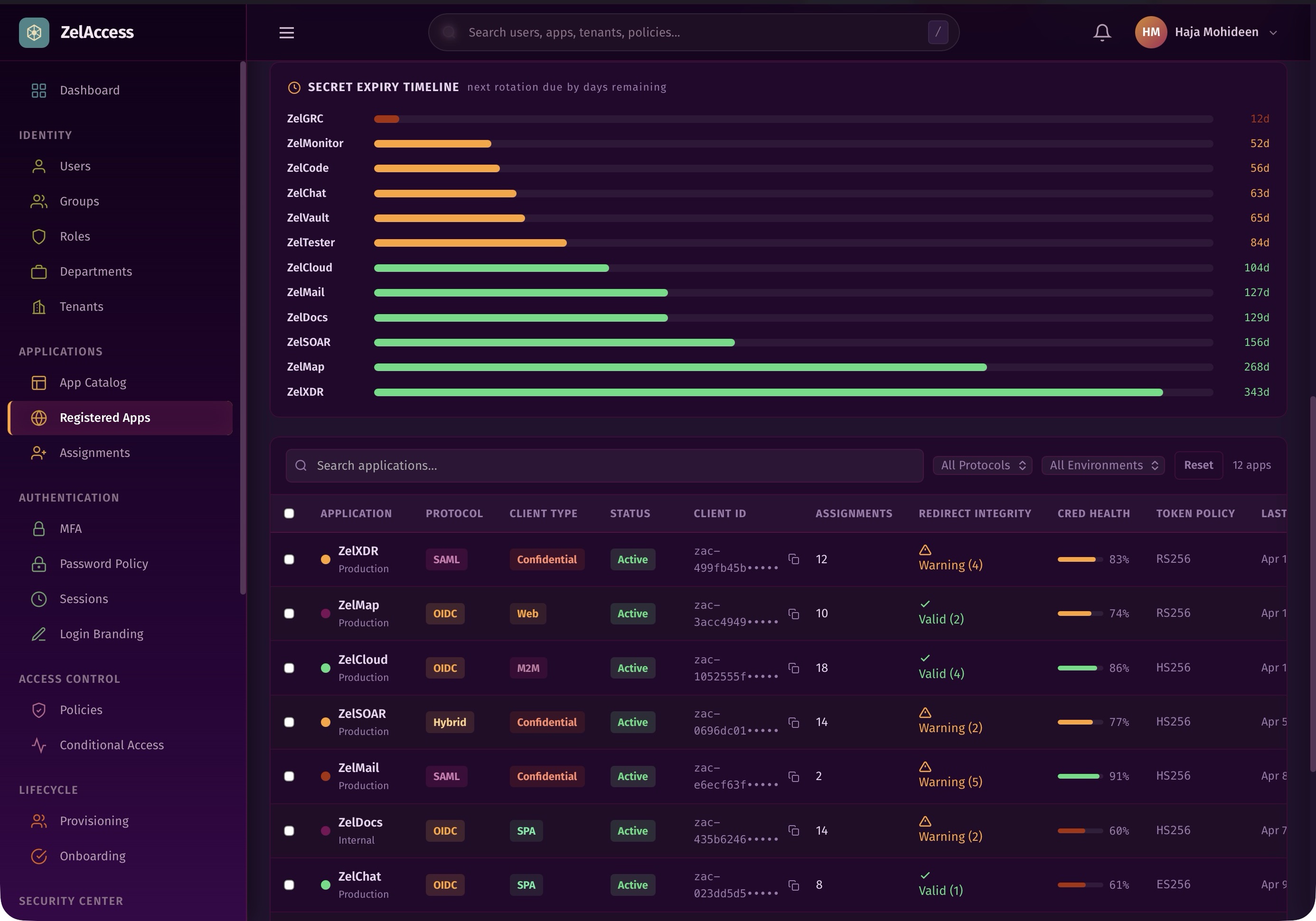
Registered applications & integrations
  • OIDC/SAML/OAuth/SCIM clients; confidential/public/M2M/SPA/native
  • Redirect/logout URIs, grants, responses, scopes, sensitive scopes
  • Secrets/certs lifecycle, token policy, PKCE, env separation
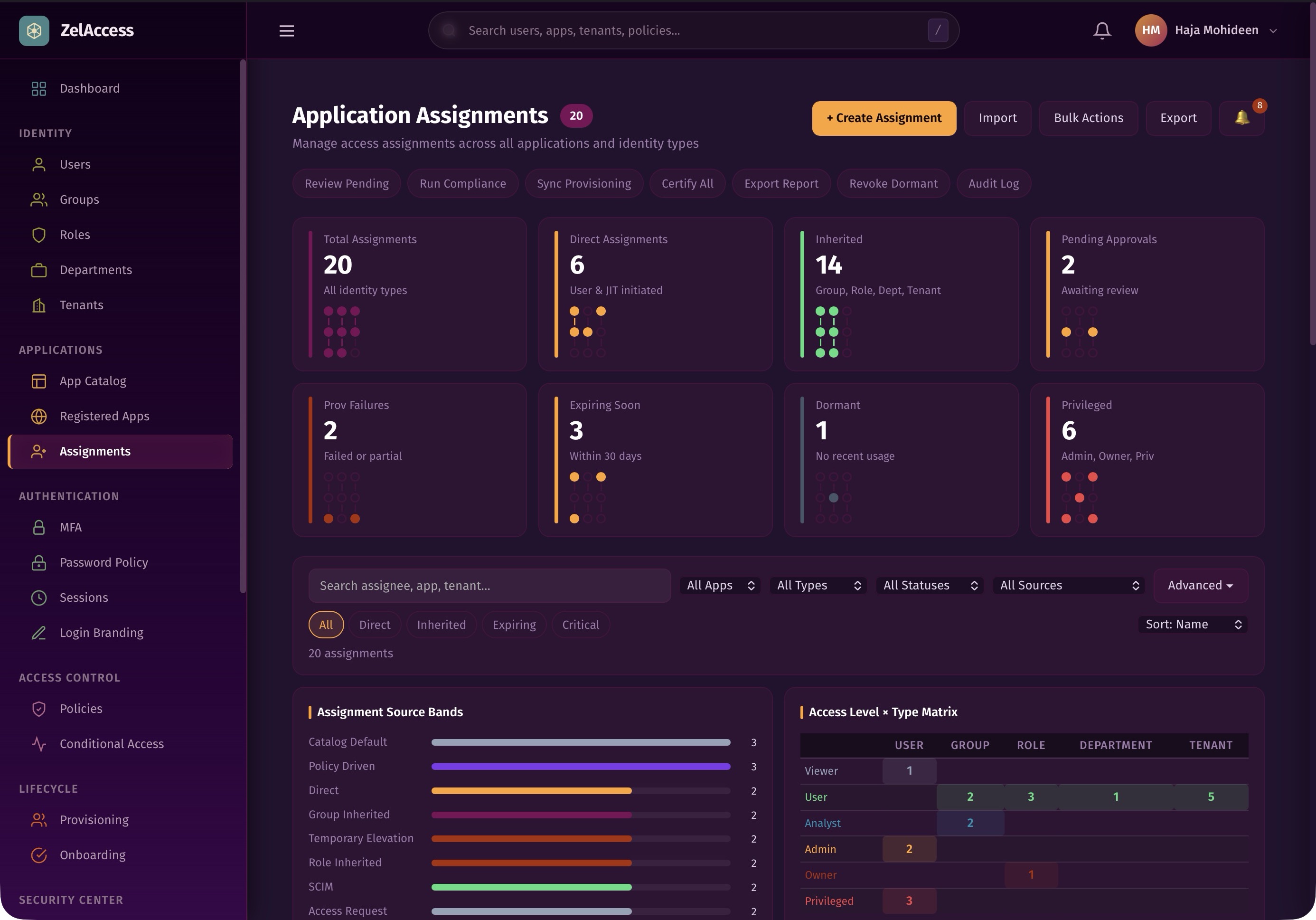
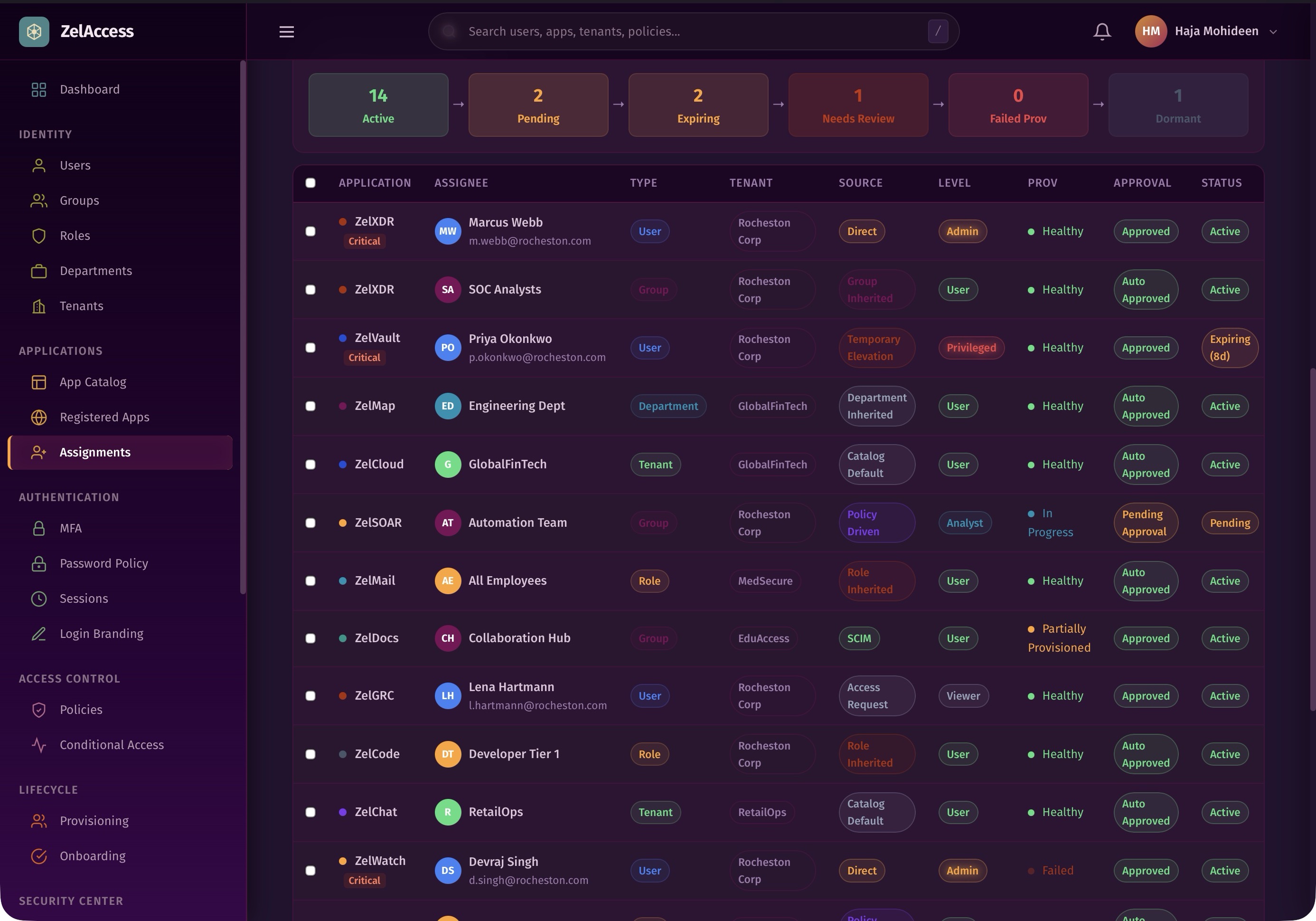
App assignments & entitlements
  • Direct/inherited/policy/SCIM/JIT/elevation-driven access
  • Approvals, levels, source visibility, provisioning/licensing impact
  • Dormant detection, expiry, path explanation, audit and reviews
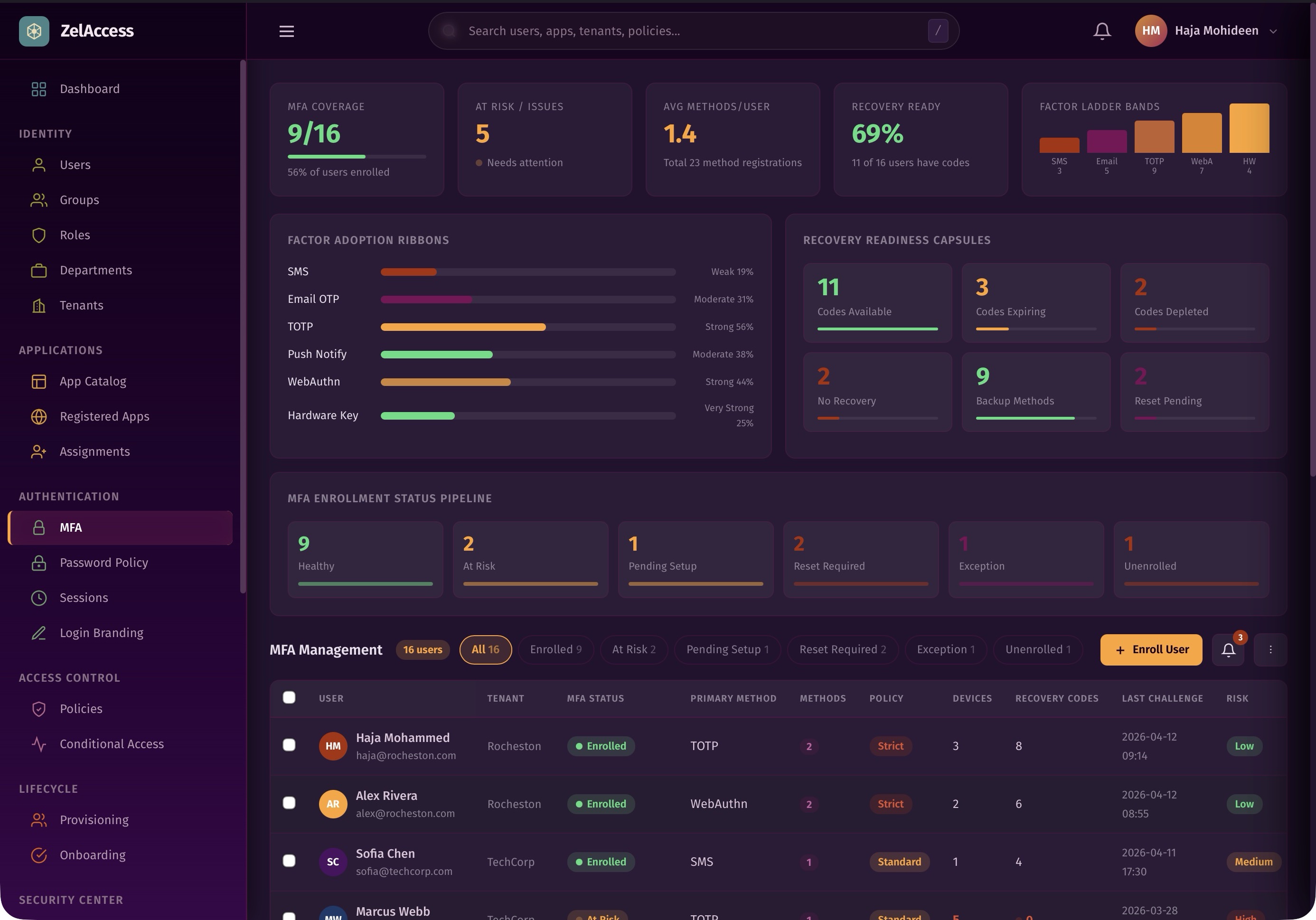
MFA and authentication security
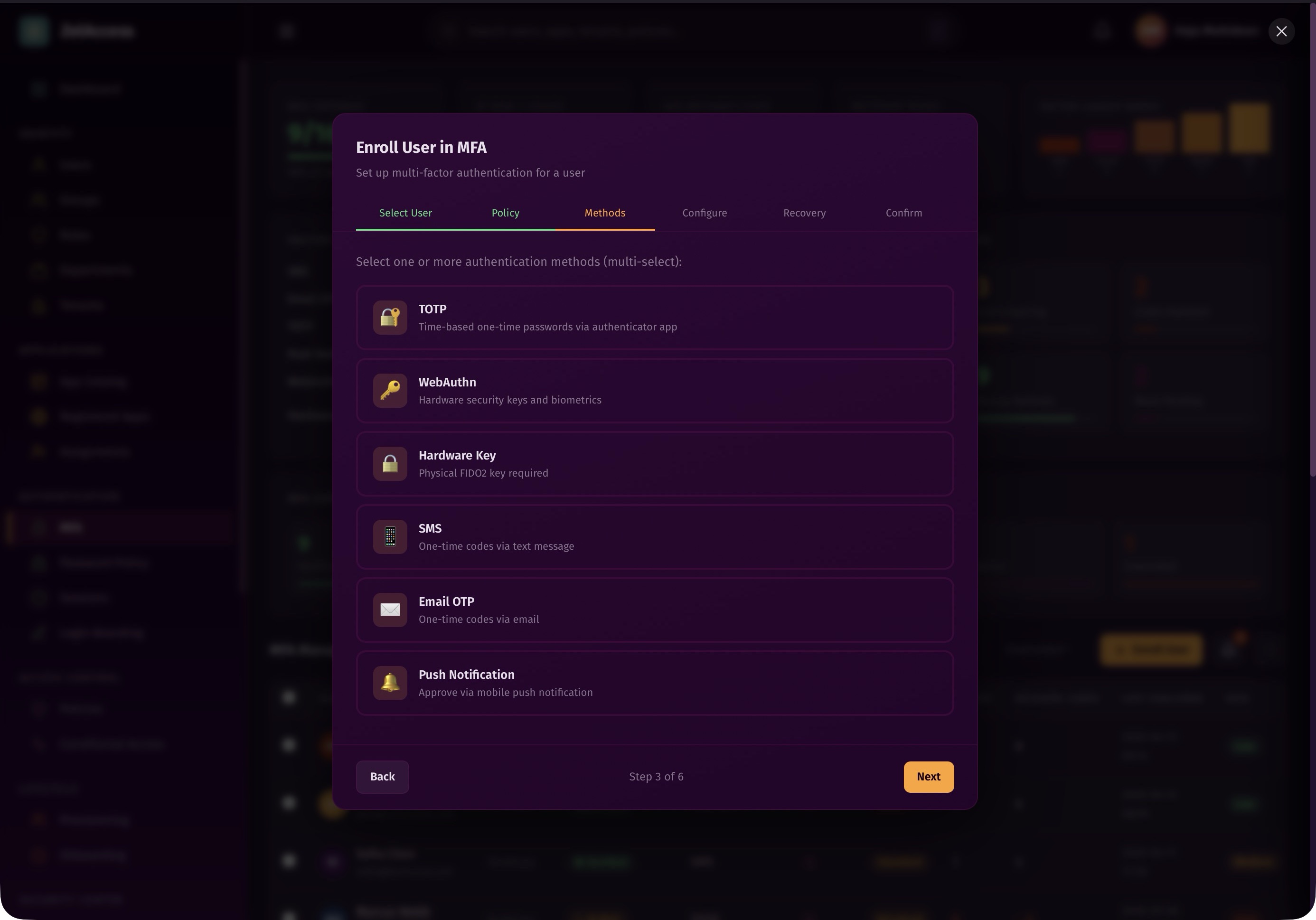
  • TOTP, passkeys, WebAuthn; recovery codes; trusted devices
  • MFA policies, step-up, factor strength and posture visibility
  • Exemptions, high-risk users, enrollment campaigns, resets
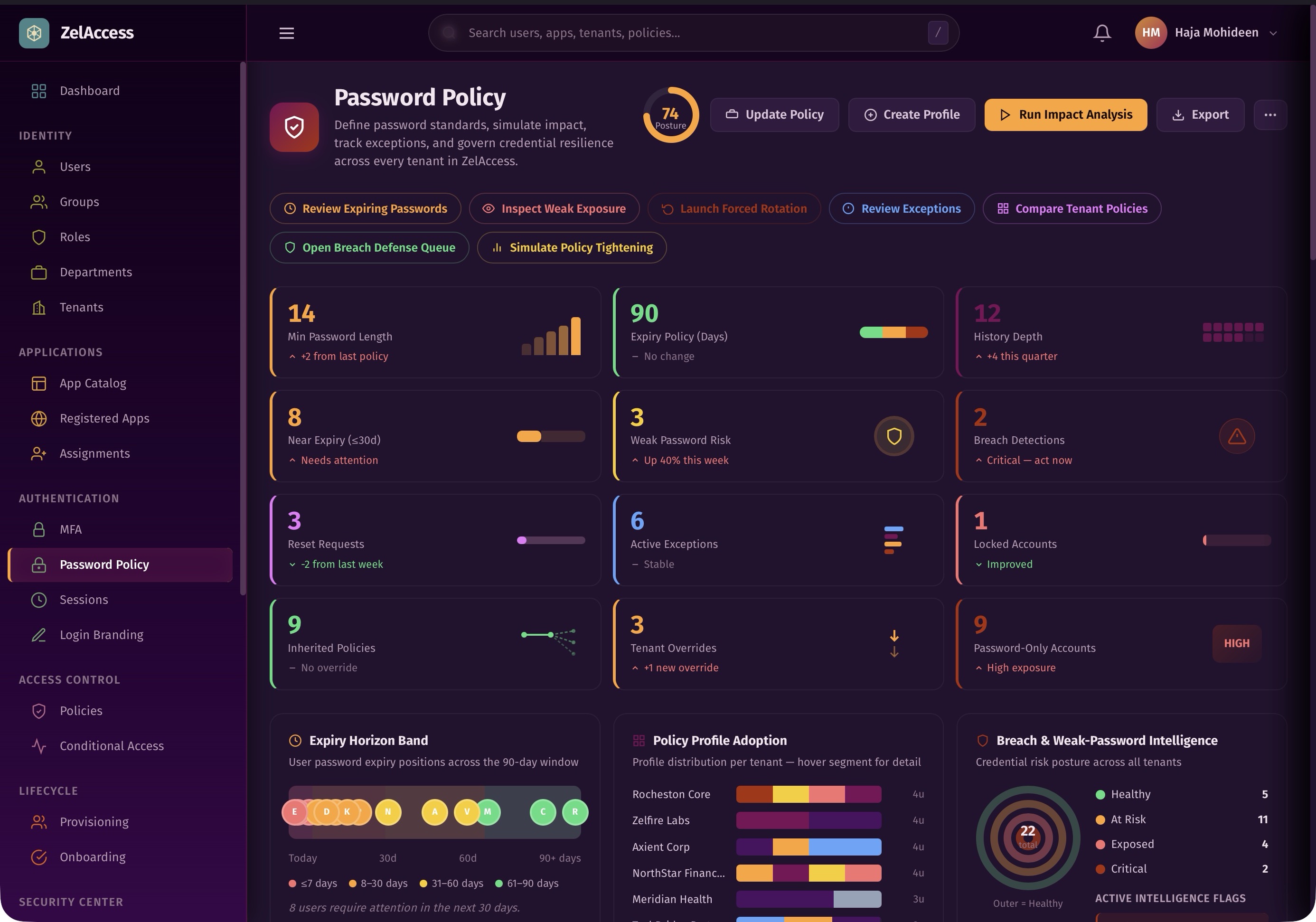
Password governance
  • Global/tenant/role/department profiles and rules
  • Common/breached blocking; passphrase; reset/lockout controls
  • Exceptions/break-glass; exposure visibility; rotation campaigns
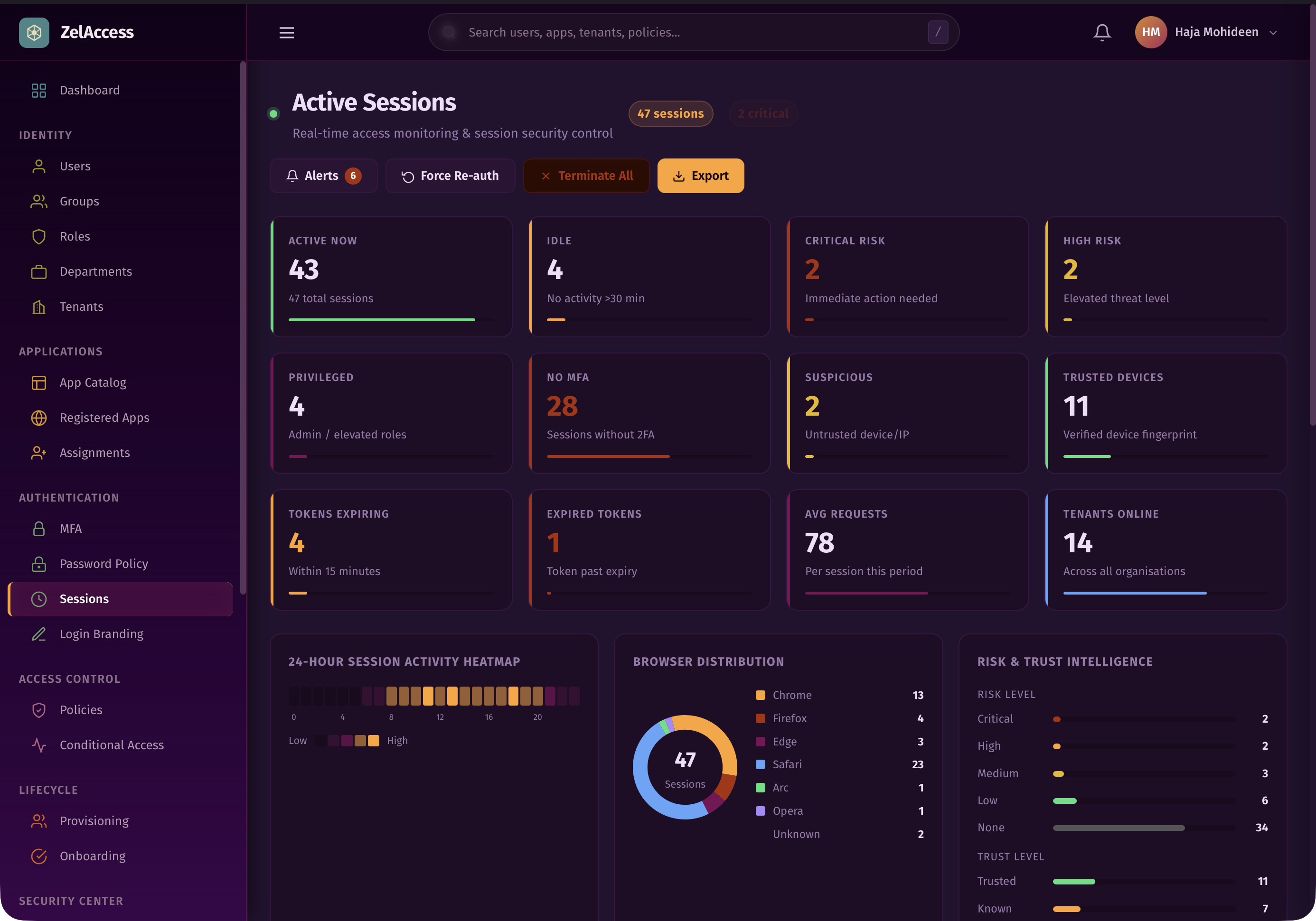
Sessions and live access control
  • Live monitoring and inventory with device/IP/geo visibility
  • Age/idle/expiry; token posture; privileged/concurrent sessions
  • Risk correlation (incl. impossible travel), revocation and reauth
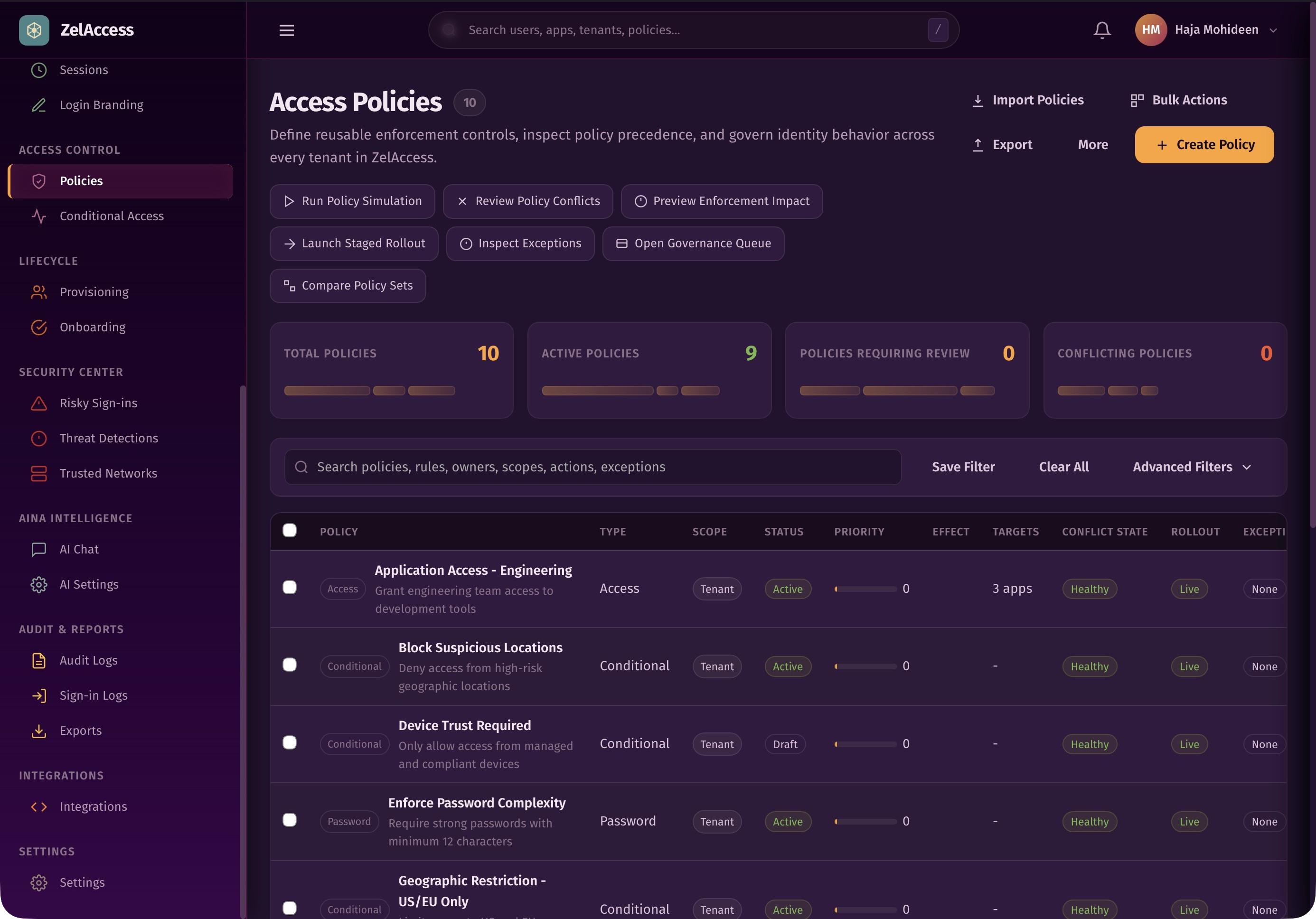
Access policies
  • Library: access, password, MFA, session, device, lifecycle, guest, audit, risk, app, compliance
  • Priority/precedence, status, staging, rollout/rollback
  • Targets, exceptions; conflict/overlap/shadow detection; simulation
Conditional access
  • Adaptive decisions by risk, device trust, location, network, browser/OS, app sensitivity, role/guest/time
  • Allow, block, challenge; MFA/passkey/trusted/compliant device
  • Report-only, staged rollout, break-glass; decision explanation
Provisioning & lifecycle operations
  • Logs across SCIM/HR/directory events and fulfillment
  • Replay/retry, reconcile drift, remediation, previews, latency
  • Partial/failed deprovisioning, orphan detection, connector health
Directory integrations
  • Entra ID, Azure AD, Google Workspace, Okta, LDAP-style, custom
  • Health and credential monitoring; OU filters; direction control
  • Full/delta sync; mapping; drift; rate/latency; topology viz
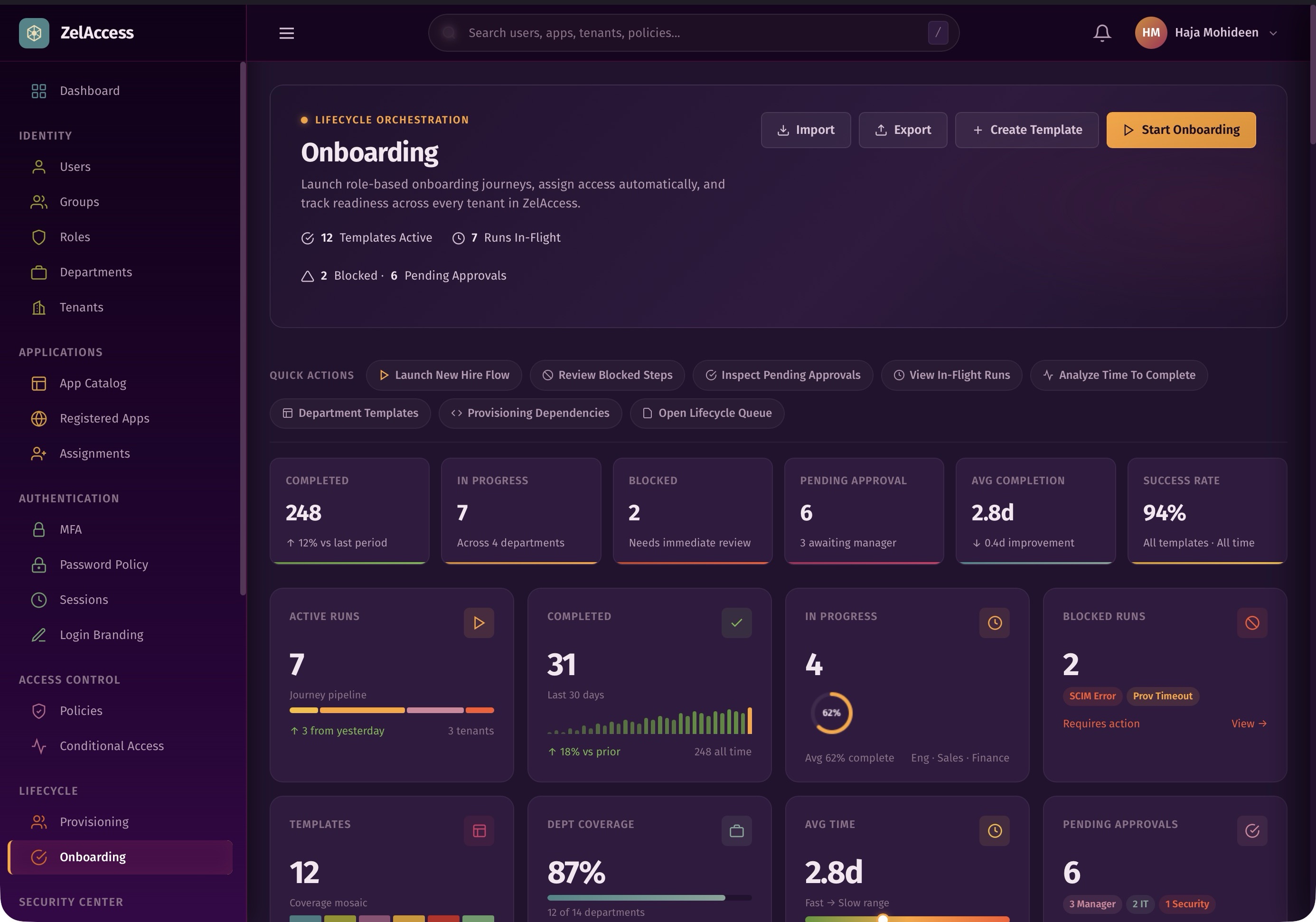
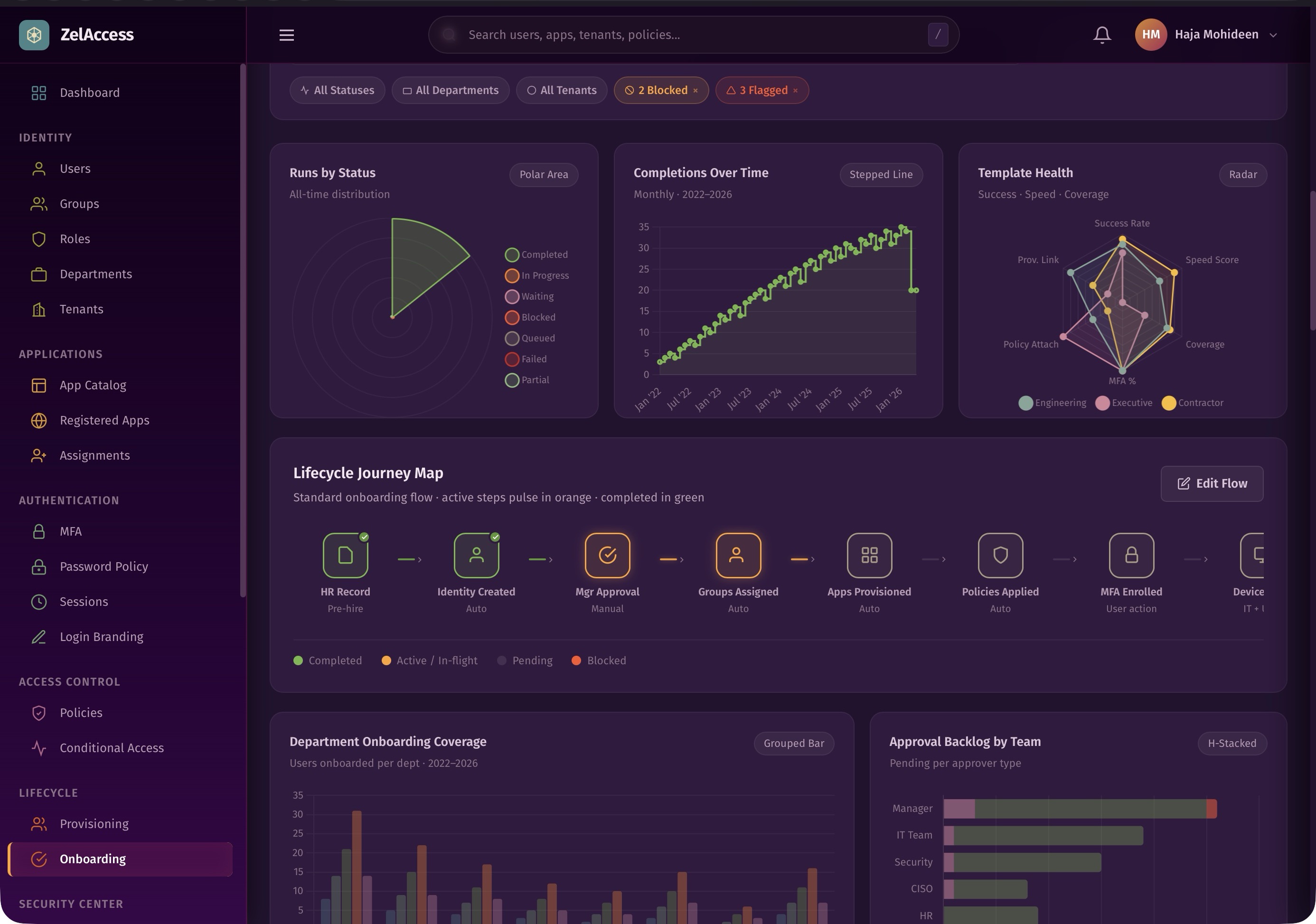
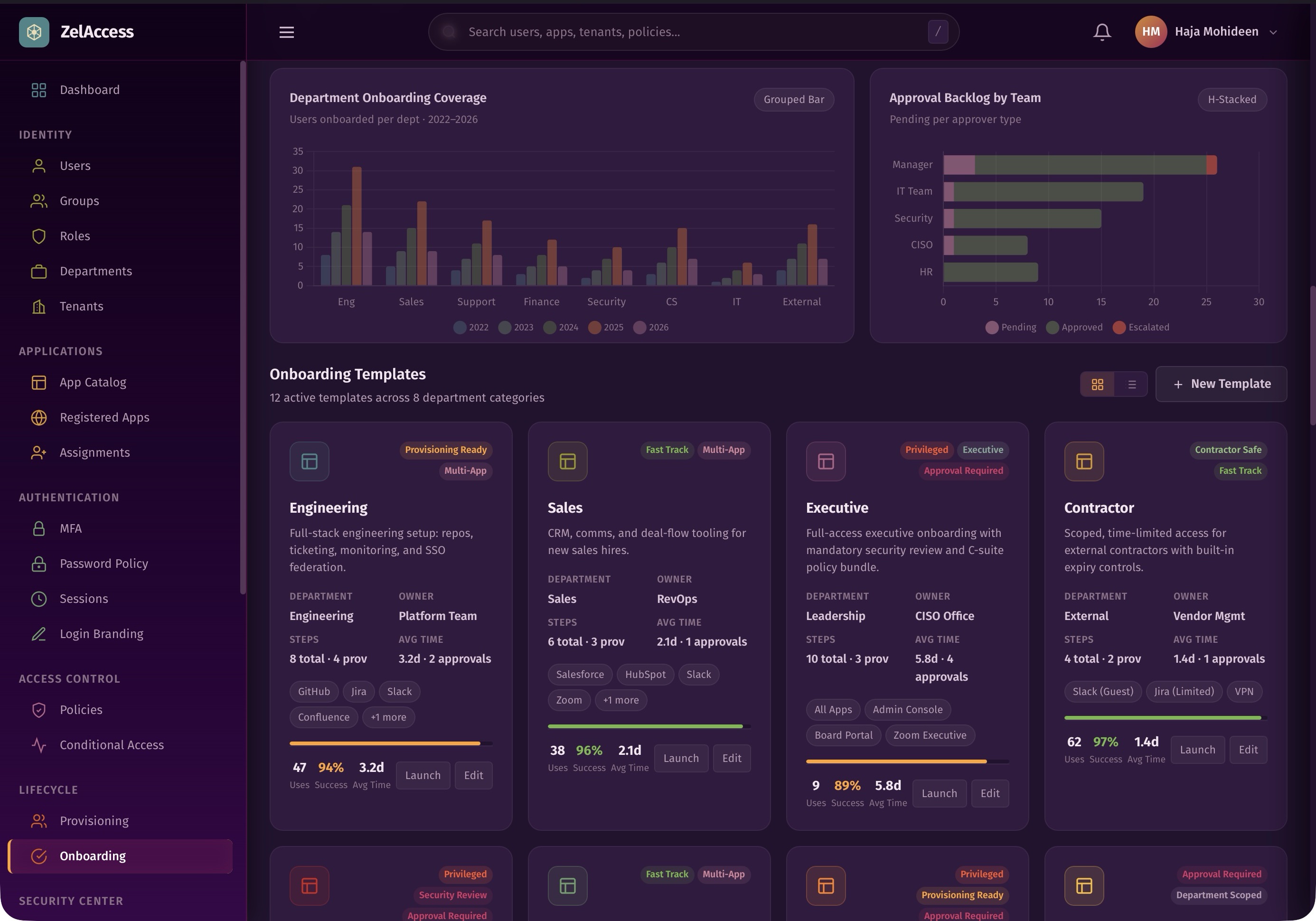
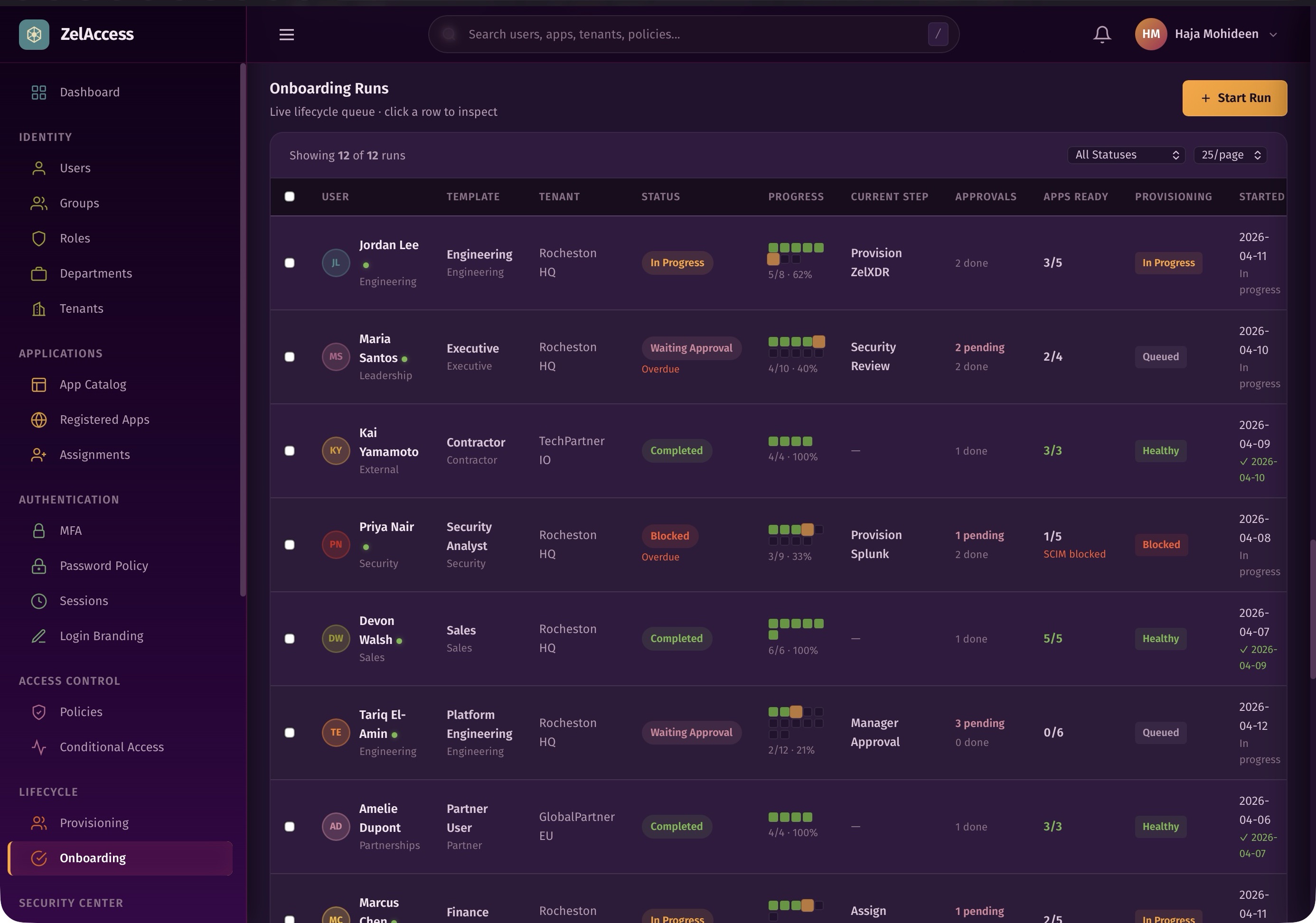
Onboarding & lifecycle kickoff
  • Templates by department/role; exec/contractor/partner/privileged
  • Multi-step with approvals, apps, roles, policies, provisioning, MFA
  • Progress, blockers, bottlenecks, analytics, retry/remediation
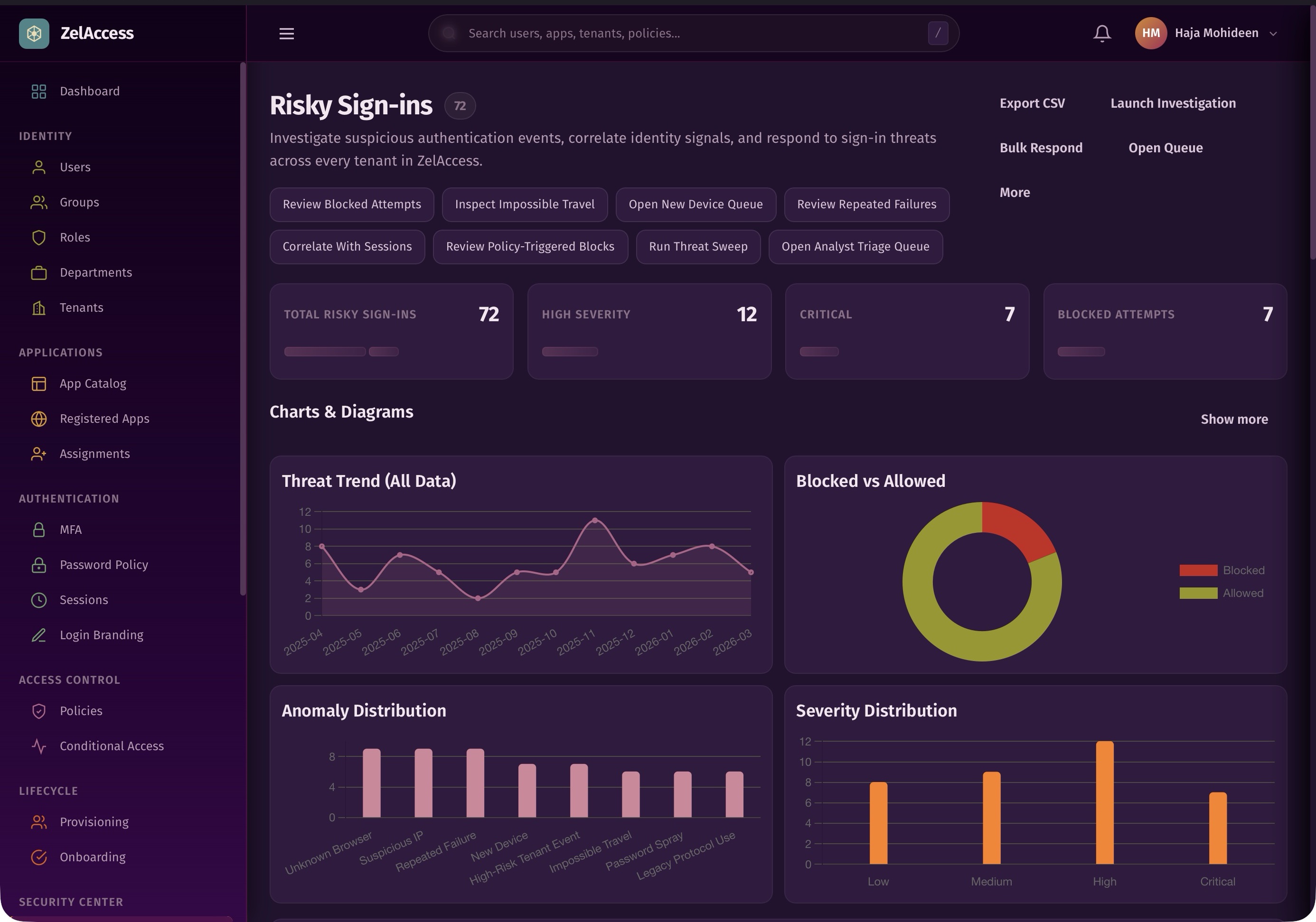
Risky sign-ins
  • Impossible travel, new device, unknown browser, suspicious IP/geo
  • Correlation with policy/MFA/session; outcomes and triage
  • Repeated-source correlation and bulk response
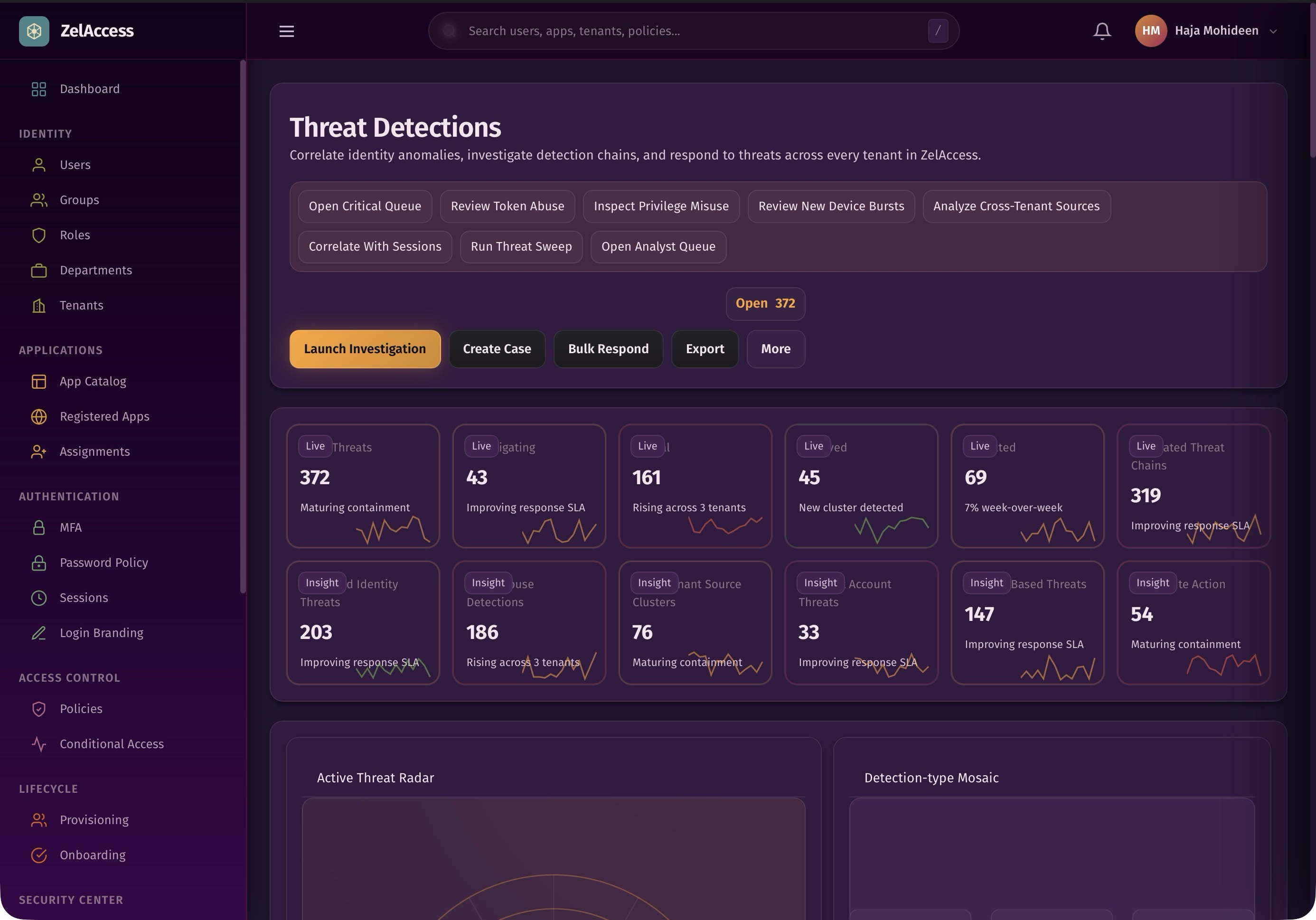
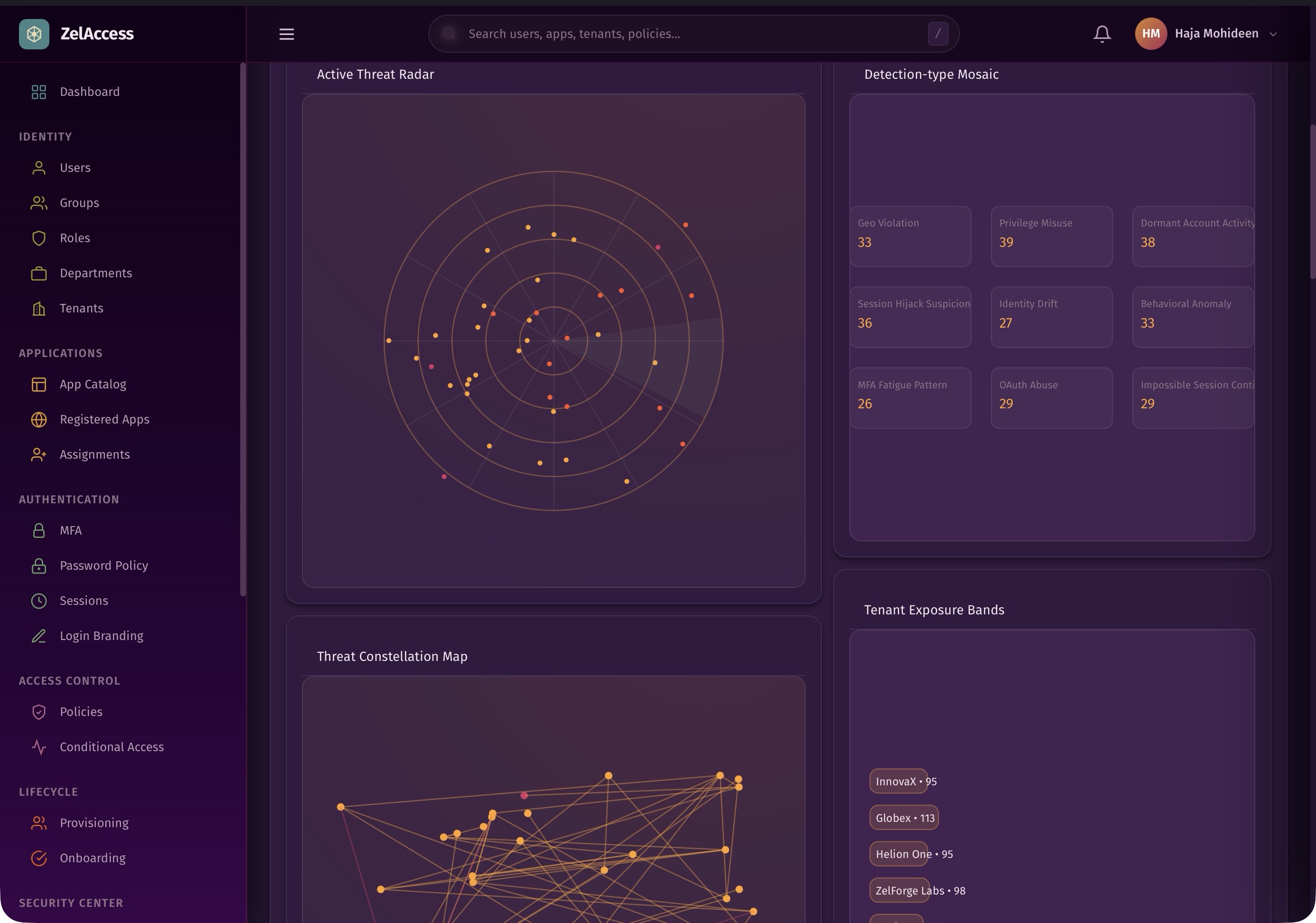
Threat detections
  • Identity threat queue with severity and states
  • Token theft, anomalous access, privilege misuse, MFA fatigue, OAuth abuse
  • Correlation, analyst assignment, containment, effectiveness tracking
Audit, reports, and exports
  • Comprehensive logs and raw events with filters and saved views
  • CSV export; drill-downs; compliance-friendly traceability
Notifications & operational alerts
  • Notification center with categories, counters, actions, quick links
  • Alerts for provisioning, policy conflicts, risky sign-ins, threats, connectors, credentials, MFA, AI recs
Global search and command
  • Search users, tenants, apps, roles, groups, policies, logs, sessions, threats, conversations
  • Quick grouping and command-style actions
AINA Intelligence & AI copilot
  • Chat with saved prompts and structured, grounded responses
  • Linked records and actions; create reports/tasks; recommendations
  • Usage/latency visibility; operational side rail
Security center
  • Identity threat monitoring and triage; posture summaries
  • Policy-trigger visibility; anomaly review; analyst workflows
UI and UX system
  • Premium dark enterprise design; responsive; accessible
  • Sidebars, rails, wizards, drawers, filters, bulk actions, skeletons
  • Creative visuals; high information density with breathing room
Data richness and demo
  • Seeded demo data with time-agnostic visuals
  • Realistic users, tenants, apps, logs, threats, sessions, policies
  • Durable meaning; no dead GUI states
Settings & operational control
  • Global/tenant settings, feature flags, regional and retention options
  • AI provider/model config; role-based AI access; defaults
Admin and self-service
  • Super/tenant admin; user self-service for profile, security, MFA, sessions
  • My apps, notifications, access requests, permitted operations
Enterprise governance strengths
  • Least-privilege orientation; unified auth/policy; adaptive runtime
  • Source trust and sync governance; replay/drift; explainable paths
  • Conflict/precedence intelligence; remediation; auditability; scale
Product modules
  • Dashboard, Users, Groups, Roles, Departments, Tenants, App Catalog, Registered Apps
  • Assignments, MFA, Password Policy, Sessions, Access Policies, Conditional Access
  • Provisioning Logs, Onboarding, Risky Sign-ins, Threat Detections, Directory Integrations
  • AINA Chat, Notifications, Global Search, Settings, Audit and Reports

THE DETAILS THAT MATTER

ZelAccess FAQ.

Answers about the product, its capabilities, and how it fits into your security workflow.

What is Rocheston ZelAccess?

Rocheston ZelAccess is the centralized identity, authentication, and access control platform of the Zelfire suite of cybersecurity products. It governs user creation, sign‑in, product access, policy application, and identity‑risk monitoring across the ecosystem. It unifies SSO, MFA, lifecycle management, access governance, sessions, provisioning, policies, and threat monitoring into one operational platform.

What does ZelAccess do?

ZelAccess manages identity from onboarding to offboarding. Admins can create users; organize tenants, groups, roles, and departments; assign apps; enforce authentication; launch onboarding; connect directories; monitor sessions; and respond to identity threats. It also controls runtime decisions such as allow, block, or step‑up based on risk and context.

How is ZelAccess related to the Zelfire suite?

ZelAccess is foundational within Zelfire. It unifies authentication, access control, provisioning, and policy enforcement so all products share the same identity engine and posture for a consistent, manageable, and secure platform.

Is ZelAccess just a single sign‑on product?

No. SSO is one capability. ZelAccess also provides lifecycle orchestration, access governance, MFA enforcement, conditional access, session visibility, provisioning, directory integrations, and identity threat intelligence—making it a full identity control plane.

What is the main benefit for an organization?

It replaces fragmented identity handling with one trusted system—improving user experience, centralizing admin control, strengthening security visibility, producing cleaner audits, and scaling access consistently across the suite.

What kinds of access can ZelAccess control?

It governs application access across the suite and decides runtime conditions—allow, challenge, block, restrict, or escalate—based on role, device trust, location, behavior, risk, app sensitivity, and policy logic.

Does ZelAccess support MFA?

Yes. It supports strong factors (e.g., TOTP, passkeys, WebAuthn), enrollment tracking, recovery readiness, trusted‑device behavior, posture analytics, and operational workflows around MFA enforcement.

Can ZelAccess manage onboarding and offboarding?

Yes. Templates and workflows apply the right apps, roles, groups, and policies; trigger provisioning; enforce MFA setup; and track progress. Offboarding revokes access, terminates sessions, deprovisions systems, and preserves audit trails.

Can it connect to external directories?

Yes. Integrations import/sync identity data with health monitoring, mapping, drift analysis, remediation, and connector status visibility—treated as an ongoing operational concern, not a one‑time setup.

Difference between access policies and conditional access?

Access policies are the broad governance layer for reusable controls. Conditional access is runtime, adaptive enforcement based on risk and context, deciding to allow, block, or challenge at sign‑in and beyond.

How does ZelAccess help identity security?

It treats identity as an active security layer—correlating sign‑ins, sessions, assignments, provisioning, policies, and threats—to surface risk, explain decisions, and accelerate response.

What are risky sign‑ins?

Suspicious authentication events such as impossible travel, new device, unusual geo, or dormant accounts. ZelAccess explains why, which policies triggered, outcomes, sessions created, and actions to take.

What are threat detections?

Broader identity‑threat correlation across sessions, sign‑ins, tokens, privileges, apps, and sources, enabling case workflows, containment, and effectiveness tracking.

What is AINA?

AINA is the AI intelligence layer that summarizes activity, explains policies, compares tenants, reviews failures, identifies gaps, recommends remediation, and produces operational outputs.

Is ZelAccess for general public licensing?

No. It is part of the Zelfire suite and exclusively licensed to RCCE engineers inside a focused cybersecurity ecosystem.

What does “exclusively licensed to RCCE engineers” mean?

It signals a disciplined, security‑oriented environment and a controlled operating model aligned to the Zelfire suite, not a mass‑market identity service.

Who should use ZelAccess?

Enterprises and teams needing centralized, auditable, adaptive, and visible identity control—admins, SOC, governance teams, onboarding/provisioning operators, and security analysts.

How does it improve operational efficiency?

By unifying identity operations and security signals, reducing tool sprawl and manual work, and speeding investigations through contextual linking.

What makes ZelAccess different from standard IAM?

It fuses IAM with identity‑driven security operations and AI, built as part of a cybersecurity suite—feels like an identity command center, not just directory+login.

Simple website description?

Rocheston ZelAccess is the centralized identity, authentication, and access control platform of the Zelfire suite. It unifies SSO, MFA, lifecycle automation, policy enforcement, provisioning, session control, and identity security into one trusted platform—exclusively licensed to RCCE engineers.

Part of a connected security ecosystem.

Explore how AINA connects intelligence across Zelfire, and find the products that complement your workflow.

Meet AINA
Protect & control

ZelWall

Web application firewall

Protect web applications with a lightweight agent and centralized security decisions, without DNS changes.

LET’S CONNECT YOUR DEFENSE

Put Zelfire to work.

Explore the products, see the workflows, and talk to Rocheston about your security environment.

Request a demo

Product screenshot